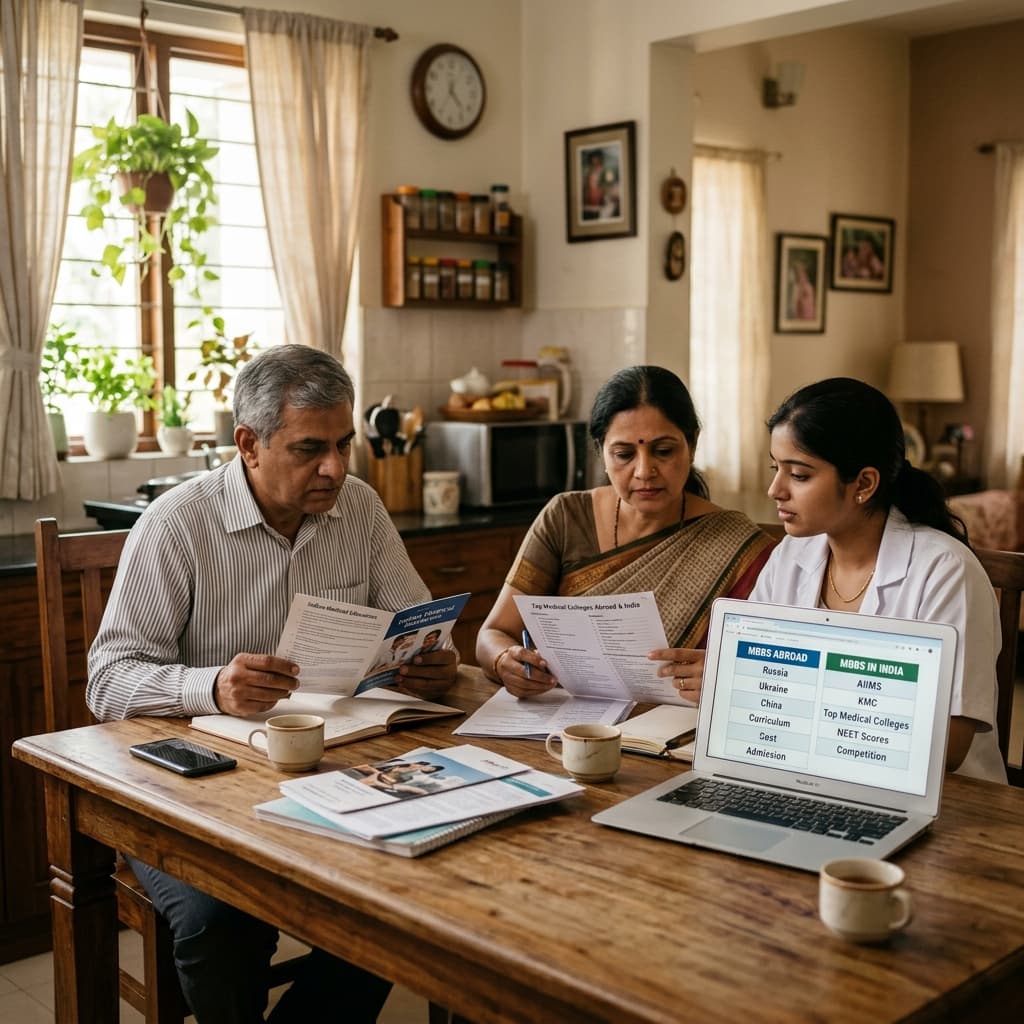
The Decision Most Indian Medical Families Face
Approximately 93,000 MBBS seats exist in India — across government and private colleges. Around 108,000 students secure government seats in state and central institutions through NEET counselling. The remaining students who want to become doctors face a choice that shapes the next 8–10 years of their lives:
Option A: Private MBBS in India — expensive, familiar, no screening test on return
Option B: MBBS abroad — lower or comparable cost, unfamiliar environment, NExT required on return
This comparison gives you the facts on both sides without an agenda. We do not benefit from sending you either way.
The Fundamental Difference in Structure
Before comparing costs or outcomes, understand the structural difference:
Private MBBS in India:
- Duration: 5.5 years (4.5 years academic + 1 year mandatory internship in India)
- Recognized automatically by NMC — no screening test required
- Internship in Indian hospitals — direct clinical exposure to Indian disease patterns
- Degree: MBBS from an MCI/NMC-recognized Indian medical college
MBBS Abroad:
- Duration: 5–6 years depending on country (includes internship at foreign hospital)
- Requires NExT Part 1 + Part 2 on return for India license
- Internship in a foreign hospital — different disease pattern, language, clinical environment
- Degree: MD (General Medicine) equivalent from a foreign university
The NExT requirement is the most consequential structural difference. It adds a real barrier — with a ~18–20% national pass rate for foreign graduates — that private MBBS students do not face.
Fees: The Complete Picture
Private MBBS in India — What It Actually Costs
Private medical college fees in India are not regulated uniformly. State-wise fee committees set ranges, but Management quota and NRI quota seats operate at significantly higher levels.
| Seat Type | Total Tuition (5.5 years) | Living Costs | Realistic Total |
|---|---|---|---|
| Government quota (state merit) | ₹3–10L | ₹10–15L | ₹13–25L |
| Management quota (private) | ₹50L–1.2 crore | ₹10–15L | ₹60L–1.35 crore |
| NRI quota | ₹80L–1.5 crore | ₹10–15L | ₹90L–1.65 crore |
The government quota at any private college is not what most students in this comparison are actually getting. Students who score enough for government quota in a private college typically also qualify for a government medical college. This comparison is relevant only for Management/NRI quota students.
Effective comparison: Private MBBS in India (Management quota) costs ₹60L–1.35 crore plus living expenses of ₹10–15L. Realistic total: ₹70L–1.5 crore.
MBBS Abroad — Realistic Total Cost
| Country | Total 6-Year Cost (all-in) |
|---|---|
| Russia (Tier 2 state univ.) | ₹43–59L |
| Kazakhstan (KazNMU) | ₹50–58L |
| Georgia (mid-tier) | ₹50–58L |
| Vietnam (UMP-HCMC) | ₹39–45L |
| Kyrgyzstan | ₹33–42L |
| Bangladesh (private) | ₹40–65L |
Add ₹2–4L for post-graduation NExT coaching.
The cost argument for MBBS abroad is strong — a reputable foreign university at ₹50–60L total is significantly cheaper than Management quota private MBBS in India at ₹70L–1.5 crore. The cost case for MBBS abroad over private MBBS India is, under most scenarios, compelling.
The cost case reverses only when comparing abroad against India's cheapest Management quota seats (₹50–60L range at tier-3 private colleges in certain states) — here the gap narrows, and the NExT risk may tip the balance back toward India.
NEET Score Requirements
| Option | NEET Requirement |
|---|---|
| Private MBBS India (Management quota) | Typically 400–500+ marks (varies by college and state) |
| Private MBBS India (NRI quota) | Usually lower than Management quota; sometimes just qualifying |
| MBBS Abroad | 50th percentile (General) / 40th percentile (SC/ST/OBC) — which is roughly 300–370 marks |
This is a critical point: The NEET cutoff for MBBS abroad under NMC rules is lower than what most private colleges in India require for their Management quota seats. A student who scored 360 marks (say, 52nd percentile) is eligible for MBBS abroad but may not be competitive for Management quota at reputable private Indian colleges.
Clinical Training Quality
This is subjective but important to assess honestly.
Private MBBS India
- Clinical training happens in India, with Indian patients
- Disease exposure is directly relevant to what you will encounter in practice — tropical diseases, nutritional deficiencies, high-volume OPDs
- Patient communication in local Indian languages — immediately practical
- Teaching hospital affiliation quality varies widely — tier-1 private colleges (KMC Manipal, St. John's, CMC Vellore — the latter is not management quota) have excellent hospitals; tier-3 private colleges may have small, low-volume hospitals
MBBS Abroad
- Clinical training in a foreign hospital — different patient population, different disease prevalence
- In Russia/Kazakhstan: clinical posting typically from Year 3–4 in affiliated hospitals; quality varies by university
- Language barrier in clinical settings — professors may be Russian/Kazakh; patient interaction in a foreign language
- Strong universities (KazNMU, RUDN, Kazan Federal) have genuine teaching hospitals with good consultant faculty
Honest assessment: For direct India-practice relevance, private MBBS India has a structural clinical training advantage — especially for students who eventually practice in semi-urban or rural India where tropical medicine and high-volume OPD exposure matters. Foreign university clinical training, while valid, requires additional adaptation to Indian practices after return.
The NExT Factor: The Biggest Hidden Cost of MBBS Abroad
Private MBBS graduates in India do not need to clear NExT to practice — they will sit for NExT as part of PG admission (like NEET-PG today), but they directly receive their provisional registration after completing the Indian internship.
Foreign MBBS graduates must clear NExT Part 1 (theory) and Part 2 (OSCE) before receiving any registration. With a ~18–20% pass rate nationally, this represents a real risk.
Modeling the risk:
If you assume an 80% chance of not passing NExT on the first attempt:
- Delay in career start: 6–12 months minimum per failed attempt
- Additional coaching cost: ₹2–4L per attempt
- Opportunity cost: A private MBBS graduate starts earning in Year 1 of their post-registration career while the foreign graduate continues preparing
A student who takes 3 attempts to clear NExT has effectively spent 2–3 additional years and ₹6–12L extra — which eats substantially into the original cost advantage of going abroad.
The counter-argument: Students who prepare systematically from Year 1 abroad (using Indian textbooks and test series throughout) consistently report pass rates well above the national average. The NExT risk is not destiny — it is a function of preparation choices made during the 6 years abroad.
Career Outcomes: PG Admission
Both pathways allow you to appear for NExT for PG admission (equivalent of today's NEET-PG) — provided you clear NExT Part 1 first.
Under the NExT system, your NExT Part 1 score becomes your PG admission ranking score. This creates, for the first time, a level playing field between domestic and foreign graduates for PG admission.
Historical advantage of private Indian MBBS for PG: Under the NEET-PG system, domestic graduates outperformed foreign graduates statistically — partly due to clinical exposure, partly due to Indian curriculum familiarity. NExT, by using the same exam for all graduates, theoretically levels this. In practice, the preparation gap likely persists.
Lifestyle and Personal Factors
| Factor | Private MBBS India | MBBS Abroad |
|---|---|---|
| Distance from family | Can commute home easily | Annual or twice-annual visits |
| Language | No barrier | Moderate barrier (clinical settings) |
| Social environment | Familiar | Requires adjustment |
| Safety | Generally safe (depends on city) | Country-dependent; most are safe |
| Cultural experience | Limited to college context | Significant international exposure |
| Independence | Moderate (can visit family) | High (builds self-reliance) |
The personal dimension matters more than most cost spreadsheets capture. Students who struggle with homesickness severely may find 6 years abroad academically compromising. Students who thrive in new environments often return from abroad with maturity and adaptability that enhances their clinical careers.
Who Should Choose Private MBBS in India
Private MBBS India (Management quota) is the better option when:
- Your family can fund ₹70L–1.2 crore without financial strain
- You want to avoid the NExT risk completely
- The specific private college has an excellent teaching hospital affiliation (verify this — not all do)
- You scored 450+ in NEET and are competitive for better private colleges
- You or a family member practices medicine and can leverage institutional connections
Who Should Choose MBBS Abroad
MBBS abroad is the better option when:
- Your family budget is ₹40–60L (all-in) and cannot stretch to Indian private Management quota
- You scored at the NEET cutoff threshold (50th percentile range) — abroad opens doors that India's Management quota does not
- You are self-directed and can commit to NExT preparation from Year 1 abroad
- You have evaluated a specific NMC-recognized university with a track record above 25% FMGE pass rate
- You want international exposure and personal independence as part of the educational experience
Frequently Asked Questions
Is private MBBS in India better than MBBS abroad? It depends entirely on your specific situation — budget, NEET score, college quality, and willingness to prepare for NExT. There is no universal answer.
Which is cheaper — private MBBS India or MBBS abroad? Generally, MBBS abroad (at a reputable NMC-recognized university) is significantly cheaper than Management quota private MBBS in India. The exception is if you compare to the cheapest Management quota seats at tier-3 private Indian colleges.
Can foreign MBBS graduates do PG in India? Yes — by clearing NExT Part 1 (provisional registration) and then appearing for NExT for PG admission ranking.
Do private MBBS graduates in India need to give NExT? They sit for NExT as part of PG admission competition — but they receive provisional registration automatically after their Indian internship, without a separate licensing test.
What NEET score should I have before choosing abroad over private India? If your NEET score is below 400 marks, you are unlikely to get a quality Management quota seat in India. In this range, a well-chosen foreign university is typically the more practical option. If your NEET score is 450–520, compare specific colleges in both categories before deciding.
The Bottom Line
The cost argument for MBBS abroad is real — against Indian Management quota fees, going abroad to a reputable NMC-recognized university typically saves ₹20–80L. The clinical training argument favors India. The NExT risk argument depends on your preparation commitment.
Do not make this decision based on a single data point. Talk to someone who has been through both paths. Students Traffic's peer connect lets you speak directly with Indian students currently enrolled abroad — the honest conversation that no brochure provides.