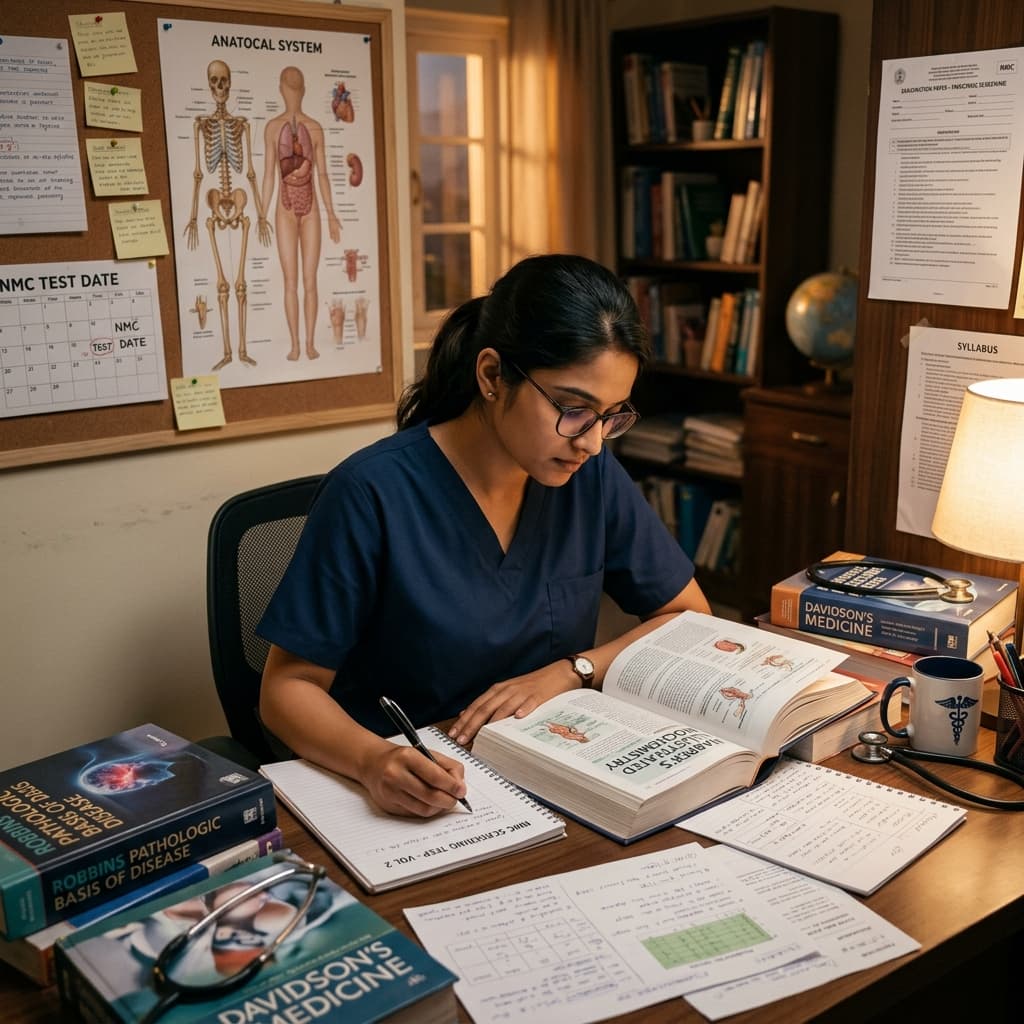
The Exam That Defines Your Career After MBBS Abroad
You can graduate from one of Russia's most reputable medical universities, return to India with your MBBS degree, and still be unable to practice medicine. That is the reality of the NExT (National Exit Test) — the mandatory screening examination for all foreign medical graduates seeking to practice in India.
For years this exam was called FMGE (Foreign Medical Graduates Examination). As of 2025–26, the regulatory framework is transitioning to NExT, which will apply to all medical graduates — those from India and abroad — making it even more consequential. This guide tells you exactly what it is, how it is structured, what to study, and how to prepare from your first year abroad.
Understanding NExT vs FMGE: What Has Changed
FMGE (old system):
- Single exam, 300 multiple-choice questions
- 3.5-hour duration
- Passing score: 150/300 (50%)
- Conducted by National Board of Examinations (NBE)
- Result: Pass/fail, no marks communication to individual subjects
NExT (new system, in transition as of 2025–26):
- Two-part examination:
- NExT Part 1 (theory): Replaces FMGE; covers all pre-clinical and para-clinical subjects
- NExT Part 2 (clinical skills OSCE): Assesses practical and clinical competence
- Foreign medical graduates must clear both parts
- NExT Part 1 passing grants provisional registration; Part 2 grants full license
The core subject matter covered remains largely similar to FMGE, but NExT introduces clinical skills assessment — meaning you cannot pass on written knowledge alone.
Practical implication: Students who are currently enrolled abroad and will graduate in the next 2–5 years should prepare for NExT. The transition is governed by NMC's regulations, which will be updated; always verify the current rules at nmc.org.in.
Historical Pass Rates: Calibrating Your Expectation
The FMGE has historically been one of India's most difficult licensing examinations, not because the content is inherently harder than MBBS subjects, but because:
- Many students do not prepare systematically during their foreign MBBS
- The exam tests Indian textbook-standard knowledge, not just general medical knowledge
- Clinical reasoning is tested more rigorously than in many foreign university exams
National FMGE pass rates (approximate, historical):
- Overall: 13–22%
- Russia (top 10 universities): 30–45%
- Philippines (UST, Fatima): 35–50%
- Kyrgyzstan, some Uzbekistan universities: 6–15% Vietnam: NMC-recognized universities are newer entrants — comprehensive FMGE outcome data is still emerging. University of Medicine and Pharmacy HCMC students who prepared actively from Year 1 report comparable outcomes to mid-tier Russia. The absence of large established Indian coaching networks at Vietnamese universities means more self-directed preparation is required.
These numbers are not inevitable. Students who prepare actively from Year 2 onwards consistently outperform these averages.
The NExT Part 1 Exam Blueprint
NExT Part 1 covers 19 subjects organized across three categories:
Pre-Clinical Subjects
- Anatomy
- Physiology
- Biochemistry
Para-Clinical Subjects
- Pathology
- Pharmacology
- Microbiology
- Forensic Medicine and Toxicology
- Community Medicine (PSM)
Clinical Subjects
- General Medicine
- Pediatrics
- Dermatology and Venereology
- Psychiatry
- General Surgery
- Orthopedics
- Ophthalmology
- ENT (Ear, Nose, Throat)
- Obstetrics and Gynaecology
- Anaesthesiology
- Radiology (Diagnostic)
High-yield subjects by weightage: Pathology, Pharmacology, General Medicine, Surgery, OB-GYN, and Community Medicine typically account for over 50% of questions. Do not neglect Anatomy — it consistently appears in clinical scenario questions.
Year-by-Year Preparation Strategy
Year 1–2: Build the Foundation
Most students abroad spend Year 1 adjusting to the academic environment and the local language. That's understandable. But this is also when pre-clinical subjects — Anatomy, Physiology, and Biochemistry — are taught.
What to do:
- Attend all university lectures and labs — clinical immersion at this stage is irreplaceable
- Supplement with Indian standard textbooks alongside your university material
- Anatomy: Snell's Clinical Anatomy, Gray's for reference; for FMGE/NExT use B.D. Chaurasia's Handbook
- Physiology: Guyton and Hall (primary), K.S. Sembulingam for NExT-oriented review
- Biochemistry: Harper's Illustrated Biochemistry; Satyanarayana for short review
Monthly commitment: 30–45 minutes of India-focused revision per day during active university semesters. This is not hours — it is consistency.
Year 3–4: Paraclincal and Clinical Integration
This is the most important phase. Para-clinical subjects (Pathology, Pharmacology, Microbiology) are directly and heavily tested in NExT.
Pathology (highest-yield subject):
- Primary: Robbins and Cotran Pathologic Basis of Disease (standard reference)
- NExT review: Harsh Mohan's Textbook of Pathology (India-specific, exam-oriented)
- Practice: Pathology FMGE question banks — solve at least 2,000 questions with explanations
- Focus areas: General pathology (cell injury, inflammation, neoplasia), then organ-wise pathology
Pharmacology:
- Primary: KD Tripathi Essentials of Medical Pharmacology (Indian standard)
- Extra: Katzung for mechanisms; but KD Tripathi is the exam bible
- High-yield: Autonomic pharmacology, CVS drugs, antimicrobials, CNS drugs, endocrine pharmacology
- Reasoning over memorization: FMGE/NExT tests clinical application, not just drug names
Microbiology:
- Primary: Ananthanarayan and Panicker's Textbook of Microbiology (India)
- Focus: Bacterial characteristics, virulence factors, disease associations, specimen handling, serology
Community Medicine (PSM):
- Primary: K. Park's Textbook of Preventive and Social Medicine
- High-yield: National health programs (NVBDCP, RKSK, NHM, Ayushman Bharat), biostatistics, epidemiology calculations
Year 3–4 study structure:
- Join an online FMGE/NExT test series (DAMS, PrepLadder, Marrow — all have FMGE-specific modules)
- Target minimum 100 subject-wise questions per week
- Monthly grand test to track improvement
Year 5–6: Clinical Subjects and Final Preparation
General Medicine and Pediatrics: These subjects together often account for the largest single block of questions in NExT Part 1.
- General Medicine: Harrison's (reference); API Textbook of Medicine (India-specific); Davidson's
- Pediatrics: Nelson (reference); OP Ghai (India-exam standard)
- Focus: Short cases — specific fever workup, approach to dyspnea, interpretation of ECG/X-ray in clinical scenarios
Surgery and Orthopedics:
- Surgery: Bailey and Love (reference); Sriram Bhat and Rajan Surgery (India-exam standard)
- Orthopedics: Maheshwari (most exam-relevant)
OB-GYN:
- DC Dutta's Textbook of Obstetrics and Gynecology — the Indian exam standard
Ophthalmology and ENT:
- Khurana (Ophthalmology), PL Dhingra (ENT) — both comprehensive for NExT
Year 5–6 study structure:
- Full-length mock test every 2 weeks
- Subject revision in 3-week cycles
- High-yield notes from test series revisions — consolidate wrong answers
The 6-Month Intensive Before the Exam
If you are returning to India after completing your degree, the 6 months before NExT are the most critical. Structure this phase:
Month 1–2: Rapid subject-wise revision
- Cover all 19 subjects in the first 8 weeks using short-form notes (from your test series or standard revision books like ROAMS/SARP/DAMS modules)
- Cover 2–3 subjects per week
Month 3–4: Integrated practice
- Attempt 3,000–5,000 questions across subjects
- Focus on clinical scenarios and case-based questions (these will increase in NExT)
Month 5–6: Mock exam and analysis
- Attempt 2–3 full-length mock exams per week (300 questions, timed)
- Analyze wrong answers meticulously — each wrong answer is a weak area to revisit
- Revise high-yield topics identified through mock analysis
NExT Part 2: Clinical Skills Assessment
NExT Part 2 is the Objective Structured Clinical Examination (OSCE) component — a practical clinical skills assessment. For foreign medical graduates, this is particularly relevant because:
- Your clinical training happened in a foreign hospital setting
- Indian clinical presentation of diseases can differ from what you observed abroad
- Patient-doctor communication in regional languages may be tested
Preparation approach for Part 2:
- Complete your foreign university internship rigorously — do not treat it as a formality
- If possible, shadow Indian doctors during holidays or after graduation
- Enroll in a structured NExT Part 2 preparatory course at an Indian medical center (several FMGE coaching institutes offer clinical skills programs)
- Practice history-taking and clinical examination systematically
Top Resources for NExT/FMGE Preparation
Books (India-Standard)
| Subject | Recommended Book |
|---|---|
| Anatomy | B.D. Chaurasia Handbook (3 volumes) |
| Physiology | Sembulingam; Ganong for concepts |
| Biochemistry | Satyanarayana; Harper's |
| Pathology | Harsh Mohan; Robbins (reference) |
| Pharmacology | KD Tripathi |
| Microbiology | Ananthanarayan and Panicker |
| Community Medicine | K. Park's |
| Medicine | Davidson's; API Textbook |
| Surgery | Sriram Bhat |
| OB-GYN | DC Dutta |
| Pediatrics | OP Ghai |
Online Platforms
- Marrow: Best for NBE-oriented question bank with video explanations; strong analytics
- PrepLadder: Excellent video lectures; popular for pre-clinical subjects
- DAMS (Delhi Academy of Medical Sciences): Long-established coaching with FMGE modules
Test Series
Any consistent, structured test series will outperform self-study without practice questions. The key is not which platform, but whether you analyze incorrect answers systematically.
Common Mistakes That Cause Failures
1. Starting preparation only after returning to India The single biggest predictor of failure. Students who begin NExT prep in Year 1 of their foreign MBBS and maintain it consistently outperform those who start after graduation by a factor of 3–4.
2. Studying only from foreign university material Foreign textbooks like Robbins or Harrison's are excellent as primary references. But the exam tests Indian-standard knowledge organization. You need Indian textbooks and Indian question banks.
3. Neglecting Community Medicine PSM is frequently underestimated. It is heavily numerical (biostatistics, epidemiology measures) and program-specific (knowing India's specific health programs). A well-prepared PSM can add 15–20 marks to your score.
4. Not tracking wrong answers Attempting 10,000 questions without reviewing errors is largely wasted time. Maintain an error log by subject. Revisit these systematically.
5. Ignoring Forensic Medicine FM&T is short, relatively high-yield, and many students leave it entirely. 10 hours of focused revision can secure 8–12 marks.
Building a Support Network
MBBS abroad students often feel isolated in their NExT preparation. Strategies that help:
- Senior student WhatsApp groups: Most universities have senior batches who have cleared FMGE. They share what worked and what did not
- Online study groups: Telegram groups specifically for university-specific FMGE prep (e.g., "KazNMU FMGE 2026 batch")
- Students Traffic peer connect: Connect with seniors at your specific university through the platform to get honest, experience-based guidance
Frequently Asked Questions
How many attempts are available for NExT? Under the current transition, NMC has not published a lifetime attempt cap for NExT. The FMGE had no attempt limit. Check nmc.org.in for updated regulations as NExT implementation progresses.
Can I practice medicine in India with a foreign MBBS degree without clearing NExT? No. The degree alone does not grant practice rights. NExT Part 1 and Part 2 clearing is mandatory for registration with any State Medical Council in India.
What is the passing score for NExT Part 1? NMC has indicated a 50% aggregate passing threshold, but this may be subject to revision. Check official NMC notifications.
Does the FMGE score affect future opportunities like PG admissions? FMGE was pass/fail only — it did not generate a merit score for PG admission. Under NExT, the same NExT examination that domestic students take for PG admission will be used. This means foreign graduates who clear NExT Part 1 will get a score that can be used for PG admission — a significant change from FMGE.
How long should I study before the NExT? 6 months of intensive full-time preparation is the minimum for a student who has been doing consistent subject-wise preparation throughout their 6-year MBBS. For those starting from scratch after returning, 12 months minimum is more realistic.
Which subject should I start with? Start with Pathology. It is the highest-yield subject, foundational to clinical diagnosis, present in every clinical subject, and gives you the most questions per hour of preparation.
Final Assessment: Are You Ready?
Before sitting for NExT Part 1, self-assess against these benchmarks:
- Averaged 65%+ on full-length mock tests in the last 4 weeks
- Completed at least one pass through all 19 subjects with dedicated revision
- Attempted at least 5,000 questions total with error analysis
- Community Medicine national programs fully revised
- Pharmacology high-yield drug classes (autonomic, CVS, antimicrobials) strongly revised
- No unread error logs — all incorrect answers from mocks have been reviewed
If you can check all six, you are positioned to pass. If you cannot, identify which boxes are unchecked and structure the next 4–8 weeks around closing those gaps.
The exam is clearable. The 80%+ who do not pass are not less intelligent than those who do — they are less systematically prepared. Systematic preparation over a 6-year horizon is the structural advantage you can build from today.