What the Videos Don't Show You
University tour videos and agent presentations show the library, the lab, the cafeteria. What they don't show is the 2 AM moment in February when it is −22°C outside, your room's heating system is underperforming, you have an oral exam tomorrow, and you are craving dal and rice that you cannot get nearby.
That moment is also part of MBBS abroad. This guide is about the full picture — the practical, daily reality of being an Indian student in Russia, Kazakhstan, Georgia, Kyrgyzstan, or Uzbekistan. Not to discourage — to prepare.
The First Two Weeks: What Actually Happens
The first two weeks after arrival are disorienting for almost every student — regardless of how prepared they feel.
What typically hits first:
- Jet lag and fatigue: Flights from India to most destinations run 5–9 hours, often overnight. Arrival orientation typically begins within 48 hours of landing.
- SIM card and banking setup: Priority task. Get a local SIM immediately (ask a senior student which network has best coverage at the hostel). Banking is country-specific — some universities handle fee payments through specific accounts; clarify before arriving.
- Hostel allocation: University hostels typically assign rooms before arrival but adjustments happen on the ground. Confirm your roommate situation with the international student office on arrival.
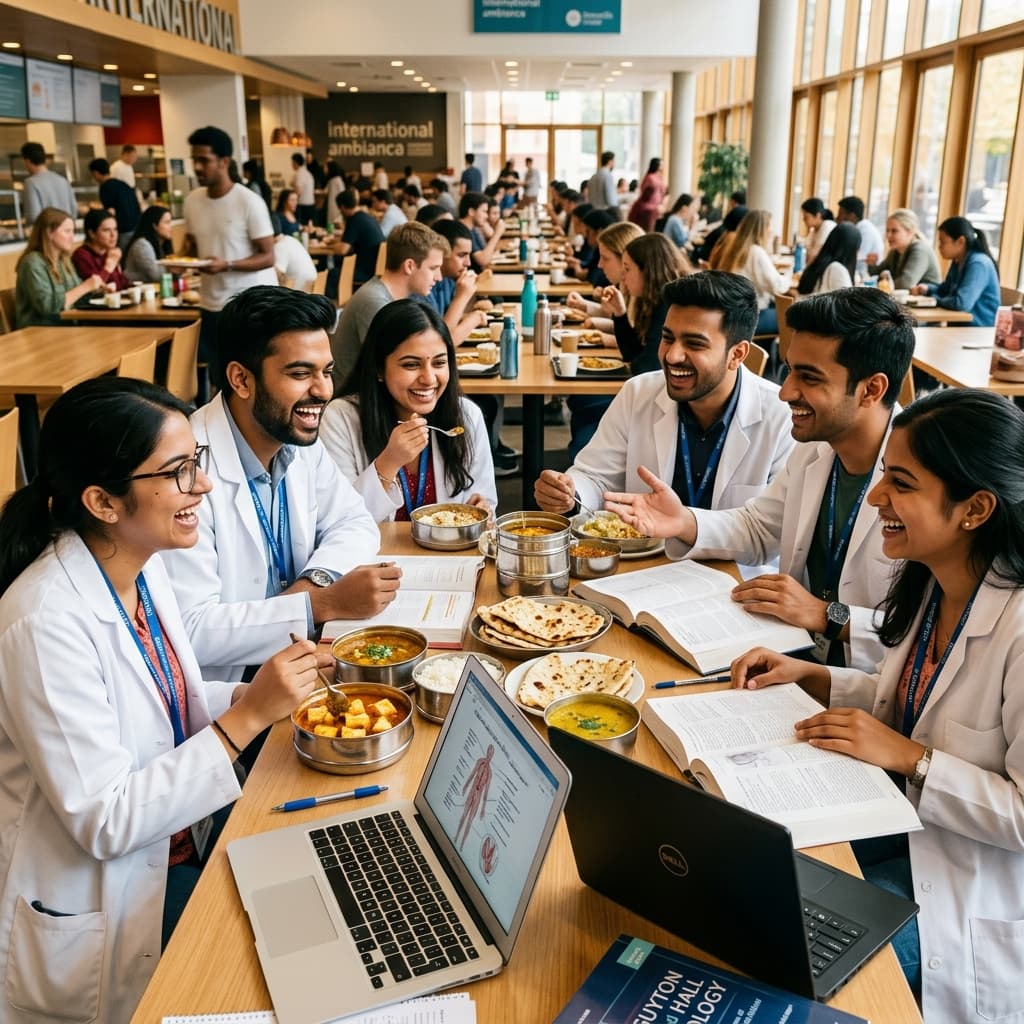
- Food shock: Most cities have limited Indian food access in the immediate vicinity of the university. The first week often involves navigating local supermarkets and cooking basics you may have never cooked before.
Advice from students who've been through it: Bring 3–4 kg of Indian staples in your checked luggage (packaged spices, instant dal, papad). This bridge period of 2–3 weeks while you identify local Indian grocery sources is genuinely important for mental comfort.
Food: The Most Searched Topic
Food is, without exaggeration, the most common source of frustration reported by Indian students in their first month abroad. Here is the practical breakdown by country:
Russia
Indian grocery access:
- Moscow and St. Petersburg: Multiple Indian grocery stores; Indian restaurants in the city center
- Kazan, Saratov, other regional cities: One or two Indian grocery shops; fewer restaurant options
- Novosibirsk, Vladivostok: Very limited dedicated Indian stores; rely on online ordering and sporadic supply
What to cook: Most Indian students in Russia cook their own meals in hostel kitchens. Basic cooking equipment (pressure cooker, a few pots) is available or purchasable for ₹3,000–6,000. Monthly food budget via self-cooking: ₹6,000–10,000 for typical Indian meals.
Dining out: Indian restaurant meals in Russia: ₹600–1,500 per meal. Not practical as a daily option; manageable as an occasional treat.
Kazakhstan
Indian grocery access:
- Almaty: A growing number of Indian/South Asian grocery stores near the university areas. Specific brands of Aashirvaad atta, MDH masalas, toor dal are available
- Nur-Sultan (Astana): Smaller selection; some specialty stores stock Indian products
Self-cooking cost: ₹5,000–8,000/month for self-cooked Indian meals in Almaty
Local food: Kazakh cuisine is heavily meat-based (lots of lamb, horse meat in traditional dishes). Vegetarian options at local restaurants are limited. Chinese restaurants in Almaty often have vegetarian options.
Georgia
Indian grocery access:
- Tbilisi: An organized Indian student community means informal supply chains exist. Some Asian grocery stores stock Indian spices and lentils. Small amount of Indian products available at specialty shops.
- Self-cooking: Most manageable in Georgia; Georgian cuisine has some overlap with Indian flavor profiles (abundant spices, flatbreads, lentil dishes)
Georgian food: Actually one of the more Indian-palatable local cuisines among MBBS abroad destinations. Khachapuri (cheese bread), lobiani (bean bread), vegetable dishes are widely available.
Kyrgyzstan
- Bishkek has a small Indian community; basic Indian grocery items available in Asian stores
- Self-cooking is essential; monthly food cost: ₹4,000–7,000
Vietnam
Vietnam consistently surprises Indian students — it is arguably the easiest country to adapt to among all MBBS abroad destinations, primarily because of food.
Food: Vietnamese cuisine is rice-based and vegetable-forward. Indian students in Ho Chi Minh City and Hanoi report substantially easier food adaptation than in Russia or Kazakhstan. Tofu, lentil-like dishes, stir-fried vegetables, and rice are daily staples — all close enough to Indian cooking that the adjustment is manageable. Indian grocery items are available in both cities. Several Indian restaurants operate in expat areas of HCMC.
Weather: Ho Chi Minh City: Hot and humid year-round (28–35°C). Two seasons: dry (November–April) and monsoon (May–October). Students from South India (Tamil Nadu, Kerala, Andhra Pradesh) adapt immediately. Students from North India adapt within 2–4 weeks. Hanoi: More variation — hot summers (35°C), cool winters (12–18°C). No extreme cold. No winter gear needed.
Safety: Vietnam is one of the safest countries for international students. Low violent crime, very welcoming to foreigners, active tourist and expat infrastructure. Motorbike traffic is dense and chaotic — use caution when crossing streets, especially in HCMC.
Language: English is widely spoken in universities, hospitals (in international programs), and urban areas. Vietnamese is challenging (6 tonal language) but you will not need it for daily survival — English suffices in most situations Indian students encounter.
Tips Applicable Everywhere
- Connect with the year above you before arriving: They know exactly which store stocks what
- Buy a rice cooker: One of the most versatile and simple tools — available for ₹1,500–3,000 locally
- Learn 10 simple Indian dishes: Dal, sabzi, rice, chapati, khichdi, poha (if you can find poha), upma — these 7 dishes cover 90% of what you will cook
- Join the Indian Students WhatsApp group before landing: Most universities have an organized group that handles group buying of Indian groceries (bulk orders reduce per-unit cost)
- Budget ₹6,000–10,000/month for food depending on city and how often you eat out
Weather: Being Honest About What You're Signing Up For
Most MBBS abroad destinations for Indian students have winters that are dramatically colder than anything experienced across most of India.
| City | Winter Range | Coldest Month |
|---|---|---|
| Moscow | −10 to −20°C | January |
| Kazan | −12 to −22°C | January–February |
| Almaty | −8 to −18°C | January |
| Nur-Sultan | −20 to −38°C | January–February |
| Bishkek | −5 to −15°C | January |
| Tashkent | −2 to −8°C | January |
| Tbilisi | 0 to −8°C | January |
What this means daily:
- At −15°C: You need a proper insulated coat, thermal underlayers, gloves, hat, and insulated boots. Walking to university (even 5–10 minutes) becomes physically challenging without proper gear.
- At −25°C (Nur-Sultan): Exposed skin freezes within minutes. Layering is not optional — it is health-critical. Many students from South India find this psychologically difficult in addition to physically challenging.
What to buy before leaving India is NOT practical: Winter clothing in India is designed for 5–15°C, not −20°C. Buy your heavy winter gear locally in Year 1 after arriving — spend ₹25,000–45,000 on quality items. The local stores (e.g., Decathlon has outlets in Moscow and Almaty) stock gear rated for appropriate temperatures.
The adjustment timeline:
- Month 1 (October): "This isn't so bad"
- Month 2 (November): "Okay, it's getting cold"
- Month 3 (December–February): "I understand now"
- Year 2 onwards: Normalized; you know what to buy and how to dress
The winter adjustment is real but manageable. Students from Rajasthan, Gujarat, and Tamil Nadu consistently report the biggest adjustment; students from Himachal Pradesh, Uttarakhand, and Kashmir adapt most quickly.
Safety: Honest Assessment by Country
Russia: Generally safe for daily campus and city life. Larger cities (Moscow, Kazan) have active university security. Exercise standard urban precautions: avoid late-night walking alone in unfamiliar areas. The post-2022 geopolitical situation has not meaningfully affected student safety on the ground. Some administrative friction exists for new arrivals.
Kazakhstan (Almaty): One of the safer MBBS abroad destinations. Low crime rate relative to city size. Indian students are a visible and accepted community. Police presence is visible. The city is Muslim-majority but highly secular in practice.
Georgia (Tbilisi): Consistently rated safe by Indian students. Georgian society is welcoming to foreigners. Low violent crime. Use standard precautions. The country has a long history of international academic visitors.
Kyrgyzstan (Bishkek): Generally safe within the university campus area. Petty theft (phones, bags) reported occasionally in city markets. Avoid political protests — occasionally occur. Standard precautions apply.
Uzbekistan (Tashkent, Samarkand): Safe and increasingly modernized since reforms. Strong police presence. Very low violent crime. Conservative social environment — dress modestly in older city areas.
Emergency contacts you need on your phone from Day 1:
- India Embassy / Consulate in your country (phone number and emergency line)
- University International Student Office (after-hours contact)
- Local emergency police number (varies by country — 112 is standard in many countries)
- Indian Students' Association leader (your seniors are your first support network)
Hostel Life: What to Expect
University hostels across MBBS abroad destinations range from Soviet-era buildings (still functional but dated) to modern purpose-built blocks. Here is what is typical:
Room setup: Double or triple occupancy is standard for Year 1 students. Single rooms become available for senior years at most universities. Rooms typically have a bed, desk, wardrobe, and shared bathroom (either ensuite or per floor).
Common facilities: Shared kitchen per floor (or per block) with gas burners, basic utensils; common area; study room; Wi-Fi (quality varies — budget for a local SIM data plan as backup).
Laundry: Most hostels have washing machines (coin-operated or free). Learn to use them in Week 1.
Room essentials to bring from India (worth the checked-luggage space):
- Pressure cooker (compact, 2L — saves hours of cooking time)
- Heating pad / electric blanket (essential for very cold nights)
- Indian spices (1kg mix — cumin, coriander, turmeric, chili, garam masala)
- Any prescription medications for 3 months
- Indian pickles (amla, mango — long shelf life, morale boost)
- Microfiber towels (dry faster in cold dormitory conditions)
Homesickness and Mental Health
This is the topic that seniors most often wish someone had addressed openly with them before they left.
The reality: Homesickness is near-universal in the first 1–3 months. It does not mean you made the wrong choice. It means you are human and you miss your family, your food, your language, and your sense of belonging. This passes for nearly everyone — typically by Month 4–6 the new environment starts feeling familiar.
What extends homesickness:
- Isolation — not connecting with other Indian students or local peers
- Not establishing a daily routine (meals, study time, sleep)
- Comparing your experience to your friends back home on social media
- Not calling family regularly (paradoxically — not calling creates anxiety while calling provides comfort)
What helps:
- Joining the Indian Students' Association immediately upon arrival — structured peer community
- Establishing meal-time rituals (cooking together with a batch-mate)
- Creating a study routine within the first 2 weeks — academic engagement is the strongest antidote to homesickness
- Weekly video calls home — not daily (daily can increase dependency), not monthly (monthly is emotionally unsustainable)
- Exploring one new aspect of the local city per week — museums, parks, markets, food
When to seek help: If low mood persists beyond 3 months, affects your academic performance, or involves thoughts of self-harm — speak with your university's student counselor or a trusted Indian senior who can help you access mental health support. Most universities have counseling services for international students.
Finances: Managing Money Abroad
Carrying money
- Do not carry large amounts of cash at once
- Open a multi-currency forex card before departure (HDFC Regalia Forex, Niyo Global, Wise) — reduces currency exchange costs
- Maintain a small cash reserve in local currency for emergencies (equivalent to ₹5,000–10,000)
- Keep family informed of your bank card PIN recovery options — losing a card abroad without the recovery process is highly stressful
Monthly budget planning
| Category | Russia (regional city) | Kazakhstan (Almaty) | Georgia (Tbilisi) |
|---|---|---|---|
| Food (self-cooking) | ₹7,000–10,000 | ₹6,000–9,000 | ₹5,000–8,000 |
| Transport (local) | ₹2,000–3,500 | ₹1,500–3,000 | ₹1,500–2,500 |
| Personal care | ₹1,500–3,000 | ₹1,500–2,500 | ₹1,500–2,500 |
| Entertainment/social | ₹2,000–4,000 | ₹2,000–3,500 | ₹2,000–3,500 |
| Study materials | ₹500–1,500 | ₹500–1,500 | ₹500–1,000 |
| Monthly total | ₹13,000–22,000 | ₹11,500–19,500 | ₹11,000–17,500 |
These exclude tuition and hostel (typically paid once or twice annually) and annual flights.
Academic Life: Differences from India
Exam format: Unlike India's NEET-style MCQ-heavy preparation, most foreign universities use a mix of oral exams, written tests, and practical lab assessments. Oral exams (sitting with a professor and answering questions verbally) are common in Russian and Kazakh universities from Year 2 onwards. This format rewards conceptual understanding over memorization — which is good for NExT preparation if approached correctly.
Attendance: Most universities have strict attendance requirements (typically 75–85%). Missing classes requires medical certificates. Unlike some Indian college cultures, you cannot casually skip here.
Language in classes: English-medium sections teach in English — but faculty English quality varies. Some professors are excellent; some need time to understand. Developing patience and learning to extract information from imperfect English is a skill that serves you well in clinical medicine too.
Study culture: International programs attract motivated students. The peer effect is positive — your classmates are generally serious about their studies. This environment is academically healthy.
Frequently Asked Questions
Is it safe for Indian female students to study MBBS abroad alone? Yes — thousands of Indian women study abroad each year without incident. Standard precautions apply: don't walk alone late at night in unfamiliar areas, share location with trusted contacts, know the emergency numbers. Most universities have dedicated support for international students.
How often can I come home during MBBS abroad? Most students return to India once or twice a year — typically for the summer break (June–August) and sometimes winter. Round-trip flights cost ₹35,000–60,000 depending on route and booking timing.
Will I have time to study for NExT while managing daily life abroad? Yes — but it requires scheduling it like a class. The students who clear NExT are those who treated India-focused revision (30–45 minutes daily from Year 2) as non-negotiable, alongside their university coursework.
Is Indian food available at all in Russia/Kazakhstan? Yes, but you need to seek it out. It is not within walking distance of most hostels. Indian grocery stores exist in most major cities — seniors will direct you to them.
Can I bring a rice cooker and pressure cooker from India? You can — but they add weight to checked luggage. Both are available locally at comparable prices. Decide based on whether the weight is worth it for you.
What phone plan should I use abroad? Get a local SIM card immediately on arrival (Beeline, MTS, or country-specific provider). Keep your Indian number active on a separate device or via a dual-SIM phone for family communication. Most Indian carriers offer international roaming, but local SIM is significantly cheaper for daily data use.
The Takeaway
Life as an Indian student doing MBBS abroad is genuinely challenging in the first semester and genuinely rewarding by the third year. The students who thrive are those who:
- Arrive with realistic expectations (not the agent's video version)
- Establish routines quickly (food, study, sleep, social)
- Start NExT preparation early rather than treating the first year as purely adjustment time
- Connect with their Indian peer community for practical support
- See the challenges — weather, food, language — as temporary adaptation problems, not permanent obstacles
The experience builds a kind of self-sufficiency that students who stayed in India often remark on in their peers who went abroad. That is real, and it is worth something beyond the medical degree.
Use Students Traffic's peer connect to speak with students at the specific university you are considering — they will tell you the specifics of their hostel, their city, their food situation, and whether they would make the same choice again.