The Primary Concern for Parents
When discussing MBBS abroad, students focus on the NEET cutoff, the hospital quality, and the weather. But parents, particularly those of female students, have exactly one primary question before all others: "Is it strictly safe to send my daughter 4,000 kilometers away for six years?"
It is a completely valid concern.
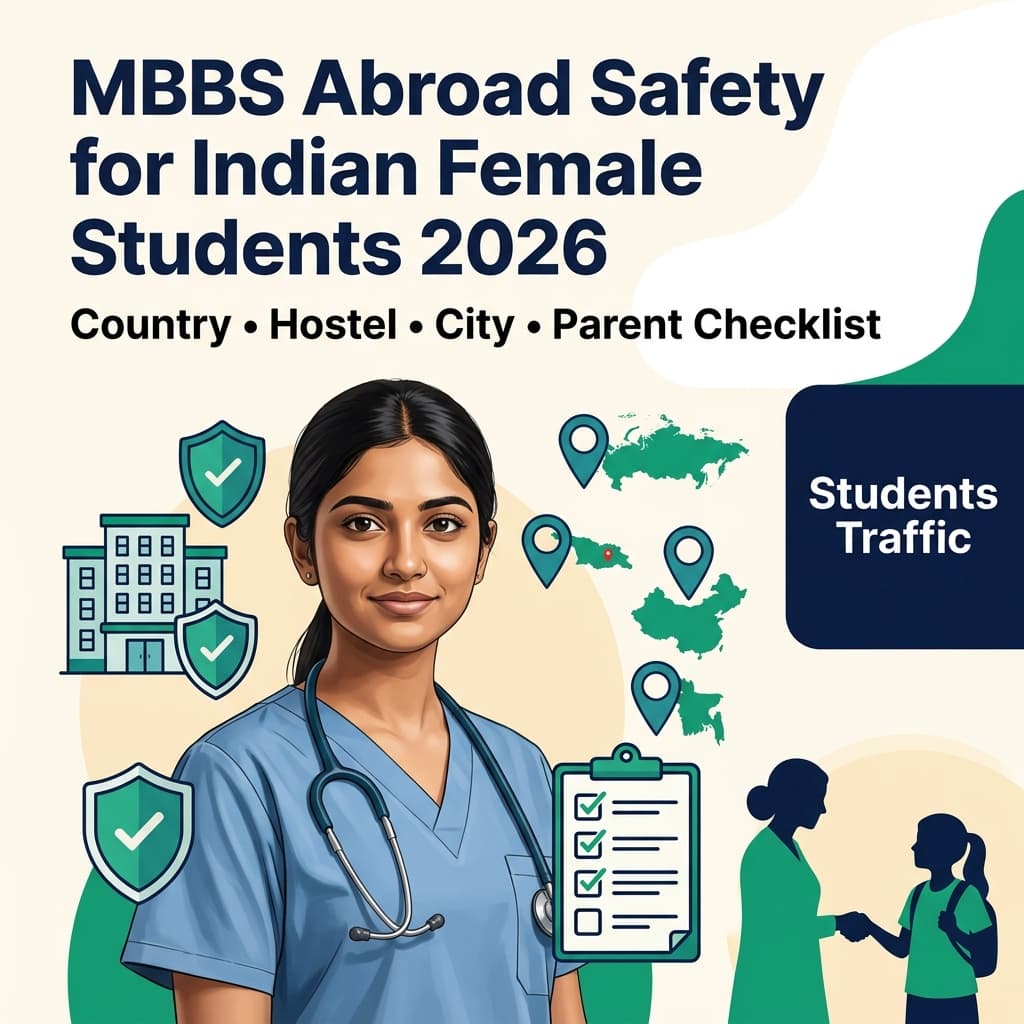
Every year, thousands of Indian girls enroll in medical universities in Russia, Kazakhstan, Georgia, Bangladesh, and Uzbekistan. The objective reality on the ground in these countries is often fundamentally different from the perceptions held back home. This guide provides an unfiltered assessment of safety for female students pursuing MBBS abroad in 2026.
Global Safety Perceptions vs. Reality
It is a common misconception that emerging nations or former Soviet republics are inherently dangerous. In reality, the day-to-day street safety in cities like Moscow, Almaty, or Tbilisi often surpasses many major Indian metropolitan areas in terms of female security and freedom of movement.
1. General Street Safety and Violent Crime
Violent crime against international students is exceptionally rare across the primary MBBS abroad destinations.
- Russia: Major cities like Moscow, St. Petersburg, and Kazan are heavily policed with extensive CCTV surveillance. Street harassment is culturally unacceptable and legally penalized.
- Georgia (Tbilisi): Frequently ranks among the top 20 safest countries globally. Walking in Tbilisi late at night is generally considered safe. Police are helpful and untainted by petty corruption.
- Kazakhstan (Almaty/Nur-Sultan): Very safe for international students. The visible police presence is high.
- Bangladesh: Highly conservative society; the street environment is functionally identically to tier-2 Indian cities, but university campuses maintain extreme security.
Rule of thumb: Petty crime (pickpocketing in crowded markets or on public transport) does exist, particularly in Russia and Kyrgyzstan, as it does in any global city. But physical violence or targeted harassment of Indian female students is statistically anomalies.
The Hostel Environment: Security and Infrastructure
The most important physical environment for safety is the university hostel, where a student will spend the majority of her non-clinical time.
Separate vs. Co-ed Hostels:
- Most state medical universities in Russia and Kazakhstan operate co-ed hostel buildings, but individual floors, wings, or specific apartments (blocks) are strictly segregated by gender.
- Bangladesh maintains completely separate, highly secure hostels for female students with strict entry and exit times.
- If separate hostels are a strict non-negotiable requirement for a parent, Bangladesh, specific universities in Uzbekistan, and select private universities in Georgia are the best choices.
Hostel Security Features:
- Access Control: Almost all university-operated hostels now use electronic access cards or biometric entry.
- Guards: 24/7 security guards (often older, strict local staff known as "Dezhurnaya" in Russian-speaking countries). No unauthorized visitors are permitted, especially past evening curfew hours.
- Curfews: Most Russian and Central Asian universities enforce a hostel curfew (typically between 10:00 PM and 11:30 PM).
- Cameras: Surveillance in all common areas, corridors, and kitchens.
Private Flats vs. University Hostels: While living in a rented private apartment becomes an option in Year 3 or 4, we strongly advise female students to remain in the university hostel for at least the first two years. Hostels provide a built-in peer support network and institutional security that private landlords cannot offer.
Cultural Attitudes Toward Indian Women
- Respectful Distance: The prevailing culture in Russia, Georgia, and Central Asia is one of respectful distance. The physical boundary issues sometimes experienced in crowded South Asian public spaces are not the cultural norm there.
- The Foreigner Factor: Locals generally view Indian students purely as transient academics. In countries like Kazakhstan and Uzbekistan, there is a strong cultural affinity for Indians.
- Attire: In Russia and Georgia, the culture is quite liberal, and female students can dress as they please. In Uzbekistan, Kyrgyzstan, and Bangladesh, dressing modestly (e.g., covering shoulders and knees) is not legally mandated but is culturally appreciated and attracts less unwanted attention in local markets.
Country-by-Country Safety Breakdown
| Country | Street Safety | Hostel Strictness | Cultural Vibe |
|---|---|---|---|
| Georgia | ⭐⭐⭐⭐⭐ | Medium | Highly hospitable, European, extremely safe at night. |
| Russia | ⭐⭐⭐⭐ | High | Regulated, strict hostel rules, heavy CCTV reliance. |
| Kazakhstan | ⭐⭐⭐⭐ | High | Friendly, structured, strong institutional support. |
| Uzbekistan | ⭐⭐⭐⭐ | High | Conservative, orderly, strong police presence. |
| Bangladesh | ⭐⭐⭐ | Extreme | Feels like a strict Indian boarding school. Extremely regulated. |
| Kyrgyzstan | ⭐⭐⭐ | Medium | Safe on campus; petty theft in city markets requires caution. |
5 Practical Safety Rules for Female Students Abroad
While the environment is generally safe, safety is also a habit. We advise all students (male and female) to adhere strictly to these basic urban survival protocols:
- The "Buddy System" at Night: For the first year, never travel alone after dark. If returning from the library or clinical postings late, always travel with a classmate.
- Use Registered Cabs Only: Do not hail random cars off the street (a common practice in some Central Asian countries). Always use official ride-hailing apps like Yandex Go (the Uber of Russia/CIS) where the driver's identity, car number, and route are tracked and shareable via GPS.
- Local Emergency Numbers: Memorize the local equivalent of 100/112, the number of the Indian Embassy duty officer, and the University's International Dean. Save these on speed-dial.
- Do Not Engage in Local Nightlife Unprepared: If exploring local cafes or clubs on weekends, do so only in a group, and never leave drinks unattended. Most universities strongly advise against frequenting late-night establishments.
- Keep Your Passport Secure: Never carry your original passport to local markets or clinical postings unless absolutely required for university registration. Carry a laminated color photocopy and a digital scan on your phone.
The Verdict for Parents
Yes, pursuing MBBS abroad is safe for female Indian students.
If you choose a recognized government medical university in a stable country, the institutional structure is designed to protect its international students. The universities understand that their reputation in India—their largest source of international tuition—depends entirely on the well-being of their students.
The primary challenges your daughter will face are not physical safety, but rather extreme winter adaptability, learning to cook for herself, and the academic pressure of preparing for the NExT/FMGE exams.
If she is mature enough to handle those academic and lifestyle challenges, the surrounding environment will be secure enough to support her.
Why Parents Need a Systems View of Safety
Most families search this topic hoping for one short answer:
"Safe hai ya nahi?"
But safety for a six-year foreign-medical journey is not one thing.
It is a system made of smaller things working well together:
- airport arrival support
- hostel discipline
- roommate quality
- campus-to-hospital commute
- local-language comfort
- city behavior after dark
- availability of Indian peer networks
- whether the university responds quickly when something small goes wrong
That means a country can have a good overall reputation and still be a weak fit for a particular student.
It also means a country that sounds intimidating to parents at first can actually feel more secure in daily life than many Indian families expect.
So the better question is not only:
"Is this country safe for girls?"
It is:
"Will this student be living inside a system that reduces avoidable risk every day?"
That is a better admissions question.
Country Reputation vs City Reality
Parents often judge safety at the country level because that is the easiest level to understand.
But the student does not live in a country in the abstract.
She lives in:
- one city
- one hostel
- one campus routine
- one group of classmates
This is why city-level and university-level evaluation matters more than national-level stereotypes.
For example, families should ask:
- Is the university located in a large metro, smaller student city, or remote town?
- How far is the hostel from the academic building?
- Are clinical hospitals within routine commuting distance?
- Is the route walkable, shuttle-based, or dependent on taxis?
- Is there an active Indian student group already present?
Those questions are more predictive than broad fear or broad reassurance.
What Usually Makes the First Year Feel Unsafe Even When the Environment Is Not
Sometimes the actual environment is reasonably safe but the student still feels anxious.
Why?
Because first-year vulnerability often comes from transition shock rather than direct threat.
That shock includes:
- unfamiliar language in shops and streets
- winter darkness and empty-looking roads
- homesickness
- learning public transport
- not yet knowing seniors or trusted classmates
- overconsumption of negative news clips from family WhatsApp groups
Parents should know this because fear perception and actual danger are not always the same thing.
A student who has not yet built routine can temporarily feel unsafe everywhere.
That is why the first 60 to 90 days matter so much.
The right university and peer system reduce that uncertainty quickly.
The wrong one leaves the student feeling isolated even if the city itself is not especially risky.
The Parent Audit Before Finalizing a University
Parents who want a more serious safety review should do a simple audit.
1. Arrival audit
Ask:
- Who receives the student at the airport?
- Is it the university, a verified local representative, or no one?
- What happens if the flight is delayed by six hours?
Arrival chaos is not a small issue.
It shapes the family's trust immediately.
2. Hostel audit
Ask:
- Is the hostel university-owned or privately arranged?
- Are visitors controlled?
- Is there a female warden or resident administrative staff?
- Are first-year students placed together or scattered?
3. Commute audit
Ask:
- How does the student travel to hospital postings?
- Is it by foot, shuttle, metro, or app cab?
- Are postings sometimes late evening?
4. Peer-network audit
Ask:
- How many Indian girls are already in the same hostel or university?
- Are there senior students who can help in the first month?
- Does the institution have an international office that actually responds?
5. Escalation audit
Ask:
- If there is a hostel issue, who handles it?
- If the student loses documents, who helps?
- If there is a medical emergency, what is the protocol?
Parents who ask these questions get much better clarity than parents who ask only whether the country is "safe."
Daily-Routine Safety Matters More Than Dramatic Scenarios
Families often imagine safety in dramatic terms:
- violent crime
- kidnapping
- extreme harassment
Those are emotionally powerful fears.
But daily-routine safety is often more important:
- taking the correct cab at the correct time
- returning before hostel rules become a problem
- not sharing private details with strangers
- managing documents carefully
- knowing which neighborhoods are fine in daytime but not useful late at night
In practice, students who follow disciplined routine habits usually avoid most preventable issues.
That is why maturity matters.
Not because the world is terrifying.
But because self-management reduces friction.
Hostel vs Private Apartment for Female Students
Many parents assume a private flat is automatically safer because it sounds more exclusive.
That is not always true.
For the first one or two years, hostel living is often safer because it offers:
- known entry rules
- peer presence
- institutional visibility
- easier access to university help
Private flats can make sense later, but only when:
- the student knows the city well
- the student has reliable flatmates
- the family understands the neighborhood
- the commute is practical
For many first-year students, private living increases logistical stress rather than reducing it.
The Transportation Rule Parents Should Insist On
Female students should have one strict travel rule:
use registered, traceable transport whenever possible.
That means:
- official ride-hailing apps
- known university shuttles
- verified public transport routes learned with seniors
It does not mean:
- random late-night lifts
- cash-only untracked transport
- guessing new routes alone in the first weeks
This sounds simple, but simple habits are what create safe routine.
Social Safety and Emotional Safety
Not all safety concerns are physical.
Some are social:
- manipulative friend circles
- unhealthy dependence on one senior or agent representative
- pressure to join social settings the student is not comfortable with
- embarrassment about asking for help
Parents should keep communication open enough that the student can report:
- confusion
- loneliness
- bullying
- roommate tension
- academic pressure
A student who feels emotionally supported makes better practical decisions.
That is part of safety too.
What Type of Student Usually Handles MBBS Abroad Safely
Female students usually do well abroad when they are:
- reasonably independent
- willing to follow routine
- not afraid to ask for help early
- careful with documents and money
- selective about friends
They may struggle more if they:
- hide problems until they become big
- resist all rules as if independence means ignoring structure
- rely fully on one person for local guidance
- treat a foreign environment casually in the first months
This is not about blaming students.
It is about matching the student to the reality of living abroad.
Questions Parents Should Ask Current Female Students
Before finalizing any university, parents should speak with at least one current female student and ask:
- How did the first month actually feel?
- How strict is the hostel in practice?
- Are there safe transport options after evening study hours?
- Do you feel supported by seniors and the university office?
- What problem surprised you most after arrival?
- Would you choose the same hostel and city again?
These questions produce better truth than asking an admissions rep:
"Madam, girls are safe there na?"
A First-90-Days Safety Plan Families Can Use
The first three months are the most sensitive because the student is still converting a new place into normal life.
Families can reduce stress a lot by creating a first-90-days plan instead of relying on vague advice.
Week 1
Focus on basics only:
- hostel settling
- local SIM and internet
- understanding campus route
- learning one safe grocery path
- identifying the nearest hospital and pharmacy
Weeks 2 to 4
Build dependable routine:
- move with classmates
- learn one reliable transport app
- save emergency numbers
- understand the hostel warden and international office process
Month 2
Shift from survival to stability:
- identify a trusted senior
- understand which areas are fine in daytime and which are not useful late evening
- learn how academic schedule affects transport and meal timing
Month 3
Start independent confidence, not careless confidence:
- solo daytime movement on known routes can begin
- document storage habits should be fully set
- parents should reduce panic calling and increase structured check-ins
This staged approach helps students grow safer because they become familiar step by step instead of pretending to be fully adjusted immediately.
How Parents Should Communicate Without Making the Student More Anxious
Some parents accidentally increase risk by increasing panic.
They call too often, react too strongly to small discomforts, and turn every ordinary adjustment issue into proof that the country is unsafe.
That approach can backfire.
Why?
Because the student stops reporting smaller concerns honestly out of fear that the family will overreact.
A better communication pattern is:
- one calm daily check-in in the first weeks
- one practical weekly review of hostel, food, studies, and commute
- immediate escalation only for real issues
Parents should ask:
- "How is your routine feeling?"
- "Any hostel issue we should know about?"
- "Do you feel you have at least two trusted people there yet?"
These questions invite honesty.
Questions like:
- "Nothing happened na?"
- "Are you really safe?"
- "Should we bring you back?"
can sometimes increase emotional pressure rather than clarity.
Good communication is part of risk management.
A Better Way to Compare Safety Across Destinations
Parents do not need a fake ranking.
They need a framework.
Here is a practical one:
| Safety lens | What to compare |
|---|---|
| Hostel control | Entry rules, warden presence, visitor discipline |
| City comfort | Late-evening environment, student density, transport predictability |
| Commute simplicity | Distance to campus and hospitals, need for taxis, route familiarity |
| Peer support | Indian student depth, female peer presence, senior responsiveness |
| Institutional response | Whether the university solves issues or only advertises support |
When families compare destinations this way, they stop chasing a magical "safest country" answer and start identifying the safest workable environment for their child.
That is much more useful.
Red Flags Parents Should Not Ignore
Pause the decision if you hear any of these patterns:
- "Hostel details will be told later."
- "Airport pickup is optional, manage somehow."
- "Many girls go there, so don't worry."
- "No need to talk to current students."
- "The city is safe, so exact location doesn't matter."
- "Private apartment is better, arrange after arrival."
These answers do not prove danger.
But they do prove weak process.
And weak process is exactly what good parents should avoid.
Final Practical Verdict
Yes, MBBS abroad can be a safe and strong pathway for Indian female students.
But the safest outcomes do not come from blind confidence.
They come from structured selection:
- the right city
- the right hostel
- the right peer ecosystem
- the right arrival support
- the right family communication pattern
When parents evaluate those pieces carefully, the conversation becomes much calmer.
The student's life abroad stops looking like a vague risk and starts looking like a manageable system.
How Students Traffic Can Help Parents Verify Safety Beyond Sales Claims
Safety is too important to be reduced to a brochure sentence like "very safe country." Students Traffic helps parents compare hostel rules, city fit, airport arrival support, student community depth, daily commute patterns, and real peer feedback before admission money is sent.
If your family wants a safer shortlist instead of a more emotional one, use Students Traffic counselling support and peer connect to speak with current students and pressure-test the practical reality before you decide.