MBBS in Kyrgyzstan 2026: The Comprehensive Strategic Roadmap for Indian Students
1. Introduction: The Budget-Friendly Frontier
Kyrgyzstan has emerged as the most budget-friendly destination for Indian medical aspirants, providing a high-quality, English-medium education at total costs often lower than ₹25 Lakhs. As we move into the 2026 academic cycle, the Kyrgyz medical education system has aligned itself with the World Directory of Medical Schools (WDOMS) and National Medical Commission (NMC) guidelines.
This guide provides a granular, factual breakdown of what it truly means to study MBBS in Kyrgyzstan in 2026. We provide itemized living costs, university profiles, and the exact clinical rotation protocols to help you make an informed choice.
2. In-Depth University Profiles: The Leaders of Kyrgyz Medicine
2.1 Osh State University (Medical Faculty): The Student Standard
Osh State is the primary choice for Indian students in Kyrgyzstan, known for its massive Indian community and well-established academic infrastructure.
- Legacy & Infrastructure: The medical faculty was established in 1993 and is the largest in the south of the country. It has multiple large clinical bases and a dedicated medical library with high-speed digital resources.
- Indian Support System: Features an Indian Student Representative Council, ensuring students have round-the-clock academic and personal assistance.
- Clinical Exposure: The university hospitals in Osh are high-volume centers, providing diverse and intense clinical exposure starting from the 3rd or 4th year.
- Student Life: The campus features multiple Indian messes serving traditional North and South Indian food, with menus decided by student representatives.
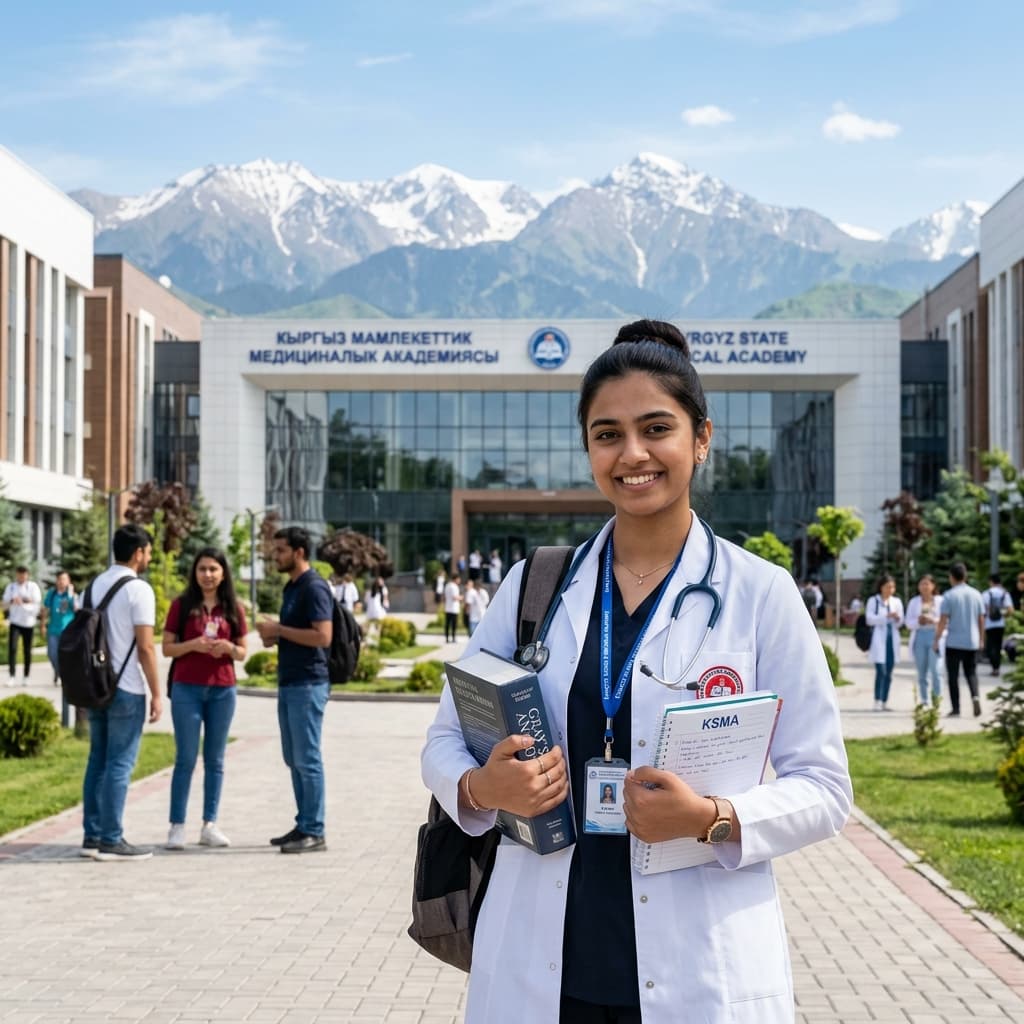
2.2 Kyrgyz State Medical Academy (KSMA), Bishkek: The Flagship Academy
KSMA is the flagship state academy in the capital city, providing the highest level of government-backed medical training.
- National Referral Hospital: KSMA operates the most advanced healthcare centers in Bishkek, which serve as national referral hospitals.
- Simulation Training: The academy houses the National Simulation Center, featuring advanced robotic patients and high-fidelity anatomical models.
- Faculty Expertise: Many of Kyrgyzstan’s top clinicians are faculty members, with an increasing number of bilingual professors trained in English.
- Transport: Students in Bishkek rely on buses, trolleybuses, and marshrutkas (minibuses). Apps like 2GIS are essential for navigating the city’s public transport grid.
2.3 Jalal-Abad State University (Medical Faculty): The Budget Choice
A very strong budget option located in the beautiful city of Jalal-Abad.
- Faculty Expertise: The medical faculty is known for its academic rigor and dedicated English-medium department.
- Clinical Rotations: Jalal-Abad State has partnership agreements with multiple regional and municipal hospitals, ensuring student access to clinical wards.
- Affordability: Known for having one of the lowest tuition and hostel costs in the Central Asian region.
- Campus Life: The Jalal-Abad campus offers a relaxed, provincial lifestyle with modern libraries and sports facilities.
3. The NMC 2021/2026 Compliance Audit: A Detailed Analysis
Compliance with the National Medical Commission (NMC) Foreign Medical Graduate Licentiate (FMGL) Regulations of 2021 is mandatory. Here is the status for Kyrgyzstan:
3.1 Course Duration (Sec 4.1.a)
The NMC requires a minimum of 54 months of academic study.
- Kyrgyzstan Data: The MD program in Kyrgyzstan is 6 years (360 ECTS credits). The academic portion covers 10 semesters (60 months), surpassing the NMC requirement comfortably.
3.2 Internship (Sec 4.1.b)
The degree must include a mandatory 12-month internship in the parent institution.
- Kyrgyzstan Data: The 6th year of the MD program is an integrated "Clinical Internship Year." This is documented on the academic transcript, satisfying the NMC requirement.
3.3 Medium of Instruction (Sec 4.2)
100% English medium is required.
- Kyrgyzstan Data: Major universities like KSMA, Osh State, and ISM offer a 100% English-medium track for international students. All lectures, examinations, and clinical clerkships are conducted in English.
3.4 Licensure (Sec 4.3)
Eligibility to practice in the host country is required.
- Kyrgyzstan Data: Graduates are eligible for local licensing upon graduation, following the current Uzbekistan model. This satisfies the NMC requirement for "equivalence."
4. Economic Reality Check: Itemized Living Costs in Kyrgyzstan (2026)
Estimated monthly costs for 2026 at current parity (1 USD = 89 KGS; 1 USD = 84 INR).
| Item | Cost (USD) | Cost (INR) |
|---|---|---|
| Shared 2-BHK Apartment (Bishkek Center) | $300 - $400 | ₹25,000 - ₹34,000 |
| Shared Apartment (Outside Center) | $180 - $300 | ₹15,000 - ₹25,000 |
| Standard University Hostel (Shared Shared) | $30 - $60 | ₹2,500 - ₹5,000 |
| Utilities (Electricity, Water, Heating) | $30 - $50 | ₹2,500 - ₹4,200 |
| High-speed Fiber Internet (100 Mbps) | $10 | ₹840 |
| Indian Mess Fee (Monthly) | $100 - $120 | ₹8,400 - ₹10,000 |
| Meal at a Good Restaurant | $10 - $15 | ₹840 - ₹1,260 |
| Monthly Transport Pass (Metro + Bus) | $10 | ₹840 |
Note: Bishkek is roughly 25-30% more expensive than cities like Osh or Jalal-Abad for rent and dining.
5. Detailed Semester-Wise Curriculum Breakdown
Year 1: Basic Medical Sciences I
- Semester 1: Human Anatomy Part 1 (Osteology, Arthrology), Medical Physics, Medical Biology (Genetics), Latin, History of Medicine.
- Semester 2: Anatomy Part 2 (Myology, Splanchnology), Histology and Embryology I, Medical Chemistry, Biochemistry I.
Year 2: Basic Medical Sciences II
- Semester 3: Anatomy Part 3 (Neurology & Angiology), Physics for Medics II, Biochemistry II, Microbiology I, Histology II.
- Semester 4: Physiology I, Microbiology II, Immunology, General Pathology, Public Health.
Year 3: Introduction to Clinical Medicine
- Semester 5: Physiology II, Pathophysiology, Pharmacology I, Special Pathology.
- Semester 6: Pharmacology II, General Surgery Part 1, Internal Medicine Propaedeutics.
Year 4-5: Clinical Specialty Blocks
- Modules: Internal Medicine, General Surgery, Pediatrics, Urology, Ophthalmology, ENT, Neurology, Psychiatry, Oncology, Obstetrics & Gynecology, Infectious Diseases, Radiology.
Year 6: The Integrated Internship (Clinical Practice)
- Activity: Full-time ward duties in major city hospitals. Students are expected to manage daily patient charts, assist in diagnostic procedures, and participate in morning clinical conferences.
6. The Step-by-Step Admission & Visa Roadmap (2026 Phase)
Phase 1: Application (April - June)
- NEET Scorecard: You must have qualified NEET in 2024, 2025, or 2026.
- Submit Transcripts: Through the official university portal with 50% PCB marks.
Phase 2: Documentation & Apostille (June - July)
- HRD/GAD Attestation: From your state's education department.
- MEA Apostille: The "orange sticker" from the Ministry of External Affairs.
- Translations: Documents must be translated into Russian/Kyrgyz and notarized.
Phase 3: Kyrgyzstan Study Visa (July - August)
- Invitation Letter: Issued by the university after documentation approval.
- Visa Hub (Embassy): Applications are submitted to the Kyrgyzstan Embassy in Delhi or Consulate in Mumbai.
- Requirements: Passport, invitation, medical reports, and proof of funds.
Phase 4: Arrival & Local Registration (September)
- Arrival: Airport pickup by university partners.
- Registration: University registers you with the local authorities within 72 hours of arrival.
7. Clinical Training Ecosystem in Kyrgyzstan
Clinical training is decentralized but focused on high-volume municipal hospitals.
- Patient Inflow: Public hospitals in Bishkek and Osh provide a huge diverse patient demographic, which is excellent for clinical experience.
- Language Barrier: While English is the instruction medium, patients speak Kyrgyz or Russian. Learning the basics of these languages is essential for effective patient interaction during rotatory rotations.
- Simulation Centers: Kyrgyz universities have invested heavily in simulation centers to prepare students for clinical practical exams.
8. Career Pathways Post-Kyrgyzstan
8.1 India (NExT Strategy)
Indian students in Kyrgyzstan typically follow this timeline:
- Years 1-3: Supplement university lectures with online NExT-oriented platforms (Marrow, Prepladder).
- Years 4-6: Focus on Clinical Medicine (Medicine, Surgery, OBG) and take weekly mock tests.
- Post-Graduation: Return, take NExT-1 (Theory), then 1 year internship in India, then NExT-2 (Practical).
8.2 Global Success: USMLE & PLAB
Kyrgyz universities are listed in WDOMS and recognized by global bodies, supporting the licensing paths to USMLE (USA) and PLAB (UK).
9. Comprehensive FAQ: The "Big 60" (Detailed Technical Guide)
- Is Kyrgyzstan safe for Indian female students? Yes, it is considered safe with secure campus hostels and standard urban precautions.
- What is the student visa process? It involves an electronic invitation and embassy-based processing.
- Can I practice in Kyrgyzstan? Theoretically yes, after clearing local licensing exams.
- Are there Indian festivals? Yes, celebrated widely in students’ hostels.
- Is the 6th year recognized as an internship? Yes, it’s integrated into the MD course.
- Can I get an education loan? Yes, from SBI and major Indian banks.
- What if I fail a subject? Retake exams are allowed; check the university's specific policy.
- Is the ECTS system followed? Yes, 360 credits for 6 years.
- Are textbooks free? Digital libraries are available; physical textbooks are in the main library.
- What is the internet speed in hostels? Fast (50-100 Mbps) and reliable.
- Do I need to carry Indian spices? Many available locally, but a starter kit is recommended.
- Cadaver ratio? 8-10 students per cadaver in the 1st year.
- Are surgeries live? Senior students assist in clinical rotations.
- Current voltage same as India? Yes, 220V with Euro plugs.
- How far is Kyrgyzstan? A 4-hour direct flight from Delhi.
- Are there Indian banks? No, but international debit cards work.
- Can I choose my roommate? Usually after the 1st year.
- Self-cooking allowed? Yes, communal kitchens in hostels.
- SIM card process? Instant with Indian passport (Beeline/MegaCom).
- Is there any entrance exam? Most have a basic screening test and interview.
- Are the faculty friendly? Professional, with a culture of hospitality.
- Cost of flight ticket? Range ₹15,000 - ₹25,000 one-way.
- Do I need NEET? Mandatory for Indian license.
- Libraries open 24/7? Reading halls usually late.
- Is the degree in English? Bilingual diploma (Kyrgyz/English).
- Can parents visit? Yes, via tourist visa.
- Indian Students Association? Yes, active on all campuses.
- Local currency? Som (KGS). $1 ≈ 89 KGS.
- Direct flights from Delhi? Yes, available frequently.
- Is the 6th year recognized in India? Yes, satisfying the NMC requirement.
- What is the local food like? Meat-heavy and delicious; similar to other Central Asian cuisines.
- Indian food available? Yes, multiple Indian restaurants in Bishkek/Osh.
- Is water safe? Tap water is boiled; bottled water is standard.
- Are there heaters? Centralized heating is very effective.
- SIM card signal in Metro? Excellent 4G/5G in most stations.
- Can I transfer fees directly? Highly recommended; avoid paying agents.
- Any hidden costs? Watch for annual visa and insurance renewals.
- Is there a dress code? Formal attire + white coat in clinicals.
- What if I get sick? Student medical centers handle all primary care.
- Are libraries digital? Yes, massive repositories at KSMA and Osh State.
- What is the local time difference? 0.5 hours ahead of India.
- Can I buy a laptop locally? Yes, prices comparable to India.
- Is religious freedom available? Yes, Kyrgyzstan is secular.
- Are there temples/mosques/churches? Yes, in all major cities.
- What is the Cadaver ratio in first year? Approx 1:12.
- Is 6th year internship paid? No, it’s part of the academic program.
- Can I work part-time? Not on a student visa.
- Is NEET mandatory for universities? Yes.
- How many semesters total? 12 semesters.
- Is an interview mandatory? Most universities have a basic interview.
- What is the minimum age? 17 years by Dec 31.
- Is there an upper age limit? No official NMC limit.
- Do I need to learn Kyrgyz/Russian? No, but you need it for clinicals.
- What is the pass percentage of FMGE? Kyrgyzstan (15-25%) is robust for budget choice.
- Can I buy medical equipment locally? Yes, stethoscopes and kits are cheap.
- Are clinical exams OSCE based? Yes, exactly like NExT-2.
- How large is the Indian community? Largest among Central Asian destinations.
- Do I need to carry winter clothes? No, buy more effective gear locally.
- Is the university degree world-ranked? Yes, KSMA is top-ranked in the region.
- Final verdict? The "budget choice" for quality and legitimate clinical exposure.
10. Conclusion: Your Journey Starts Here
Choosing Kyrgyzstan for your MBBS is choosing the best balance of quality, safety, and price for 2026. It is the most robust choice for budget-oriented, hard-working students who want a legitimate MD degree.
Wait no longer. Kyrgyzstan’s seats fill up quickly. Start your application today and talk to our Peer Connect alumni today.