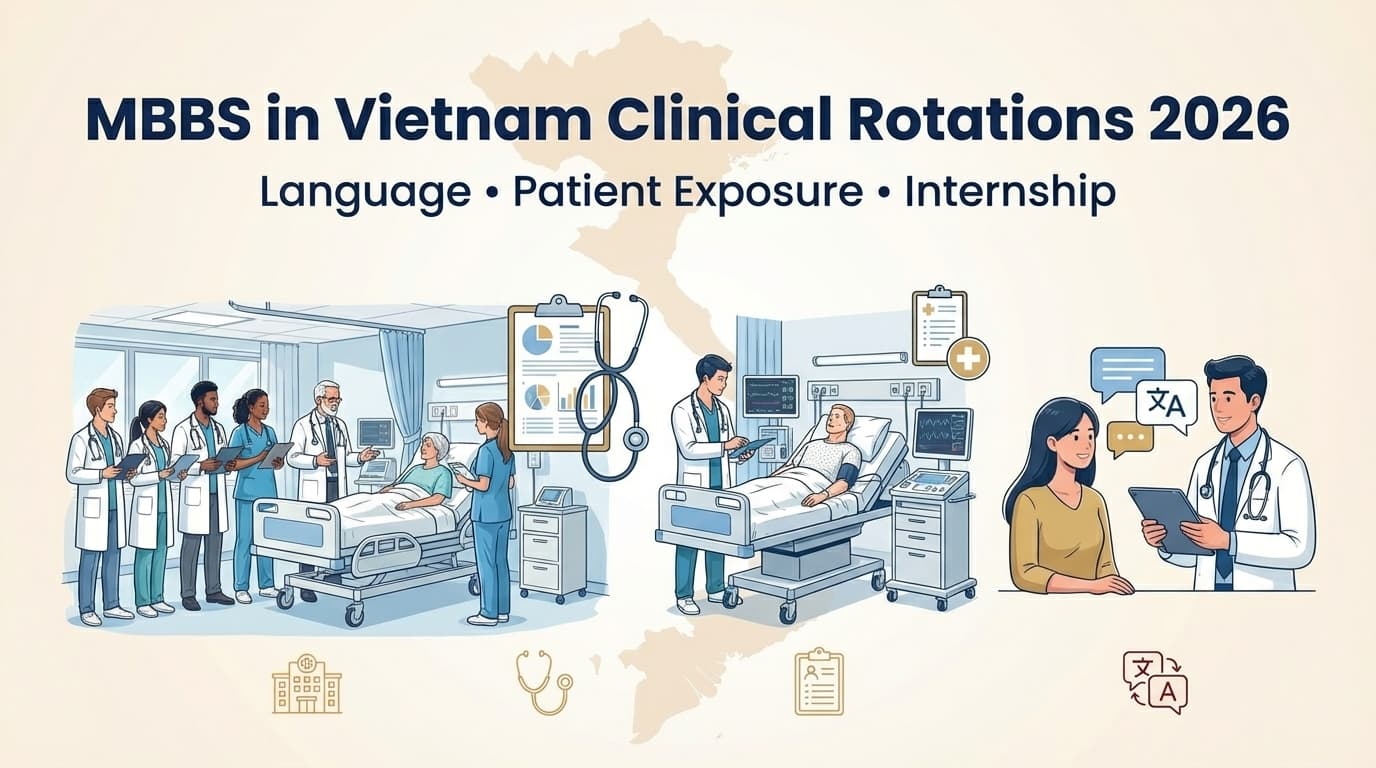
Why Clinical Training Is the Most Misunderstood Part of MBBS in Vietnam
Families usually compare three things first:
- tuition fee
- hostel
- whether the course is described as English medium
Those things matter. But they are not what decides whether the student becomes a confident doctor-in-training.
The real turning point in any MBBS-abroad decision is the clinical pathway:
- when hospital exposure starts
- whether patient flow is real
- whether simulation training is only decorative or actually useful
- how language affects wards and case-taking
- what the internship structure really looks like
That is exactly where Vietnam needs a more serious discussion.
This article is built to answer that discussion for Indian families evaluating Vietnam in 2026.
It should be read together with Best Medical Universities in Vietnam 2026, Is MBBS in Vietnam Valid in India?, and MBBS in Vietnam Admission 2026.
First Principle: A Beautiful Campus Is Not Clinical Depth
This sounds obvious, but it is where many families still get misled.
A university can show:
- smart classrooms
- polished labs
- modern buildings
- strong social-media visuals
and still leave the family with unanswered questions about the actual clinical years.
Clinical depth means the student can see a credible path from classroom learning to real hospital learning.
That path usually depends on:
| Clinical factor | What families should ask |
|---|---|
| Teaching hospital access | Is there a real hospital ecosystem, not only a brochure mention? |
| Patient volume | Does the hospital actually handle enough OP, IP, and case variety? |
| Early exposure | When do students begin clinical observation or guided training? |
| Simulation support | Is the simulation lab a serious bridge or just a sales point? |
| Language transition | How are students prepared for patient-facing communication? |
| Internship structure | How does the final practical phase work in real terms? |
Once families start comparing Vietnam this way, weak programs become easier to spot.
What a Strong Vietnam Clinical Story Usually Looks Like
A convincing Vietnam university does not need perfection. But it should give a coherent answer to these:
- Where does the student train?
- When does the student enter clinical settings?
- Is the hospital owned, attached, or partner-based?
- How much patient flow is there?
- What happens when local language becomes relevant?
- How does the final practical phase connect to graduation and India-return planning?
If any of those answers are vague, families should slow down immediately.
Four Useful University Examples from Your 2026 Inputs
The university points you shared are helpful because they move the conversation away from generic country talk and toward actual hospital structure.
BMU / BMTU
Buon Ma Thuot Medical University is being positioned around a clinical model with:
- a 500+ bed multi-specialty hospital on campus
- OP flow of more than 33,000 patients per month
- a university-hospital position described as one of the top hospitals in the city
- 12 affiliated hospitals
- more than 20,000 surgeries yearly
- simulation-lab support
That is the kind of hospital narrative families should want to examine closely, because it gives concrete indicators rather than only saying "excellent exposure."
CTUMP
Can Tho University of Medicine and Pharmacy is being presented as:
- a long-established government university
- attached to a 500+ bed teaching hospital
- beginning clinical training from the second year
- backed by 11+ hospital tie-ups
- supported by simulation and research labs
That matters because an older public identity plus hospital depth is usually easier for cautious families to evaluate.
PCTU
Phan Chau Trinh University is being positioned with:
- a simulation hospital
- a medical museum
- a stem-cell research centre
- 9 own hospitals
- 1500+ total hospital beds
- collaborations with Stanford and UCSF
This is one of the strongest examples of a private university trying to build a medicine-first identity instead of just a campus-first identity.
DNU
Dai Nam University is being presented with:
- 16+ hospital affiliations in Hanoi
- 2 modern teaching hospitals
- simulation labs and smart classrooms
- visibility around advanced diagnostic infrastructure
- a curriculum pitch that is India-aware
For families comparing private options, that kind of capital-city hospital-network story can be attractive if the clinical continuity is clear.
Simulation Lab vs Real Hospital: Why Both Matter
Simulation labs are valuable. They help students learn:
- examination flow
- procedural sequence
- emergency response basics
- communication confidence
- early clinical discipline
But a simulation lab is still not a patient ward.
That means families should see simulation as a bridge, not as a substitute.
The best setup is:
- simulation for early confidence
- supervised observation for transition
- meaningful hospital exposure for real case understanding
When a university sells simulation too aggressively without enough hospital detail, that is usually a sign the real clinical story needs harder questioning.
When Does Clinical Training Usually Start?
Families often hear phrases such as:
- clinical exposure from year 2
- hospital visits from early years
- practical orientation from the first phase
Those statements can all be true while still meaning very different things.
Three levels of "early clinical exposure"
| Phrase used in marketing | What it can actually mean |
|---|---|
| Clinical orientation | Hospital visits, observation, or introductory exposure |
| Practical training | Lab-heavy or simulation-based structured learning |
| Clinical rotations | Patient-facing departmental movement under supervision |
This distinction matters because some families hear "clinical exposure" and assume the student is already doing substantial hospital work.
The better question is:
What exactly is the student doing in year 2, year 3, year 4, and final year?
That one question reveals a lot.
Language Reality in the Clinical Years
This is the most sensitive and most important part of the Vietnam discussion.
Early years may feel comfortable in English-medium teaching.
But once the student enters hospitals, language becomes practical:
- history taking
- patient instructions
- ward communication
- understanding local records and routines
- observing doctor-patient interactions
So the real clinical question is not "Is the course English medium?"
It is:
How does the university support the student when hospital learning becomes locally grounded?
Families should ask:
- Is there structured Vietnamese language support?
- When is local-language exposure introduced?
- Are international students grouped with support in clinical settings?
- How are case discussions handled?
If the answers are weak, the student's clinical growth may become slower than expected.
Hospital Ownership vs Affiliation: Which Is Better?
Families often hear both stories:
- "We have our own hospital"
- "We are affiliated with many hospitals"
Neither is automatically superior.
Own hospital can be strong when:
- it has serious patient flow
- it serves as a real teaching site
- students are consistently integrated
Affiliate model can be strong when:
- the partner hospitals are active and relevant
- the rotation structure is organized
- there is continuity across years
The weak version of both models also exists:
- an "own hospital" that looks good but does not create enough structured learning
- an "affiliate network" that sounds large but feels thin in practice
That is why numbers alone are not enough. Families need numbers plus continuity.
Internship and Final-Year Questions Families Should Not Skip
When Indian families ask about internship, they are often really asking three different things:
- What happens during the final clinical phase?
- How is that documented?
- How does it connect to India-return planning later?
The student should know:
- where the internship or practical final-year phase happens
- whether it is fully within the university's hospital ecosystem or distributed
- what documents are issued
- whether the structure is clear enough for future verification if required
This is especially important because a weakly understood internship model can become a problem only years later, when fixing it is much harder.
A Simple Clinical-Due-Diligence Checklist
Before saying yes to a Vietnam university, families should be able to answer these:
- What is the main teaching-hospital path?
- When do students start clinical observation?
- When do they move into structured departmental training?
- What is the OP/IP or patient-volume story?
- What language support exists for clinical years?
- What does internship look like on paper and in practice?
- Can the university explain all of this clearly in writing?
If the answer to half of these is still "we will tell you later," do not treat the university as clinically validated.
What Strong Counselling Should Actually Do Here
Good counselling should not reduce this to "hospital tie-up yes or no."
It should help the family compare:
- hospital depth
- language readiness
- city fit
- final-year structure
- India-return discipline
That is the practical gap Students Traffic tries to solve in Vietnam decision-making: not simply who can get admission, but who is entering a clinical pathway they actually understand.
Final Takeaway
Vietnam can offer meaningful clinical training. But families should stop judging that by surface claims alone.
The strongest universities are the ones that can show a credible bridge from:
- classroom
- to simulation
- to hospital
- to internship
- to documented graduation readiness
When that bridge is visible, Vietnam becomes much easier to trust.
When that bridge is vague, even a polished campus should not be enough.
Frequently Asked Questions
Q: Is clinical training in Vietnam strong for MBBS students?
It can be, but the answer depends heavily on the exact university, hospital network, patient flow, and language-support structure.
Q: Are simulation labs enough?
No. They are useful, but they should support real hospital learning rather than replace it.
Q: Does English-medium teaching solve clinical-language problems?
No. Once hospital interaction deepens, local-language readiness becomes important in practical ways.
Q: Is a university with many hospital tie-ups automatically better?
Not automatically. The family still needs to understand how those tie-ups translate into structured training.
Q: What is the best way to judge a Vietnam university's clinical strength?
Ask for clarity on hospital path, start year, patient volume, language support, and internship structure. If those answers are precise, the university is easier to evaluate seriously.
Related: Best Medical Universities in Vietnam 2026 | MBBS in Vietnam Admission 2026 | Is MBBS in Vietnam Valid in India? | MBBS in Vietnam Student Life 2026
How Families Should Evaluate Hospital Exposure in Vietnam
The phrase "hospital exposure" is used constantly in MBBS-abroad marketing, but it usually remains vague.
Families should ask what kind of exposure is actually being discussed:
- structured observation
- ward postings
- lab-based simulation
- guided case discussion
- direct patient interaction where legally and practically permitted
These are not the same thing.
A university can honestly offer early observational exposure while still having limited direct clinical depth for international students in later stages. Another university may show a less glamorous campus but have a stronger linkage with a busier real hospital environment.
That is why the right Vietnam question is not:
"Do you have hospital tie-ups?"
It is:
"How does the clinical path change from year to year, and what exactly can an Indian student expect at each stage?"
Families should ask for clarity on:
- the name and type of teaching hospital
- whether the hospital is public, private, or mixed-network
- how frequently students are posted
- whether postings are meaningful or mostly symbolic
- whether language support exists before patient-facing stages deepen
The more precisely a university can answer those questions, the more confidence the family should have in its clinical story.
A Better Year-by-Year Way to Judge Vietnam Clinical Training
Students and parents often imagine clinical training as one big block that begins late in the course. In reality, the stronger universities create a progression.
Early academic years
In the first phase, students usually need:
- strong anatomy, physiology, and biochemistry foundations
- practical lab discipline
- communication confidence in the classroom
- comfort with hospital terminology even before entering deep postings
At this stage, a university's simulation culture matters a lot. Good simulation is not a replacement for hospitals, but it can make the transition far less abrupt.
Middle years
This is where hospital exposure starts becoming a real differentiator.
Families should ask:
- Are students only shown facilities, or are they being integrated into a proper academic-clinical sequence?
- Does the university help students bridge theory into bedside thinking?
- Are there enough departments and case diversity to prevent clinical training from becoming repetitive?
Later years and internship-facing period
This is where language reality becomes decisive.
Even if lectures are English-friendly, patient flow depends on local communication environments. The best universities are not the ones pretending language never matters. They are the ones that prepare students for it earlier and more honestly.
Language Is Not a Side Issue in Vietnam Clinical Rotations
This may be the single most important operational question in the Vietnam pathway.
Families hear "English-medium" and often assume:
- classroom learning will be smooth
- clinical years will stay equally simple
- patient interaction will also happen in English
That is rarely how medical education works in any country.
In patient-facing settings, local language almost always matters at some level because:
- patients explain symptoms in the local language
- attendants and support staff communicate locally
- ward routines are built around domestic workflow
- case history-taking becomes difficult if the student has no functional language bridge
That does not automatically make Vietnam a bad choice.
It simply means the family must ask better questions:
- When does local-language preparation begin?
- Is it formal, informal, or mostly self-managed?
- How much does the university help international students adjust clinically?
- Does the student understand that English-medium does not eliminate patient-language reality?
The best-fit student is not the one looking for a country where language magically disappears. It is the student willing to adapt with the right support.
Simulation Labs: Real Bridge or Sales Decor?
Many Vietnam universities promote simulation centers heavily. That can be a genuine strength, but only if families know how to interpret it.
Simulation matters because it helps students practice:
- basic examination flow
- procedural confidence
- communication sequence
- emergency response thinking
- structured clinical behaviour before entering higher-pressure hospital contexts
But simulation becomes weak value if it is used only as:
- a campus-tour attraction
- a photo opportunity for parents
- a substitute for weak real-hospital access
The right question is:
"How does simulation connect to actual clinical progression?"
If the answer is clear, the university may have thought seriously about training design. If the answer is fuzzy, the family should be careful.
Public vs Private Vietnam Universities in Clinical Training
This is another area where families need nuance.
Public universities
Public institutions may offer:
- older and deeper academic identity
- stronger integration into government hospital ecosystems
- a more serious institutional feel
- potentially stronger clinical credibility in some settings
But they may also feel:
- less polished in presentation
- less internationally hand-held
- more demanding in adaptation
Private universities
Private institutions may offer:
- better presentation and infrastructure
- easier onboarding for international students
- stronger communication and support systems
- modern labs and appealing student services
But families should still verify:
- the depth of hospital access
- the seriousness of the internship story
- whether branding is outrunning clinical maturity
Neither category is automatically better. The right choice depends on whether the family's priority is:
- public-institution depth
- private-infrastructure comfort
- city fit
- budget
- or clinical-network clarity
What a Strong Internship Conversation Should Sound Like
Families often ask, "Is internship included?" and stop there.
That question is too shallow.
A better internship conversation should ask:
- Where is the internship or practical final-year training anchored?
- How much of it is observational versus hands-on within legal limits?
- What documentation will the student have at the end?
- How clearly can the university explain this to Indian families in writing?
The reason this matters is simple:
For many MBBS-abroad students, the final years are where the family finally asks the hardest questions. But by then, the student is already invested financially and emotionally.
Those questions should be asked at the beginning, not only at the end.
Red Flags Families Should Not Ignore
Vietnam can be a strong shortlist country, but families should slow down if they hear only vague answers on:
- hospital names and affiliations
- year-wise clinical progression
- language adaptation
- internship structure
- current Indian student experience in clinical years
Other red flags include:
- very polished admissions messaging with weak hospital detail
- promises that "language is never an issue"
- refusal to discuss patient exposure honestly
- no clarity on how international students transition from theory to wards
When people avoid detail, it usually means the detail is the difficult part.
The Student Profile That Usually Fits Vietnam Best
Vietnam often works well for students who want:
- a warmer climate than Russia
- a more Asia-near geography
- a serious but still evolving medical option
- a balance between affordability and liveability
- a pathway where city and university selection can be tailored carefully
The strongest-fit student usually has:
- realistic expectations about language
- patience for gradual adaptation
- interest in a structured medical pathway rather than just a cheap seat
- enough maturity to ask whether clinical depth is real
Vietnam may be less suitable for students who only want:
- the easiest possible admission
- zero language adjustment
- maximum comfort with no ambiguity about hospital exposure
That does not mean Vietnam is weak. It means fit matters.
A Practical Hospital-Visit and Verification Checklist for Parents
If families can gather evidence directly or through reliable student feedback, they should verify:
- Which hospitals are actually used?
- How far are they from campus?
- Are they busy enough to create real learning exposure?
- What do current students say about the later years?
- Is the simulation setup functioning as a bridge or just as marketing?
- Does the student support ecosystem help with language and adjustment?
The most useful advice often comes from students already in years 3 to 6, not only from fresh arrivals.
Final Addition: Clinical Reality Should Decide the Shortlist
Tuition attracts families. Hostel comforts families. English-medium branding reassures families.
But clinical reality is what decides whether the student's six-year journey feels medically serious.
That is why Vietnam should be shortlisted not just by cost or city appeal, but by:
- hospital depth
- language honesty
- year-wise training progression
- public vs private fit
- and the student's ability to adapt
When families evaluate those factors early, Vietnam becomes easier to judge fairly and much harder to mis-sell.
How Students Traffic Can Support Your Vietnam Shortlist
Students Traffic works as an admission support partner for Indian families comparing MBBS in Vietnam. The focus is not to push one university blindly. It is to help students compare cities, fee structures, clinical pathways, and paperwork before money is committed.
If you want a cleaner shortlist, use Students Traffic's peer connect to speak with students already studying abroad and reach out for admissions guidance when you are ready to move from research to application.