Why This NEET 2026 Update Matters More Than Most Students Think
For MBBS abroad aspirants, NEET is not just an exam date on the calendar. It is the event that decides whether your next six years become:
- a rushed and emotional admissions scramble
- a calm comparison between India and abroad
- a smart shortlist built around your likely score and budget
- or a series of expensive mistakes made under pressure
That is why a genuine NEET 2026 update should do more than repeat one line like "the exam is on 3 May."
Students and parents need to understand what the current official dates mean in practical terms:
- what has already happened in the application cycle
- what the correction window means if there were mistakes in the form
- what should be prepared before the result
- how MBBS abroad aspirants should think about score planning
- and which decisions should not be postponed until counselling starts
As of April 5, 2026, the National Testing Agency's NEET (UG) 2026 information bulletin and subsequent public notices provide a clear enough timeline to plan against, even though some later milestones such as admit card release and city intimation may still be announced separately.
This article is written for one specific reader:
the Indian student who may still choose MBBS abroad after NEET 2026 and wants to prepare intelligently before the usual counselling chaos begins.
The Official NEET UG 2026 Timeline Students Should Know
Here is the timeline that matters right now.
According to the NEET (UG) 2026 Information Bulletin, the original key dates were:
| Event | Official date in bulletin |
|---|---|
| Online application window | 08 February 2026 to 08 March 2026 |
| Last date for fee payment in original window | 08 March 2026 |
| Correction in particulars | 10 March 2026 to 12 March 2026 |
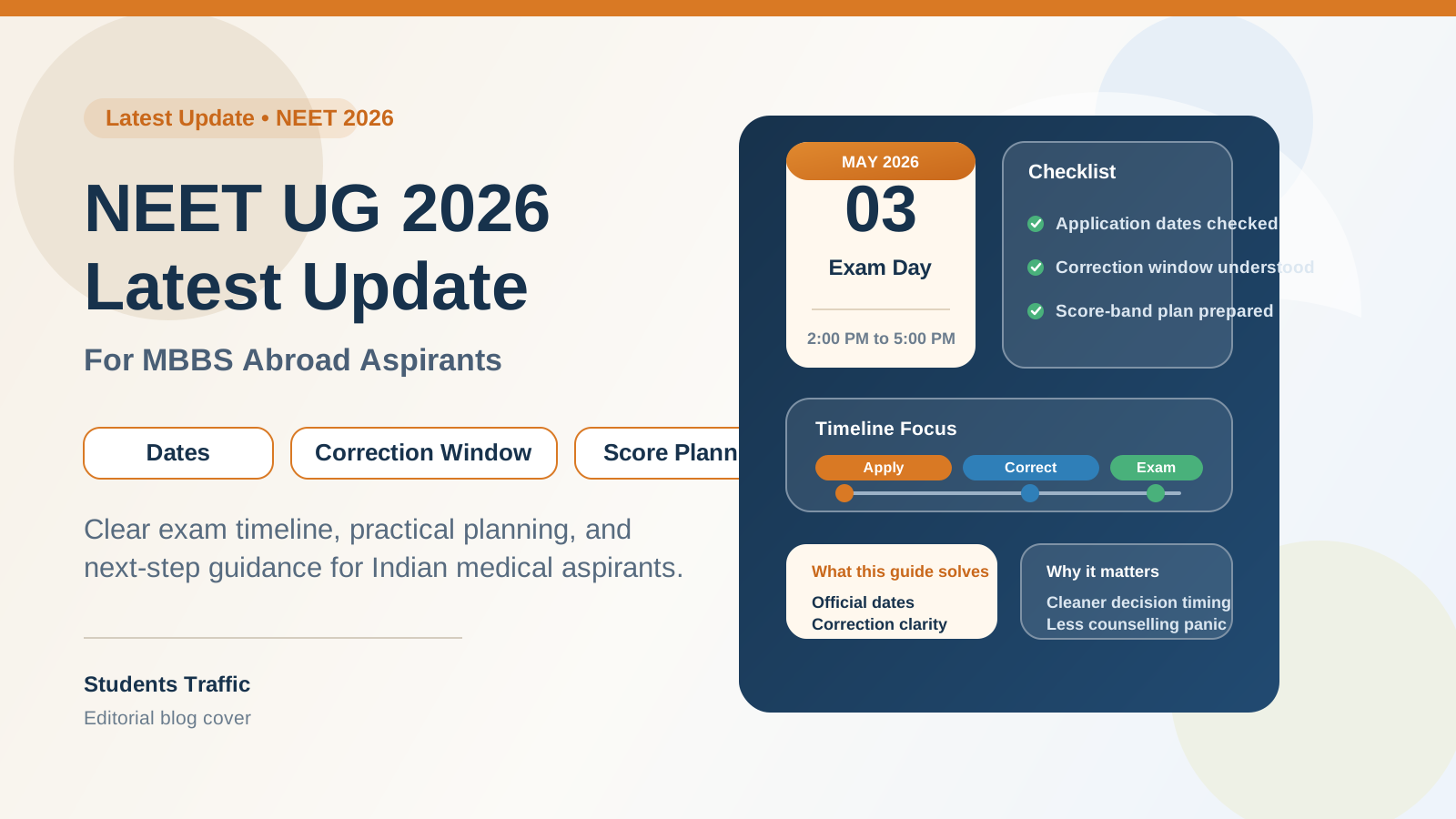
| Exam date | 03 May 2026 (Sunday) |
| Exam timing | 02:00 PM to 05:00 PM IST |
After that, the NTA issued a public notice dated 08 March 2026 extending the last date for application submission up to 11 March 2026, 09:00 PM, with fee payment allowed up to 11:50 PM on 11 March 2026.
Then another NTA public notice dated 11 March 2026 clarified the practical correction window for NEET (UG) 2026 as:
- from 12 March 2026, 12:00 hours
- to 14 March 2026, 23:50 hours
That later notice matters because many students still rely only on the earlier bulletin snapshot and miss the operational correction dates.
So the clean version is this:
- the application cycle has already closed
- the correction opportunity has already closed
- the exam is scheduled for 03 May 2026
- and students should now be in the execution phase, not the confusion phase
That sounds obvious, but many aspirants continue acting as if they have unlimited time.
They do not.
Why MBBS Abroad Students Must Take NEET Planning Seriously
A surprising number of students still treat NEET in the MBBS-abroad context as a formality:
- "I only need to qualify."
- "Abroad admission is easy anyway."
- "We will see after the result."
- "If India does not work out, we will go abroad."
That mindset creates weak decisions.
For students who may eventually study abroad, NEET still influences three major things:
1. Eligibility logic
For many India-return-minded families, NEET remains central to long-term safety. Even when the student studies outside India, the NEET outcome affects how securely the family thinks about documentation, legitimacy, and later return planning.
2. Decision quality
A stronger NEET result gives a family better negotiating power with reality. It does not automatically guarantee a government MBBS seat, but it changes the comparison:
- private MBBS in India vs abroad
- gap year vs immediate admission
- premium country vs budget country
- safer shortlist vs desperation shortlist
3. Counselling psychology
Students who enter the post-result period without a framework become easy targets for pressure selling. Agents, consultants, and random online advisors sound more convincing when the family has not already decided what score band means for them.
That is why the right NEET strategy for MBBS abroad aspirants is not:
"Wait for the result and then panic."
It is:
"Prepare score-based decision paths before the result arrives."
What the Closed Correction Window Means Now
If your application was submitted, the correction phase was the final opportunity to fix eligible fields.
That matters because many students think they can sort out mismatches later during counselling or visa processing. Sometimes they can. Sometimes they create avoidable pain.
NEET form mistakes can become stressful when they affect:
- candidate identity details
- date of birth consistency
- category details
- exam city choices
- Class 10 and Class 12 information
- signature or other uploaded items
Now that the correction window has passed, the practical task is no longer "Should I edit the form?"
The task is:
"Is all my identity, academic, and document data internally consistent for the rest of the year?"
That includes checking alignment between:
- Aadhaar or passport name
- Class 10 mark sheet
- Class 12 mark sheet
- NEET application details
- future passport issuance or renewal data
- and any admission documents you may later submit to Indian or foreign universities
Families underestimate how much damage small data mismatches can cause when the student later has to handle:
- invitation letters
- visa files
- university registration
- embassy formalities
- NMC-facing document trails
The NEET form is over. But the document discipline it demanded still matters.
The Single Biggest Mistake Families Make After the Application Window Closes
They wait passively.
Once the form is submitted, many students drift into a dangerous middle zone:
- not fully studying with exam urgency
- not fully preparing documents either
- not comparing destinations
- not estimating budget properly
- not discussing what happens if the score is lower than hoped
This period between application close and exam day is where smart families quietly get ahead.
Why?
Because the students who move early can do four things before the market gets noisy:
- define score-based decision paths
- gather documents while there is no panic
- compare India vs abroad more honestly
- reject weak universities before an agent sells them emotionally
That is why this phase should be treated as a planning window, not as empty waiting time.
A Better Way to Think About NEET 2026 If You May Study Abroad
Instead of treating NEET as a single yes-or-no event, think in layers.
Layer 1: Exam outcome
You need to know where your performance may realistically land:
- significantly above your current mock average
- around your current mock average
- moderately below your current mock average
This is not pessimism. It is planning.
Layer 2: India pathway
What does each likely score band mean for:
- government seat probability
- semi-government possibility
- deemed/private college options
- management quota affordability
- repeat-year logic
Layer 3: Abroad pathway
If India is not the right fit, what will you compare abroad?
- Russia
- Georgia
- Vietnam
- Kyrgyzstan
- Kazakhstan
- Philippines
- Bangladesh
- or another destination
Layer 4: Budget truth
The family's real budget must be discussed honestly:
- first-year payment capacity
- full 5.5 to 6 year commitment
- hostel and living cost tolerance
- travel budget
- emergency reserve
Layer 5: India-return plan
If the student studies abroad, what is the long-term objective?
- return to India after graduation
- keep multiple exam pathways open
- target only lower upfront cost
- or prioritize city comfort and English-medium marketing
Once these five layers are discussed, NEET becomes a decision anchor rather than a stress bomb.
The Official Dates Matter, But What Matters More Is What You Do Before 03 May 2026
The exam date is fixed for 03 May 2026. That gives students a finite runway.
The students who use that runway well usually work on two tracks at the same time:
Track A: Examination performance
- complete revision with a real timetable
- focus on mock discipline and error analysis
- build stamina for a full offline paper
- stop collecting random strategy advice every day
Track B: Post-exam readiness
- shortlist likely abroad destinations
- keep passport and identity documents ready
- gather Class 10, Class 12, NEET, and personal records
- understand budget bands instead of relying on one verbal quote
- identify which consultants are informative and which are purely sales-driven
Students often think this second track is a distraction.
In reality, it reduces future panic and helps the family avoid bad decisions after results.
What MBBS Abroad Aspirants Should Prepare Right Now
The most efficient families use the pre-exam and immediate post-exam window to create a clean document base.
Here is a practical list.
Academic records
- Class 10 mark sheet
- Class 12 mark sheet
- provisional Class 12 document if final certificate timing varies
- school leaving certificate if available later
Identity records
- Aadhaar card
- passport
- PAN card of parent if needed for financial workflows
- address proof
NEET-related records
- application details
- confirmation page if saved
- exam-related communications
- later admit card, score card, and result documents when issued
Personal records
- passport-size photos in usable digital format
- scanned signatures
- medical or vaccination records if later needed by a country or university
Finance readiness
- rough all-in budget sheet
- parent income documentation if education loan discussion is likely
- clarity on whether the family can manage first-year payment without distress
You do not need every final document before the exam. But you should know where everything is and whether anything important is missing.
NEET Score Planning: Do Not Wait for the Result to Start Thinking
One of the smartest things a family can do is create a score-planning framework before the result.
This does not mean predicting a rank precisely. It means deciding in advance how you will respond to a broad score outcome.
For example:
| Likely score situation | Better family response |
|---|---|
| Stronger-than-expected outcome | Compare India options carefully before rushing abroad |
| Mid-range outcome | Compare private India cost against safer abroad shortlists |
| Lower-than-expected outcome | Decide early between repeat attempt, abroad, or alternate health-science path |
Why does this matter?
Because once the result is released, parents and students start hearing extreme opinions:
- "Take anything now before seats disappear."
- "Do not waste a year."
- "This country is filling fast."
- "This university is your only safe option."
- "Budget will increase next week."
Families that have already discussed the score-to-decision logic are much harder to manipulate.
The India vs Abroad Comparison Should Be Started Before the Result, Not After
This is especially important for students who are not fully sure whether they prefer:
- private MBBS in India
- an abroad option with lower upfront tuition
- a gap year and repeat attempt
The comparison should cover at least these questions:
1. What is the six-year total cost?
Do not compare one year's tuition in India with one year's tuition abroad. Compare the full expected pathway:
- tuition
- hostel
- food
- flights
- visa
- insurance
- city-wise living cost
- emergency buffer
2. What is the academic environment?
Ask whether the student is genuinely suited to:
- a large Indian private college setting
- a strict and colder Russian environment
- a more premium but costlier Georgia setting
- a developing Vietnam pathway with hospital-language questions
- a tighter-budget Kyrgyzstan route
3. What is the India-return confidence?
Families should never ask only, "Can we get admission?"
They should ask:
"If the student completes this degree, how cleanly does the return pathway fit the family's long-term plan?"
4. What kind of support does the student need?
Some students adapt well anywhere. Others need:
- stronger peer support
- bigger Indian community
- calmer city environment
- more guided first-year transition
That has real implications for country choice.
Students Must Not Confuse "Admission Availability" With "Good Decision"
This is one of the most dangerous post-NEET traps.
After NEET, many students are shown an easy-looking pipeline:
- send documents
- pay booking amount
- receive offer letter
- start visa process
When a process feels simple, the family assumes the decision is safe.
But safe admission and easy admission are not the same thing.
A good abroad decision should survive questions like:
- Which exact university are we joining, and why this one?
- What is the full six-year cost, not just year-one cost?
- What is the medium of teaching in classrooms and in clinical settings?
- What is the hospital pathway and internship structure?
- What documents should we preserve from day one for future compliance?
- What happens if the student struggles academically or wants to transfer?
- How large is the current Indian student ecosystem?
- Are we choosing by fit, or simply because the score was disappointing?
Families that skip those questions are often the same families who say a year later:
"We did not know this part."
Usually the problem is not that the information never existed.
The problem is that the decision was made too fast.
A Practical Month-by-Month Plan From Now
Since the exam is on 03 May 2026, students should think in short windows.
From now until exam day
- study with full seriousness
- reduce information overload
- keep your documents organized
- avoid committing to any university out of fear
- shortlist likely countries quietly in the background
Immediately after the exam
- do not sign up emotionally based on how the paper felt
- note the paper difficulty and your own performance honestly
- prepare to compare options once answer-key clarity improves
Around answer key and score phase
- compare actual likely score against your earlier plan
- start country shortlisting only after your decision framework is clear
- if considering abroad, evaluate 3 to 5 universities seriously, not 20 names casually
Around counselling season
- keep India and abroad options in the same spreadsheet
- do not let urgency kill due diligence
- review refund rules and booking-amount terms carefully
This is how families stay strategic instead of reactive.
What Parents Need to Understand Right Now
Parents often become most anxious during this stage because the future still feels open-ended.
That anxiety is understandable. But it should not push the family into one of two bad extremes:
- ignoring abroad completely until NEET results arrive
- or emotionally pre-booking a university before proper comparison
The healthier parent role is different:
Be honest about budget
Do not say "We will somehow manage" unless you have actually tested the numbers. A weak budget conversation creates stronger sales pressure later.
Be honest about the student's profile
Some students are resilient and adaptable. Some need more structure. Some genuinely want medicine. Some mainly want to avoid a drop year. These differences matter.
Do not let social comparison drive the decision
Another student's NEET score, admission choice, or country path should not become your family's decision model.
Separate urgency from importance
Urgent tasks will come later: applications, visa steps, payments.
Important tasks are happening now:
- understanding options
- defining score bands
- gathering documents
- identifying risky advice
The families that do the important work early usually handle the urgent work better later.
The Three Most Common Wrong Reactions to NEET Uncertainty
Wrong reaction 1: "We will think about it after the result"
This sounds sensible but usually creates rushed decisions. If the family has not compared pathways earlier, the result week becomes emotionally expensive.
Wrong reaction 2: "Abroad is always the backup"
Abroad is not one single backup option. It is a group of very different countries, university types, fee structures, and risk profiles. Treating all foreign options as interchangeable is a serious mistake.
Wrong reaction 3: "Any low-fee option is fine if the score is low"
Low fee does not automatically mean good value. Sometimes the cheapest option becomes the most stressful six-year experience if the university fit is poor, the support is weak, or the family did not think about the India-return pathway.
If You Already Know You May Choose MBBS Abroad, Here Is the Smartest NEET Strategy
- Take NEET seriously as a core milestone, not as a symbolic formality.
- Keep every academic and identity document clean and consistent.
- Build a score-based decision plan before results.
- Compare full six-year costs, not headline tuition alone.
- Shortlist universities only after comparing country-level fit and student-level fit.
- Refuse pressure selling built around artificial urgency.
That combination gives students the best chance of making a calmer and safer decision after the NEET cycle moves forward.
Final Takeaway
The most useful thing about the official NEET UG 2026 dates is not the dates themselves. It is the planning discipline they force on you.
As of April 5, 2026, the most important facts for MBBS abroad aspirants are simple:
- the application cycle is over
- the correction window has closed
- the exam is scheduled for 03 May 2026
- and the smartest students are using the remaining time to prepare both for performance and for post-exam decision-making
If you may choose MBBS abroad, this is the right time to become more systematic, not more anxious.
Do not wait until the result week to think about:
- country choice
- budget fit
- documentation
- India-return planning
- and what your score will actually mean for the family
The students who handle those questions early usually make stronger choices later.
Frequently Asked Questions
Q: What is the official NEET UG 2026 exam date?
As of April 5, 2026, the NTA information bulletin lists 03 May 2026 (Sunday) as the NEET (UG) 2026 exam date, with exam timing from 02:00 PM to 05:00 PM IST.
Q: When did the NEET UG 2026 application window close?
The bulletin listed 08 March 2026 as the original last date, but the NTA later extended application submission up to 11 March 2026, 09:00 PM, with fee payment allowed until 11:50 PM on 11 March 2026.
Q: What was the NEET UG 2026 correction window?
The bulletin originally listed 10 March 2026 to 12 March 2026, and the later NTA correction notice operationally opened the correction facility from 12 March 2026 (12:00 hours) to 14 March 2026 (23:50 hours).
Q: Is NEET still important if I want to do MBBS abroad?
Yes. NEET remains an important decision anchor for Indian students considering MBBS abroad, especially when the family wants a cleaner long-term path and better post-result decision quality.
Q: What should I do now if I may choose MBBS abroad after NEET 2026?
Focus on the exam first, but also prepare your documents, define score-based decision paths, compare full-budget country options, and avoid waiting until counselling chaos begins to start your research.
Related: MBBS Abroad Admission Process 2026 | MBBS Abroad vs Private MBBS in India 2026 | Education Loan for MBBS Abroad 2026 | NMC Eligibility Certificate Guide
How Students Traffic Can Help After NEET 2026
Students Traffic helps students turn a NEET score into a practical decision, not a panic decision. That means comparing private MBBS in India, Russia, Georgia, Vietnam, Kyrgyzstan, and other options through the lens of total cost, document readiness, India-return planning, and university-level risk.
If you want a shortlist built around your likely score, budget, and long-term plan, use Students Traffic's counselling support and peer connect before you pay any booking amount.