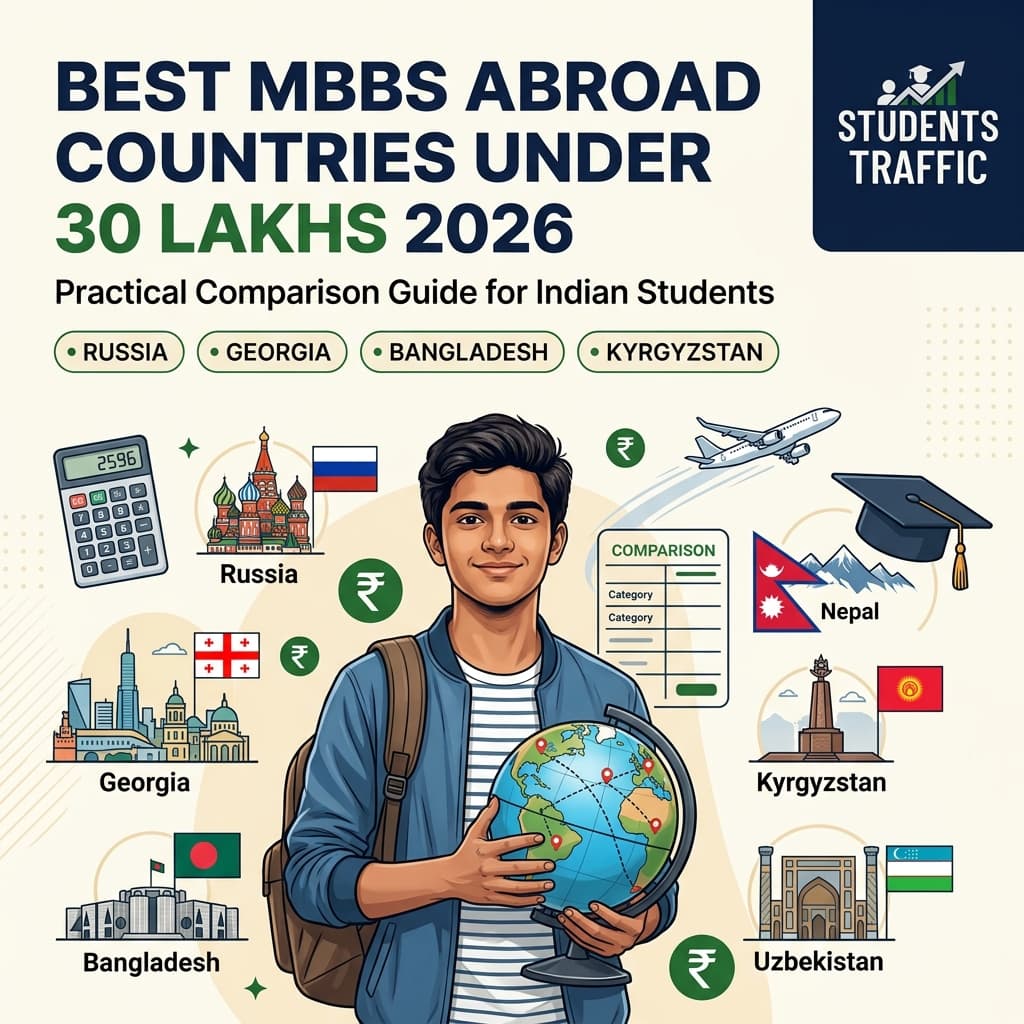
Best MBBS Abroad Countries Under 30 Lakhs in 2026: Practical Comparison Guide for Indian Students
"Under 30 lakhs" is one of the most common starting points in MBBS abroad enquiries from Indian families.
That number is emotionally important because it feels like a ceiling that might still keep the foreign-study dream alive without pushing the family into dangerous financial stress.
But budget-based searches also create one of the biggest traps in the market.
When families search for the best MBBS abroad countries under 30 lakhs, many of them are not actually being shown the best options. They are being shown the easiest-to-sell options. The difference matters.
The easiest-to-sell option is usually the one with the most attractive headline price. The best option is the one that still makes sense after you include total cost, academic reality, lifestyle fit, documentation discipline, language environment, and India-return planning.
So this guide takes a different approach.
Instead of promising magical low-cost solutions, it explains how Indian families should think about the under-30-lakh budget in 2026 and which countries deserve serious consideration within or around that range.
The first truth: "under 30 lakhs" only works if you define the budget honestly
Many MBBS abroad packages look affordable because they are presented incompletely.
A family hears one number and assumes that number covers the full journey. Later, new costs appear:
- hostel deposits
- annual inflation
- food and personal living expenses
- visa and documentation charges
- travel
- medical insurance
- exam-related expenses
- local registration costs
- emergency reserve
That is why the phrase "under 30 lakhs" should always mean one of two things:
- under 30 lakhs in a conservative real-world estimate
- under 30 lakhs in a narrow tuition-only sales estimate
These are not the same.
If the family does not clarify which one is being quoted, they are not comparing countries accurately.
A better way to build the budget
Instead of asking for one total number, divide the cost into categories:
Tuition and university-linked academic charges
This is the obvious part, but not the whole story.
Hostel and accommodation
Sometimes the hostel assumption in a brochure is more optimistic than the actual student experience.
Food and daily living
Some cities and student lifestyles raise the real cost more than families expect.
Documentation and travel
Tickets, visa processes, local permits, and document handling add up.
Academic buffer and emergency reserve
This matters because families rarely regret keeping a buffer, but they often regret pretending none is needed.
Once the family builds the budget this way, country comparison becomes much more intelligent.
What kind of countries usually enter the under-30-lakh conversation?
For Indian students in 2026, the under-30-lakh discussion often includes some or all of the following:
- Kyrgyzstan
- Uzbekistan
- Kazakhstan in selected scenarios
- some Russia pathways, depending on currency and institution
- a few other lower-cost or mid-cost options marketed aggressively
Countries like Bangladesh, Nepal, Georgia, Egypt, or China may enter the wider comparison set, but they are not always a true under-30-lakh fit once families calculate conservatively. Sometimes they belong in the "stretch budget" or "different value bracket" conversation instead.
This is important because families should not force a country into the wrong budget category just because they emotionally prefer it.
How to judge a budget country without becoming penny wise and career foolish
A lower-cost destination can still be a strong destination. But price should never be the only reason to choose it.
When families evaluate a budget-focused option, they should ask:
- Is the university structurally believable?
- What is the language environment in classes and clinics?
- What is the quality of hostel and student support?
- How stable is the academic system?
- What does the city feel like for an Indian student?
- How strong is the documentation trail?
- What are the trade-offs compared with spending more?
In other words, cheap is not automatically smart and expensive is not automatically better. The right decision comes from matching budget to trade-offs consciously.
Country-by-country thinking for under-30-lakh planning
Kyrgyzstan
Kyrgyzstan frequently appears in low-budget MBBS abroad conversations because the overall cost can feel accessible compared with some other countries.
Why families consider it:
- comparatively budget-friendly pathway
- large market familiarity among Indian students
- many agents actively selling it
- relatively predictable positioning in the "affordable MBBS abroad" category
What families must verify:
- which exact university is being recommended
- how serious the academic environment feels in practice
- hostel standards and city reality
- language and clinical exposure questions
- whether the family is choosing it because it is suitable or simply because it is affordable
Kyrgyzstan can work for students whose budget is constrained and whose expectations are realistic. It becomes dangerous when families convince themselves that a low-cost path has no trade-offs.
Uzbekistan
Uzbekistan attracts families who want a destination that may feel slightly more structured or less over-saturated in conversation than some other budget options, though experiences still vary by institution.
Why families consider it:
- often positioned as comparatively affordable
- can appear more organized in some discussions
- attracts families who want a lower-cost route without blindly following crowd behavior
What families must verify:
- institution-level quality
- medium of instruction reality
- hostel and city fit
- consistency of student support
- how the program looks from an India-return planning perspective
Uzbekistan can be a thoughtful choice when it is chosen through comparison, not hype.
Kazakhstan
Kazakhstan may enter the under-30-lakh bracket in certain pathways and deserves comparison, but the conversation should remain institution-specific.
Why families consider it:
- sometimes seen as a practical middle ground
- can enter affordability conversations depending on the university and currency situation
- may attract families looking for alternatives to more crowded agent narratives
What families must verify:
- actual total budget rather than headline price
- quality and seriousness of the recommended university
- language and adaptation challenges
- hostel and administration reliability
Kazakhstan is a reminder that a country should not be accepted or rejected solely on social-media volume.
Russia in selected budget cases
Russia is not always an under-30-lakh answer, but some institutions and currency situations may place it into the conversation for some families.
Why families still look at it:
- long-standing medical education visibility
- strong recognition in the MBBS abroad market
- wide range of institutions and city types
What families must verify carefully:
- real current cost in Indian rupee terms
- city-specific living expenses
- geopolitical comfort level of the family
- language-learning expectations
- whether the specific university actually fits the student's budget and temperament
Russia should never be treated as one monolithic budget answer. The spread between institutions and cities matters too much.
Countries that are often compared but may sit above this budget
Families should also know what usually falls outside or at the edge of the under-30-lakh frame.
Bangladesh
Bangladesh can be attractive for proximity and perceived academic seriousness, but it often belongs in a different budget conversation for many families.
Nepal
Nepal may appeal emotionally because it is nearby and familiar, but it is usually not a straightforward "under 30 lakhs" choice in the way aggressive sales content suggests.
Georgia
Georgia may attract students for environment and presentation quality, but it often competes in a higher budget band.
Egypt and China
These destinations can be interesting for some families, but they are not usually the first answer for a strict under-30-lakh ceiling.
This matters because a lot of student disappointment comes from confusing preference with feasibility.
The five trade-offs budget-conscious families must face honestly
1. Lower budget may mean fewer premium comforts
The student may need to compromise on hostel finish, city convenience, room configuration, or personal comfort.
2. Lower budget may increase the importance of self-discipline
When the family cannot buy prestige, they must buy clarity. The student has to compensate with seriousness, routine, and careful university choice.
3. Lower budget options require stronger verification, not weaker verification
Because the price is attractive, the family should become more careful, not less.
4. Language and adaptation should never be ignored
Some lower-budget pathways become stressful not because the tuition was wrong, but because the day-to-day academic and clinical environment was not understood.
5. Saving money upfront can be expensive if the university choice is weak
A poor fit wastes not only money, but also time, confidence, and career momentum.
How families should shortlist under-30-lakh options in 2026
A smart shortlist should include no more than a few serious candidates at first.
Use this process.
Step 1: Define the real budget, not the dream budget
Decide whether 30 lakhs means an absolute ceiling or a comfortable working range with a small buffer.
Step 2: Decide your non-negotiables
Examples:
- nearby travel
- lower language friction
- stronger hospital environment
- better hostel standards
- more predictable administration
Once non-negotiables are clear, many countries drop out naturally.
Step 3: Compare countries by trade-offs, not by slogans
Every country has strengths and compromises. The goal is not to find a perfect country. The goal is to find the most acceptable trade-off set for your student.
Step 4: Compare universities, not just countries
Two universities in the same country can create completely different student experiences.
Step 5: Pressure-test the India-return path
Do not wait until later to ask the hard questions about structure, documentation, and long-term risk.
Red flags in low-budget MBBS abroad marketing
Families should be cautious when they hear:
- "This is the cheapest and the best"
- "No need to worry about future licensing"
- "This is fully approved, just trust us"
- "Everyone goes there, so it is safe"
- "Pay now because seats will close in a few hours"
Any serious medical education decision that depends on panic marketing is already on weak ground.
Three sample student profiles and how budget changes the answer
Profile 1: strict budget, high adaptability
This student is disciplined, can live simply, and comes from a family that understands trade-offs clearly. For this student, a lower-cost country may work if the university is carefully verified and the family stays realistic about comfort and prestige.
Profile 2: strict budget, low adaptability
This student struggles with change, routine, or independent living. In this case, the cheapest available option may become a false economy because lifestyle stress can damage academic performance.
Profile 3: flexible budget, strong need for confidence
This family may begin by searching under 30 lakhs, but after comparison they realize that spending slightly more for a better-fit environment creates less long-term risk. That can be a smarter move than forcing the original number.
These profiles show why no budget article should be read as a universal ranking.
A budgeting worksheet families should complete before shortlisting
Create a simple worksheet and compare every country using the same headings:
- tuition
- hostel
- food and personal living
- travel
- visa and documentation
- emergency buffer
- likely yearly increase
- total five-to-six-year comfort level for the family
Then add another section:
- language challenge
- clinical environment confidence
- city comfort
- student maturity fit
- India-return confidence
Once families put budget and fit on the same page, weak options usually expose themselves.
How Students Traffic-style counselling should differ from package-selling
Package-selling starts with the country that is easiest to push.
Real counselling starts with:
- student profile
- budget truth
- family risk tolerance
- regulation awareness
- shortlisting by fit
That difference matters because the under-30-lakh search segment is full of emotionally vulnerable families. They are often worried, hopeful, and afraid of missing the MBBS dream. Good counselling protects them from being sold urgency when what they really need is structure.
Frequently asked questions about MBBS abroad under 30 lakhs
Can under 30 lakhs still lead to a good MBBS abroad decision?
Yes, but only if the family understands the trade-offs and does not mistake "possible" for "automatically wise."
Should we choose the country with the lowest total package?
Not by default. The lowest package may come with academic, lifestyle, or documentation compromises that are not obvious at first.
Is it smarter to stretch the budget a little for a better-fit country?
Sometimes yes. A modest stretch for clarity and stability can be smarter than forcing an uncomfortable budget choice.
Can a budget country still give a serious academic experience?
Yes, but it depends heavily on the exact university and the student's discipline.
Should parents be worried if every conversation is only about money?
Yes. If the counselling process barely discusses language, hostel life, clinical learning, or India-return planning, the family is not seeing the full picture.
What families should do after creating the first shortlist
Once the family has identified a few countries in budget, the work is only half done.
The next stage should look like this:
Compare institutions inside each country
Do not stop at country-level comfort. Ask which specific universities are being recommended and why.
Ask for a conservative total-budget estimate
A good estimate should include known extras and some buffer. If the number looks too neat, ask what has been left out.
Speak to current students
Ask about routine, hostel life, city comfort, academic seriousness, and what they wish they had known before joining.
Check your own family stress tolerance
Some families can handle uncertainty better than others. That matters. A country that is workable on paper may still be a poor fit if the family will remain anxious for six years.
Decide what trade-off you are most willing to accept
Do you prefer lower cost with simpler living conditions? Slightly higher cost with better comfort? Lower travel friction? Better city environment? Clarity here makes the final choice easier.
Final shortlist rule: never let the cheapest option win by default
The cheapest option should win only if it also survives the fit test.
That means:
- the student can adapt
- the university has been checked carefully
- the family accepts the comfort level
- the language environment is understood
- the long-term pathway still feels defensible
If those conditions are not met, the cheapest option is not actually cheaper. It is simply a hidden-risk option.
Parent mistakes that quietly break budget planning
Sometimes the budget itself is not the problem. The planning behavior is.
Here are a few mistakes that create avoidable stress:
Mistake 1: starting with the child of a family friend instead of starting with your own student
Just because another student managed a certain country on a certain budget does not mean your child should follow the same path.
Mistake 2: using optimism as a budgeting strategy
Some families build the plan assuming there will be no extra costs, no travel surprises, and no personal adjustment expenses. That is not budgeting. That is hoping.
Mistake 3: not reserving money for emotional comfort
A student living abroad may sometimes need better food access, occasional travel, healthcare spending, or a more comfortable living arrangement than originally expected. Ignoring this can make a manageable course feel much harder.
Mistake 4: choosing a country just to stay under the number
If the country is a poor fit, staying under the number may not be a victory at all.
If your budget is close to 30 lakhs, ask this before locking a country
Would we rather:
- stay strictly under budget with more trade-offs, or
- stretch slightly for a stronger-fit institution if it reduces long-term stress?
There is no universal right answer. But families should answer it consciously. Hidden stretching is dangerous. Conscious stretching, when affordable, can sometimes be smarter than pretending the strict ceiling is working when it is not.
What makes a country truly "best" under 30 lakhs?
The best country is not the one with the smallest number on paper.
The best country is the one where:
- the full budget is believable
- the student can adapt
- the university is credible
- the trade-offs are understood
- the family can sustain the decision emotionally and financially
- the long-term pathway still looks defensible
For one family, that may be Kyrgyzstan.
For another, Uzbekistan may feel more balanced.
For another, stretching the budget slightly for a stronger-fit institution may actually be the wiser decision.
This is why ranking articles can only do so much. Real counselling begins where generic ranking ends.
A realistic 2026 mindset for Indian families
If your ceiling is under 30 lakhs, do not feel embarrassed by that. It is not a weak position. It is simply a constraint that should shape a smarter decision.
The danger is not having a budget.
The danger is pretending a constrained budget can buy a premium result without trade-offs.
Families who succeed with budget-oriented MBBS abroad planning do three things well:
- they compare honestly
- they document carefully
- they choose a student-fit option instead of chasing the loudest marketing campaign
Final verdict
The best MBBS abroad countries under 30 lakhs in 2026 are not defined by marketing popularity alone. They are defined by whether the student can realistically live, study, adapt, and complete the long path responsibly within that financial ceiling.
If you are searching in this budget band, treat the process like a comparison exercise, not a bargain hunt.
Under-30-lakh planning can absolutely lead to a workable MBBS abroad decision. But only when the family stays disciplined enough to ask the next question after price:
What exactly am I getting for this budget, and what trade-offs am I accepting in return?
That question protects families better than any country-ranking headline ever will.
How Students Traffic Can Help You Build a Budget-First Shortlist
Budget-based decision-making is where Students Traffic can add the most value. Instead of starting with a random country name, we help families compare total cost, academic match, language fit, risk level, hostel reality, and India-return practicality across multiple destinations in one place.
If you want a shortlist that matches your actual budget instead of a sales pitch, use Students Traffic counselling support and peer connect to compare real options before paying an admission amount.
Related: MBBS Abroad | Contact Students Traffic | Talk to Students Abroad