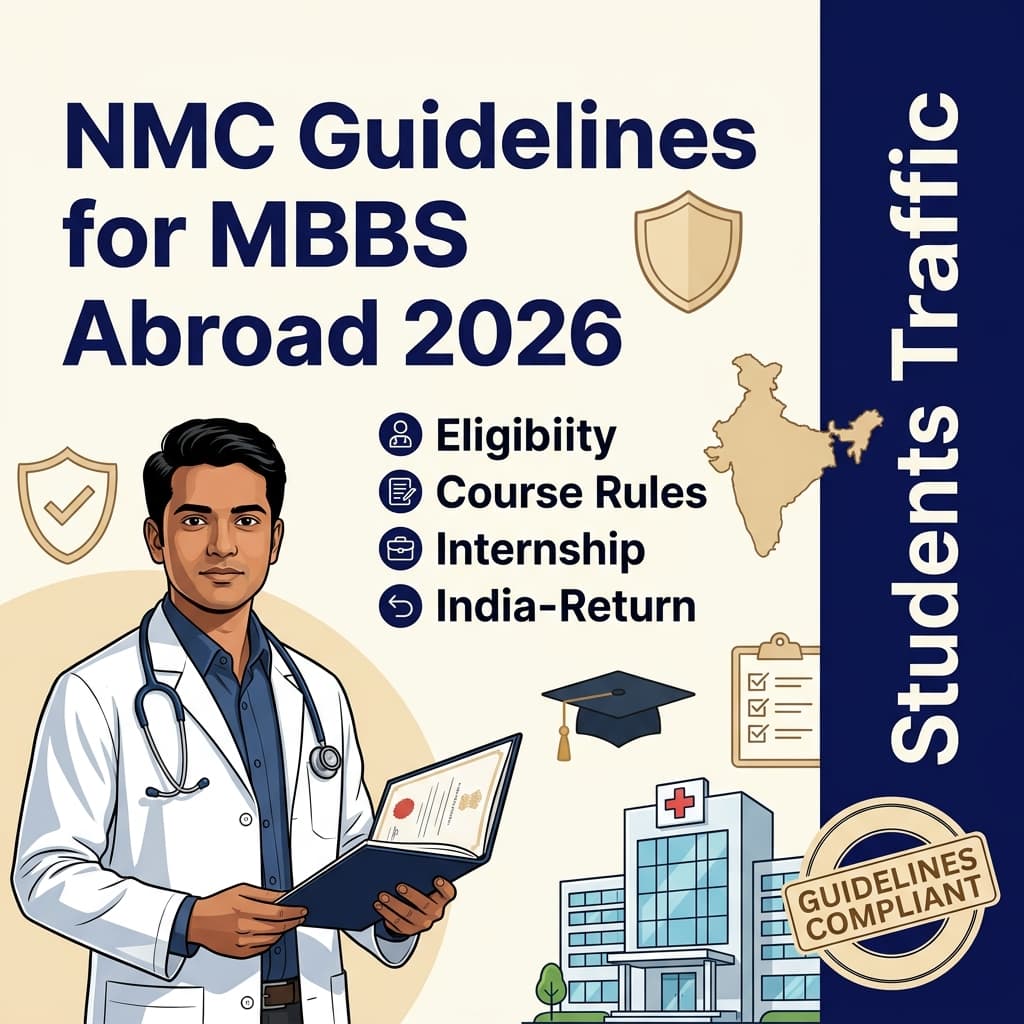
NMC Guidelines for MBBS Abroad 2026: Complete Guide for Indian Students
If there is one area where Indian families should be extremely careful before choosing MBBS abroad, it is regulation.
Most admission mistakes do not begin with a bad brochure. They begin with a weak understanding of the rules. A family hears a partial explanation, assumes the university is acceptable because "students are already there," and moves forward without fully understanding what the National Medical Commission expects from a foreign medical graduate who eventually wants to practice in India.
That gap between marketing and regulation is where long-term damage happens.
So this guide is built around one simple goal: helping Indian students and parents understand how to think about NMC guidelines in 2026 before paying any admission amount.
This is not legal advice. It is a practical decision guide based on the current public NMC framework that families should use to ask sharper questions.
As of April 9, 2026, two official realities remain especially important.
First, the NMC's "For Students to Study Abroad" page continues to say that the Commission does not endorse any list of foreign medical institutions or universities for MBBS or equivalent study abroad. That means families should stop asking, "Which countries are NMC approved?" as if there is a magic official recommendation list that removes all risk.
Second, an NMC public notice published last month warned against foreign institutions issuing so-called compensation certificates without genuinely extending study duration and physical training where compensation was supposedly granted. That matters because it shows the regulator is not interested in cosmetic paperwork. It is looking at whether the education structure is genuinely comparable and compliant in substance, not just in marketing language.
Those two points alone should change how families approach MBBS abroad.
The first big myth: there is no universal "NMC approved country" shortcut
Families often ask:
- Which country is NMC approved?
- Which university is NMC approved?
- Can you give the official approved list?
This framing is risky because it invites oversimplification.
The safer way to think is this:
NMC does not give you a shortcut that replaces due diligence. Instead, it gives you a regulatory framework you must satisfy. The student's foreign degree pathway needs to align with that framework if the student wants to seek registration and practice in India later.
That means the family has to verify the actual university, actual course structure, actual training pattern, actual documentation, and actual long-term implications.
If an agent answers a complex regulation question with a one-line slogan, the family should slow down immediately.
Why NMC rules matter even before admission
Some students think regulations become important only after graduation. That is too late.
NMC rules matter before admission because the wrong decision made in the first month can create a structural problem six years later.
For example:
- if the student joins without satisfying required eligibility conditions
- if the course structure is not aligned with the expected duration and training pattern
- if the medium of instruction and academic pathway are not understood properly
- if internship assumptions are wrong
- if the documentation trail is weak
- if the university is being sold based on reputation while the compliance details are vague
then the student may discover the risk only after investing years of effort and a major family budget.
That is why serious counselling starts with regulation, not with destination glamour.
Core NMC ideas every MBBS abroad family should understand
Let us simplify the framework into decision language.
1. NEET is not optional for the Indian student who wants the India-return path
For Indian citizens and OCI candidates pursuing a primary medical qualification abroad, NEET qualification has long been tied to eligibility logic for those intending to return to India. Families should not treat this as a minor formality.
If a student is being told not to worry about NEET because "admission can still happen," that is exactly the kind of sentence that should make parents cautious. Admission abroad and long-term practice eligibility in India are not the same conversation.
2. The foreign medical qualification must be valid where it is awarded
A foreign degree cannot simply look official on paper. It has to be a qualification recognized for enrolment as a medical practitioner in the country where the institution is located. Families should verify this carefully and document what they verified.
3. The course should be commensurate with the Indian MBBS structure
This is where many students underestimate the seriousness of the rule. The issue is not merely whether classes are happening. The issue is whether the education structure, duration, clinical training, and subject coverage are broadly aligned with what is expected under the regulatory framework.
4. English-medium expectations matter
The language of education is not a decorative brochure point. It affects both regulation and academic survival. Families should clearly understand how teaching happens, what role local language plays in patient interaction, and whether the student can genuinely cope.
5. Internship and clinical training are not paperwork afterthoughts
A medical degree is not only about classroom years. Clinical training and internship logic matter deeply. The family should never assume that "some certificate later" will solve structural gaps.
The Foreign Medical Graduate lens: what NMC is really trying to avoid
If we translate the regulatory philosophy into plain language, NMC is trying to prevent weak shortcuts from entering the professional pipeline.
The broad concern is simple:
India does not want someone to study through a pathway that is too short, too diluted, too poorly structured, insufficiently clinical, badly documented, or detached from the expected professional standard and then claim equivalence only at the end.
Once families understand that, many confusing marketing claims become easier to evaluate.
For example, if a university is attractive mainly because:
- admission sounds very easy
- fees sound unusually low without explanation
- duration sounds compressed
- internship details are hand-wavy
- the language pathway is glossed over
- the representative keeps saying "don't worry, everyone does it"
then the family is probably looking at the situation from a sales angle, not a regulatory angle.
The 54-month idea and why duration cannot be treated casually
Under the regulatory framework and related explanatory material, course duration is not a casual matter. Families should understand whether the medical course plus internship or clerkship structure genuinely satisfies the expected educational arc.
This matters because duration is not just time on a calendar. It reflects depth of training, sequence of subjects, clinical exposure, and academic maturity.
If a course looks too short, too fragmented, or too creatively explained, the family should not rely on verbal assurances. Ask for written academic structure. Ask how many months are spent in theory, practical training, clinical training, and internship. Ask whether anything depends on later "adjustment" documents.
When the answers become unclear, risk begins.
The recent NMC caution about "compensation certificates"
This is one of the most important current signals for 2026.
In the public notice issued last month, NMC warned that some foreign institutions were issuing compensation certificates without genuinely extending the period of study and without ensuring that the additional training happened in physical mode. The notice emphasized that this undermines the intent of the FMGL framework.
Why should families care?
Because it tells you the regulator is not easily impressed by cosmetic paperwork.
If a university or consultant suggests that any structural deficiency can be "managed later" through an adjustment certificate, families should treat that as a major warning sign. A weak academic structure cannot be safely repaired by clever wording after the fact.
This is exactly why documentation should be verified before admission, not repaired after graduation.
Internship questions families must ask before selecting a university
Internship is one of the most misunderstood parts of MBBS abroad planning.
Parents often ask about tuition, hostel, and visa, but forget to ask:
- Where does internship happen?
- Is it integrated into the course structure in the way that matters?
- How is clinical exposure built progressively?
- What proof and documentation will exist?
- How does this align with the India-return pathway?
Internship should not be treated as an afterthought. A medical graduate is expected to show not only academic completion but serious clinical preparation. That is why vague answers are not enough.
If the university-side explanation sounds inconsistent across different people, the family should not move fast.
The medium of instruction trap
Another common family mistake is assuming that "English medium" means the entire learning and hospital environment will be frictionless.
The smarter approach is to separate three questions:
- In what language are core academic classes taught?
- In what language do students interact in clinical environments?
- Can this specific student realistically function in both academic and practical settings?
Some destinations may technically market English-medium instruction but still require local-language adaptation for patient interaction. That does not automatically make the university bad, but it does mean the family must be realistic about the student's ability to adapt.
The most damaging decisions happen when parents choose a destination on the assumption that the language challenge is negligible, only to discover later that the student struggles in clinical learning settings.
NExT, FMGE logic, and why families should avoid false certainty
The licensing landscape for foreign medical graduates has been shaped by the transition conversation from screening-test-era language toward the National Exit Test framework. Families often hear confident claims from the market about exactly what will happen and when. That confidence is frequently exaggerated.
The correct approach is to avoid false certainty.
Families should operate with humility and planning discipline:
- understand the current framework
- track official updates
- keep documentation impeccable
- choose structurally stronger universities
- avoid admission decisions that depend on optimistic loophole theories
If the entire sales pitch works only when future regulatory interpretation becomes unusually convenient, that is not a strong decision.
How to verify a foreign university through an NMC lens
Families should build a verification checklist and not rely on emotion.
Academic structure
Ask for the official course structure, duration, subject mapping, and training sequence.
Recognition in the home country
Verify whether the qualification is recognized for registration or enrolment as a medical practitioner in the country where it is awarded.
Medium of instruction
Get clarity in writing about how the program is taught and what language expectations exist in hospital settings.
Internship and clerkship pathway
Ask where, how, and for how long clinical training and internship happen. Ask what documentation is issued.
Website and curriculum transparency
One important regulatory principle is that the curriculum should be publicly available and properly documented. Weak transparency is not a good sign.
Paper trail
Store everything:
- admission letters
- invoices and payment proofs
- curriculum screenshots or PDFs
- internship documentation
- university email confirmations
- visa and travel records
Clean documentation can become extremely important later.
Common regulatory mistakes that create future pain
Mistake 1: choosing the cheapest available seat without asking structural questions
Low price can be attractive, but a low price without compliance clarity is dangerous.
Mistake 2: relying only on the existence of current Indian students
A university having Indian students does not automatically mean every current and future regulatory concern is solved.
Mistake 3: assuming country reputation equals university compliance
No country label replaces institution-level verification.
Mistake 4: believing verbal promises about future documentation fixes
If the resolution depends on "we will manage later," families should worry now.
Mistake 5: not planning for India return from day one
The family must think backward from future registration and practice goals before the student ever leaves India.
How parents should talk to consultants about NMC rules
Parents often feel intimidated by regulatory jargon. They should not.
A good consultant should be able to explain:
- why the university is being recommended
- how the course structure aligns with current expectations
- what the risks are
- what is still uncertain
- what documents the family should preserve
If the consultant becomes irritated when asked detailed compliance questions, that is useful information. Good advisers respect caution. Weak advisers try to outrun it.
A practical self-audit every family should do before admission
Before choosing a foreign medical university, families should sit down and do a written self-audit. This is one of the easiest ways to reduce expensive confusion later.
Write down answers to these questions:
- What is our exact reason for choosing MBBS abroad?
- What is our realistic total budget, not our optimistic budget?
- What level of uncertainty are we actually comfortable with?
- Is the student ready for a demanding medical program away from home?
- Which regulatory points are fully clear to us and which are still vague?
- Are we choosing this university because it is genuinely strong or because the consultant made it sound easy?
If these answers are still messy, the family should not interpret that discomfort as weakness. It is useful information. It means more work is needed before commitment.
The difference between a compliant-looking file and a compliant education
This distinction matters enormously.
Some families feel reassured when they receive PDFs, admission letters, and verbal confirmation that "everything is NMC compliant." But the regulatory issue is not whether the file looks complete. The deeper issue is whether the education pathway itself is structurally sound.
A compliant-looking file may include:
- a polished admission letter
- a university website
- a fee chart
- a curriculum page
- friendly verbal reassurance
But a compliant education requires more:
- correct eligibility before joining
- proper duration
- real academic delivery
- real clinical exposure
- real internship structure
- proper recognition in the awarding country
- proper documentation of what actually happened
Families should train themselves to distinguish between polished presentation and structural strength.
How regulation should influence country comparison
Many students compare countries by comfort, budget, weather, or popularity. That is natural, but incomplete.
Regulation should also shape comparison.
For example, when comparing two countries, parents should ask:
- which destination creates fewer unanswered questions about language and clinical training?
- which destination gives the strongest documentation confidence?
- which specific universities look more transparent about academic structure?
- where are we being asked to trust verbal promises the most?
This approach often changes the shortlist. A country that looked exciting in the first call may start looking fragile once the regulatory lens is applied. That is good. The filter is working.
What a healthy decision sounds like
By the time a family is close to a good decision, the conversation usually sounds calm.
They can explain:
- why this university fits the student
- what the known trade-offs are
- how the budget will be managed
- what documents they have preserved
- what remains uncertain and how they plan to monitor it
An unhealthy decision usually sounds different. It is built around phrases like:
- "The agent said not to worry"
- "Everyone is going there"
- "We will manage later"
- "At least admission is happening"
The more the family hears those phrases, the more caution they should bring into the process.
Questions worth asking a university directly
If a family wants to be especially careful, it should send some questions to the university itself instead of relying only on representatives.
Useful questions include:
- What is the full duration of the program and how is it structured?
- In which language are classes conducted?
- In which language does patient interaction typically happen?
- How is clinical training organized?
- How is internship organized and documented?
- Is the qualification recognized for registration in your country?
- Where can we review the official curriculum and academic calendar?
Even if replies are brief, the process helps the family collect evidence and assess transparency.
Frequently asked NMC-rule questions from parents
If a university says it is "approved," should we trust that phrase?
Only after understanding what exactly is meant and what evidence supports the claim. Generic approval language is not enough.
Is the presence of Indian students enough comfort?
No. It may be a useful signal, but it does not replace structural verification.
Can a regulatory gap always be solved after graduation?
Families should never assume that. Planning on future adjustment is much weaker than choosing a structurally safer pathway from the beginning.
Does a detailed brochure guarantee compliance?
No. Brochure quality and educational compliance are different things.
What is the safest mindset?
Think long term, verify in writing, preserve documents, and choose only those universities that still look strong after hard questions are asked.
A realistic way to think in 2026
The smartest families in 2026 are not looking for the easiest answer. They are looking for the most defensible one.
That means:
- choosing a university with structure
- understanding that NMC does not give blanket endorsements
- respecting the seriousness of duration, clinical training, and documentation
- paying attention to recent official caution notices
- staying humble about evolving licensing discussions
Families should remember that medicine is a long-horizon profession. The student may live with this decision for decades. A rushed interpretation made at age eighteen can affect confidence, time, money, and career options long afterward.
Final verdict
The best way to use NMC guidelines in 2026 is not as a fear tool and not as a marketing slogan.
Use them as a filter.
If a university becomes stronger after you apply the NMC lens, that is a good sign.
If a university becomes harder to justify once you ask about duration, internship, language, recognition, and documentation, that is also useful. It means the questions are doing their job.
Families do not need a perfect crystal ball. They need disciplined decision-making.
And disciplined decision-making begins with this principle:
Do not choose a foreign medical university first and ask regulation questions later. Ask the regulation questions first, and let the answers decide whether the university deserves consideration at all.
How Students Traffic Can Help You Apply the NMC Rules Correctly
Most mistakes do not happen because families never heard of NMC rules. They happen because someone gives them a half-true explanation and pushes them to move fast anyway. Students Traffic helps families translate regulations into a practical shortlist: course duration, internship structure, language pathway, registration risk, and document checks before admission money is sent abroad.
If you want your shortlist stress-tested against NMC and India-return reality, use Students Traffic counselling support and peer connect before you decide on any university.
Related: MBBS Abroad | Contact Students Traffic | Talk to Students Abroad