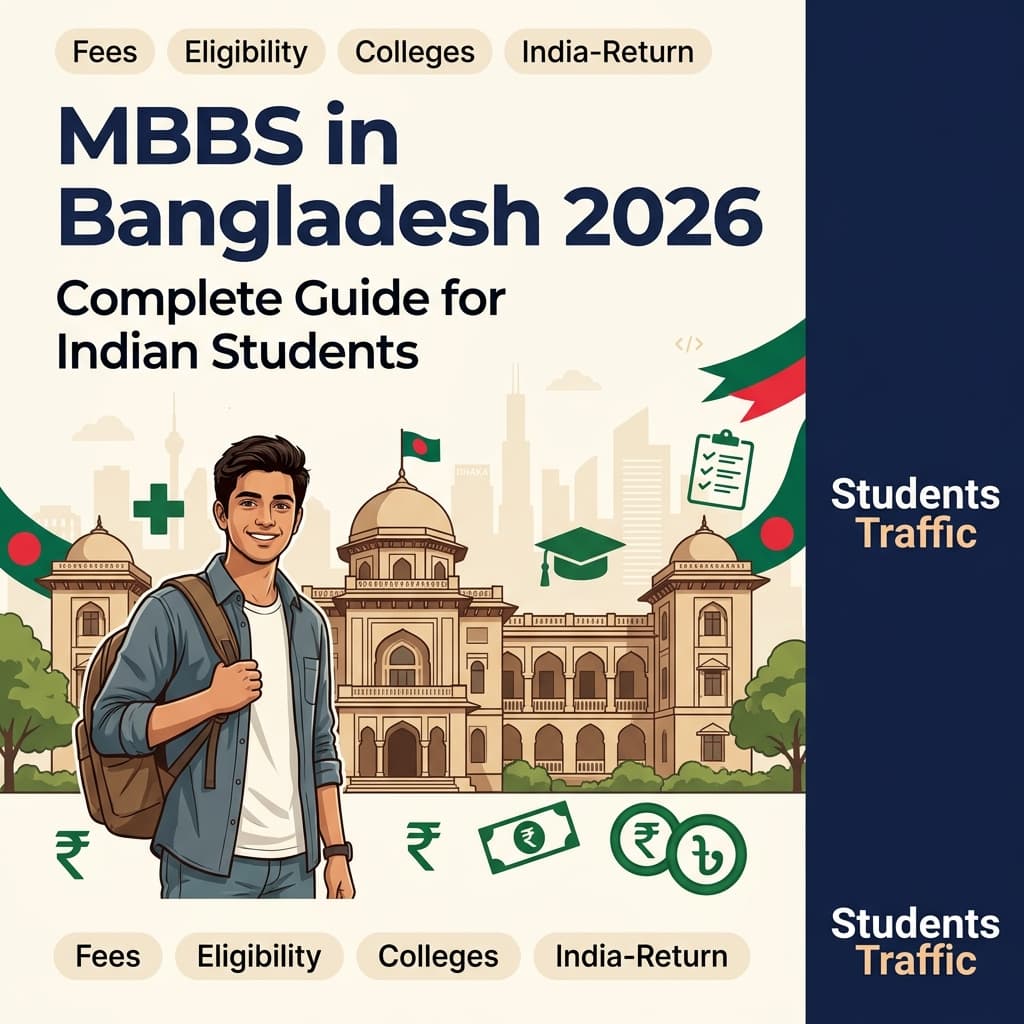
MBBS in Bangladesh 2026: Complete Guide for Indian Students
Bangladesh is one of the first countries many Indian families consider when they begin exploring MBBS abroad. The reason is easy to understand. It is geographically close, culturally familiar in many ways, food can feel less alien than in distant destinations, the patient flow in teaching hospitals is often strong, and the idea of studying medicine in a neighboring country feels less intimidating than flying to Central Asia, Eastern Europe, or the Caucasus.
But familiarity can also create a dangerous illusion.
Many families assume Bangladesh is automatically simple, automatically affordable, automatically safer, and automatically better for India-return outcomes. None of those conclusions should be made on autopilot.
Bangladesh can be a strong option for the right student, but it is not a shortcut decision. The seat structure is not infinitely open. Fee expectations can vary sharply by institution and quota pathway. Documentation discipline still matters. Hostel and city life still matter. University-level differences still matter. And the student still has to complete the degree responsibly and prepare for the India-return licensing path with seriousness.
So the real question is not, "Is Bangladesh good or bad?"
The real question is, "Under what circumstances does Bangladesh become the right MBBS destination for this specific Indian student in 2026?"
That is what this guide is built to answer.
Why Bangladesh attracts Indian MBBS aspirants
Bangladesh usually enters the conversation when a family wants a destination that feels academically familiar but does not want the unpredictability of chasing too many unfamiliar choices. Families often like Bangladesh for five reasons.
First, proximity matters. Parents feel more comfortable when the student is not extremely far from India. Travel planning feels more manageable, emotional distance feels smaller, and the country does not feel completely disconnected from home.
Second, the clinical environment matters. Bangladesh is often discussed as a destination with good patient exposure in several teaching hospitals, and this matters to families who worry that some foreign universities may have low clinical volume or an overly theoretical experience.
Third, the perceived cultural adjustment is lower. Students may find food, social environment, and general lifestyle slightly easier to adapt to than some other destinations, though this still depends on the city and campus.
Fourth, the medium of instruction conversation often sounds more comfortable to Indian families than in destinations where the local language barrier becomes a major practical issue from the first year onward.
Fifth, Bangladesh is often positioned as a destination that feels more grounded and less experimental. Families who are nervous about brand-new or aggressively marketed options sometimes feel Bangladesh is easier to evaluate.
All of these reasons are valid. But none of them should replace due diligence.
Who should seriously consider Bangladesh in 2026
Bangladesh is not for every student. It tends to work best for a particular profile.
It can suit students who want a nearby country, are willing to follow structured academics, and come from families that value stable, documentable pathways over marketing glamour. It can also be a strong fit for families who want to compare a few serious options rather than jump through a long list of random countries.
Bangladesh becomes more attractive when the student wants:
- a relatively familiar regional environment
- a degree path that feels academically close to the Indian imagination of medical education
- a serious hospital-learning atmosphere
- manageable travel access to India
- a destination that can be evaluated through practical questions instead of hype
Bangladesh may be a weaker fit if the family is expecting the absolute cheapest foreign MBBS option, if the student only wants a destination because "everyone says it is safe," or if the decision is being made without university-level verification.
In other words, Bangladesh is a fit-based decision, not a slogan-based decision.
MBBS in Bangladesh 2026: basic eligibility for Indian students
Eligibility conversations should always start with the fundamentals rather than with agent assurances.
For Indian students, the usual decision filters include:
- NEET qualification as required for Indian students pursuing MBBS abroad
- PCB background in Class 12
- marks that satisfy the admission pathway being considered
- valid passport and academic documents
- readiness for medical education in a full-time, disciplined environment
Some universities and seat categories can have different internal expectations, and specific documentation requirements can differ. That is why families should ask for university-specific written requirements instead of relying only on generic WhatsApp summaries.
The safest approach is to treat eligibility as a three-layer check:
- Indian-side eligibility
- university-side eligibility
- long-term India-return eligibility logic
If even one of these is fuzzy, the family should slow down.
Understanding the Bangladesh fee conversation properly
This is where many families go wrong.
They ask, "What is the total package?" and treat the first number they hear as reality.
That is risky because Bangladesh fee structures may be discussed in ways that hide important details. The headline number may not fully explain hostel terms, food assumptions, exam charges, visa renewals, university deposits, documentation expenses, inflation, travel frequency, or city-specific living differences.
Families should split the budget into six buckets:
- Tuition and seat-linked academic charges
- Hostel and accommodation charges
- Mess and personal living expenses
- documentation, admission, and visa processing costs
- travel and emergency buffer
- India-return planning buffer for later stages
If the family only compares bucket one, they are not comparing countries or universities honestly.
Bangladesh is often treated as a premium-neighbor option rather than the ultra-budget option in the MBBS abroad market. That matters. Some families discover too late that while Bangladesh feels attractive, the total spend is still substantial and needs to be compared with what the same budget could buy elsewhere.
So the correct question is not, "Is Bangladesh cheap?"
The correct question is, "At this total cost, does Bangladesh offer the academic environment, lifestyle fit, and risk profile my child needs?"
Bangladesh is not one single experience
One of the most common mistakes in MBBS abroad counselling is country-level overgeneralization.
Families ask:
- Is Bangladesh good?
- Is Bangladesh safe?
- Is Bangladesh worth it?
- Does Bangladesh have good patient flow?
These questions are understandable, but they are incomplete.
No country is one single student experience. Different colleges create different outcomes. Different hostels create different comfort levels. Different cities create different adaptation pressure. Different administration styles create different documentation experiences.
That means the family should shift from country questions to institution questions:
- Which college exactly?
- What is the track record of student support?
- What is the teaching hospital reality?
- What is the hostel environment like?
- How does the administration handle international students?
- Is the university being recommended because it is actually suitable, or because a seat is easy to sell?
This shift from country-level thinking to institution-level thinking can save families from expensive mistakes.
How to evaluate colleges in Bangladesh
When shortlisting Bangladesh colleges, families should not begin with glossy brochures. They should begin with due diligence.
Here are the questions that matter more than marketing.
1. What is the actual teaching and hospital environment?
Students do not become stronger medical graduates because a campus photo looks polished. They benefit when the teaching structure, ward exposure, hospital culture, and academic accountability are real.
Families should ask what the hospital attachment is, how active the teaching environment feels, and whether seniors describe the system as supportive or merely formal.
2. How transparent is the fee structure?
Transparency is a trust test. If the institution or representative is vague about what is included, what is excluded, when payments happen, or how refunds work, the family should be cautious.
3. What is hostel reality, not brochure reality?
Hostel conditions change the student experience more than many families expect. Room occupancy, washroom standards, internet quality, mess discipline, security, and access to campus services all influence how stable the student feels.
4. What is the city fit for this student?
A quieter student, an anxious first-time traveler, and a highly independent student may all react differently to the same city. City fit matters. Noise, transport, weather, convenience, food access, and travel routes affect day-to-day resilience.
5. How strong is the documentation trail?
Every serious MBBS abroad decision should produce a strong paper trail. Admission letters, fee receipts, university communication, curriculum details, internship clarity, and payment evidence should be cleanly stored from day one.
If a process feels informal, the family should step back.
Student life in Bangladesh: what families should expect
Student life should not be idealized, but it should not be feared blindly either.
Most students going abroad for MBBS face the same broad transitions:
- living away from home
- learning time management without family supervision
- adjusting to a new hostel environment
- figuring out food, routine, and study rhythm
- learning how to ask for help early instead of after things become serious
Bangladesh may feel less culturally distant than some other destinations, but that does not mean adaptation is automatic. Homesickness can still hit. Academic pressure can still feel heavy. Hostel adjustment can still take time. Friend circles can still influence study discipline positively or negatively.
Families should talk honestly with the student about emotional readiness. A student who is going abroad only to escape pressure at home may struggle. A student who understands why they are going, accepts the discipline of medicine, and is ready to build structure can do far better.
Safety, support, and practical stability
Safety is another area where families often want a single yes-or-no answer.
But the correct way to think about safety is layered:
- campus and hostel safety
- city movement and transport practicality
- availability of trusted local support
- responsiveness of university administration
- ability of the student to follow safe routines consistently
Students who manage routine responsibly usually reduce risk substantially. Families should still verify what support exists for accommodation, emergencies, documentation issues, and parent communication.
It is also wise to ask current students what small daily problems look like, because these details rarely appear in official presentations.
India-return planning: the part families must not ignore
The biggest strategic mistake in MBBS abroad decisions is treating admission as the finish line.
Admission is only the first chapter.
The family must think about the full arc:
- eligibility before joining
- degree completion
- quality of study discipline during the course
- clinical learning
- documentation integrity
- internship structure
- the licensing pathway in India
Bangladesh should not be judged only on how easy it is to enter. It should be judged on whether the student can complete the entire path responsibly and return with a clean, defensible academic journey.
This is why families should avoid any representative who speaks in shortcuts. Medicine is not a shortcut profession. If someone is selling it as one, that itself is a red flag.
Common mistakes Indian families make when choosing Bangladesh
Some errors repeat so often that they deserve a separate warning list.
Mistake 1: choosing Bangladesh only because it is close to India
Distance matters, but proximity alone is not a reason to spend years and a major family budget.
Mistake 2: assuming every Bangladesh college is equally good
This is one of the most expensive myths in the market.
Mistake 3: comparing only tuition, not total cost
A decision made on partial budget math usually becomes stressful later.
Mistake 4: not asking how the student will actually live and study
A college may look fine on paper but still be a poor fit for the student's temperament.
Mistake 5: relying on verbal promises
If it matters, get it documented.
Mistake 6: ignoring the India-return lens
A destination that is easy to sell is not automatically easy to convert into a strong long-term outcome.
How Bangladesh compares to other popular MBBS abroad options
Bangladesh is often compared with Nepal, Russia, Kyrgyzstan, Uzbekistan, Georgia, and occasionally Egypt or China depending on budget and academic expectations.
The comparison should not be made by social media opinion. It should be made by filters.
Use these filters:
- total cost
- travel convenience
- language environment
- clinical exposure
- lifestyle comfort
- degree structure
- hostel quality
- document transparency
- perceived academic seriousness
- long-term confidence of the family
Bangladesh may win on proximity and familiarity for some families.
Another country may win on total budget.
A third may win on a specific university-level value proposition.
That is why a comparison-based counselling process is smarter than a one-country obsession.
Is Bangladesh worth it for MBBS in 2026?
It can be, but only when the answer is evidence-based.
Bangladesh is worth serious consideration if:
- the student wants a nearby destination
- the family accepts the actual total cost
- the specific college has been verified properly
- the student is ready for disciplined medical study
- the family is thinking about India return from day one
Bangladesh is not worth forcing if:
- the budget is already strained
- the college choice is weak but being justified emotionally
- the student is not ready for life away from home
- the family is using the country name as a substitute for due diligence
A month-by-month admission mindset for Bangladesh aspirants
Families often become reactive because they do not plan the timeline in advance. A calmer approach is to think in stages.
Stage 1: clarity stage
This is where the student confirms that MBBS abroad is genuinely required and the family defines the budget honestly. At this stage the family should not commit to a country emotionally. It should compare Bangladesh with realistic alternatives.
Stage 2: shortlist stage
This is where the family moves from "Bangladesh sounds good" to "these are the exact institutions we are willing to evaluate." At this stage, fee structure, city fit, hostel reality, and university credibility all matter.
Stage 3: verification stage
This is the most skipped stage. Families should speak to seniors, collect written fee details, review documents, ask about hostel life, and test the claims made during counselling.
Stage 4: documentation stage
Once the family is satisfied, documentation should be handled methodically. Keep digital copies and printed copies. Preserve receipts. Track every payment. Save all communication that clarifies course structure or fee commitments.
Stage 5: readiness stage
Before departure, the student should prepare for lifestyle transition, not just packing. That means sleep discipline, self-management, budgeting habits, emotional readiness, and realistic study expectations.
Families who follow these stages usually make more stable decisions than those who compress everything into a few rushed calls.
Questions students should ask current Bangladesh seniors
One of the smartest ways to evaluate a college is to ask students already studying there the right questions.
Do not ask only, "How is the college?"
Ask:
- What surprised you after joining?
- What does the daily routine actually look like?
- Is the hostel manageable over the long term?
- How supportive is the administration when problems happen?
- How serious are studies in reality?
- What should a new student prepare for mentally?
- If you were starting again, what would you verify more carefully?
These questions help the family move from brochure language to lived reality.
Parents should evaluate themselves too
This may sound unusual, but many MBBS abroad decisions become stressful because the parents themselves are not aligned.
One parent may want a nearby destination at any cost.
Another may want the cheapest option.
A relative may push a college because somebody's child went there.
The student may quietly want something else.
Before finalizing Bangladesh, the family should answer three internal questions:
- Are we choosing this because it fits the student, or because it reduces our own anxiety?
- Are we stretching the budget emotionally just because the country feels familiar?
- Have we compared Bangladesh honestly with at least a few other serious options?
Families who answer these questions honestly reduce conflict later.
Frequently asked practical questions
Is Bangladesh automatically safer than other MBBS abroad destinations?
Not automatically. Safety depends on the specific city, hostel, student routine, support system, and how responsibly the student lives.
Is Bangladesh always better for academics?
Not automatically. Academic seriousness varies by institution and student effort. Country reputation cannot replace college-level verification.
Is the travel convenience enough reason to choose Bangladesh?
No. It is a meaningful advantage, but not a complete decision.
Is Bangladesh good for students who are emotionally dependent on home?
It may feel easier than a faraway destination, but students still need independence. "Nearby" does not remove homesickness or academic pressure.
Should we decide quickly if seats are limited?
Families should move efficiently, but not blindly. A fast decision is only good when the due diligence has already been done.
A practical decision checklist before you pay anything
Before any commitment, the family should be able to answer all of the following clearly:
- Which exact college are we choosing and why?
- What is the confirmed total cost over the full journey?
- What is included and excluded in writing?
- What is the hostel and city reality?
- What do current students say?
- How will the student manage academics, routine, and emotional adjustment?
- How does this path look from an India-return point of view?
- What alternative countries have we compared honestly before deciding?
If these answers are still vague, the family is not ready to pay.
Final verdict
MBBS in Bangladesh in 2026 can be a very good option for the right Indian student, but it should not be chosen because it sounds familiar, nearby, or socially approved.
It should be chosen because the college is right, the budget is realistic, the student can handle the environment, and the family has compared Bangladesh against other serious options with discipline.
The best MBBS abroad decisions are rarely emotional. They are calm, documented, and comparative.
If Bangladesh still looks strong after that process, then it deserves real consideration.
If it only looks strong when the family stops asking questions, then it is the wrong decision.
How Students Traffic Can Support Your Bangladesh Shortlist
Bangladesh works best when the family goes beyond the headline that it is "close to India" and checks the college-level details carefully. Students Traffic helps families compare tuition structure, hostel reality, documentation quality, city lifestyle, English support, and India-return readiness before any booking amount is paid.
If you want a cleaner Bangladesh shortlist, use Students Traffic counselling support and peer connect to speak with current students and compare real budgets before locking a college.
Related: MBBS Abroad | Contact Students Traffic | Talk to Students Abroad