Can You Finance MBBS Abroad With a Loan?
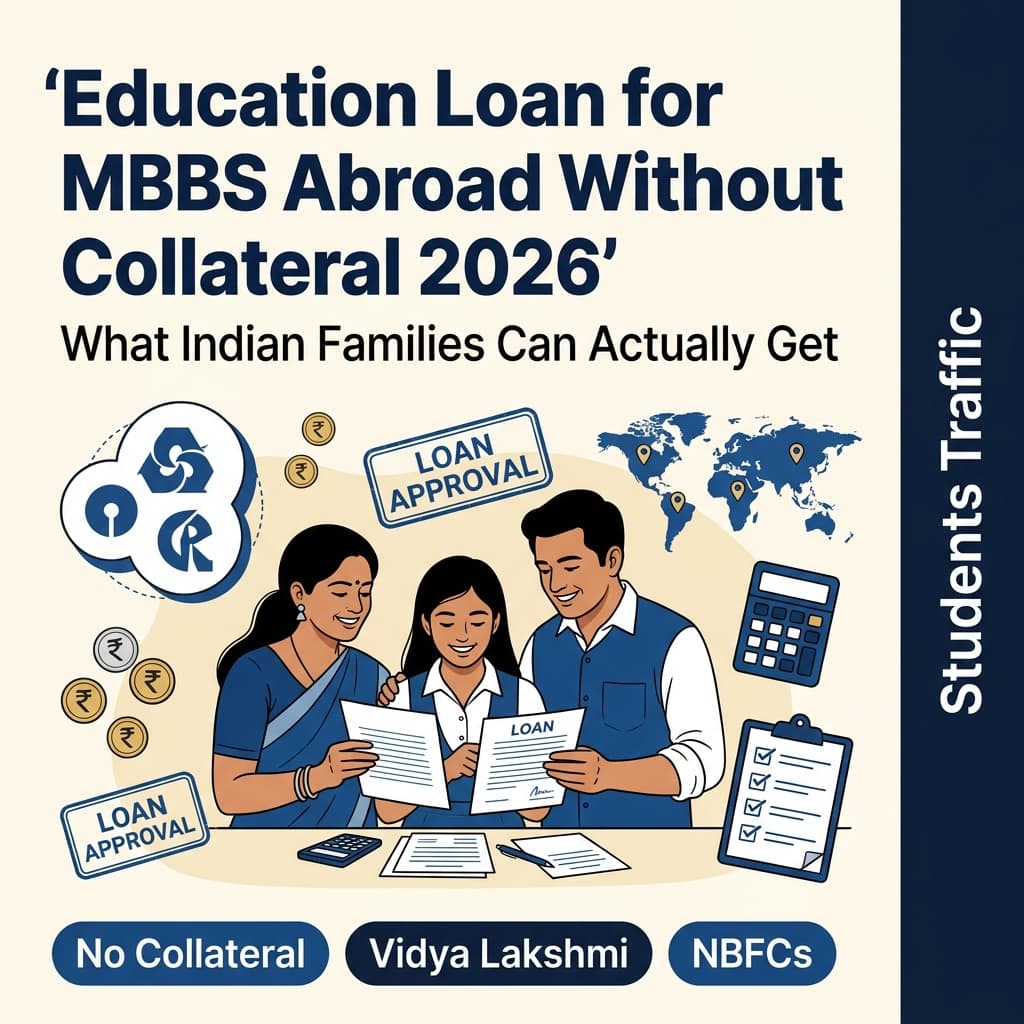
Yes — education loans for MBBS abroad are available from both public sector banks and private lenders in India. However, there are specific conditions that most families discover only after sitting across the table from a bank officer.
This guide explains exactly how education loans work for MBBS abroad: which banks offer them, how much they lend, what security they require, how interest accrues during the course, and the documents you genuinely need. No generic advice — specific, actionable information.
Who Qualifies for an Education Loan for MBBS Abroad?
To be eligible for an education loan for MBBS abroad, you need to meet these criteria:
- NMC-recognized university: The bank will verify this. Most public sector banks require the university to appear on the NMC approved list. If your university is not NMC-recognized, most banks will decline the loan (a signal you should also use to question the university choice itself)
- Valid NEET score: Many banks now require NEET qualifying proof for MBBS abroad loans, aligned with NMC rules
- Indian citizenship: Standard for domestic education loans
- Co-applicant (parent or guardian): Required for all student education loans in India; the co-applicant's income and credit history are assessed
- Collateral (for loans above ₹7.5–10L): Most MBBS abroad loans exceed this threshold, so collateral is standard
Bank-by-Bank Overview
SBI (State Bank of India)
SBI is the most used lender for education loans in India, including for MBBS abroad.
Products:
- SBI Student Loan Scheme: Up to ₹20L without collateral for approved institutions; up to ₹1.5 crore with collateral for international programs at select institutions
- SBI Global Ed-Vantage: Specifically designed for overseas education — covers tuition, hostel, travel, equipment, insurance
Interest Rate (as of early 2026):
- Base: Repo rate linked — approximately 9.5–11% per annum
- 0.5% concession for female students
- 1% concession if full interest is paid during moratorium
Moratorium: Course duration + 6 months (or 1 year after getting a job, whichever is earlier)
Collateral requirement:
- Up to ₹7.5L: No collateral (third-party guarantee needed)
- ₹7.5L–₹20L: Third-party guarantee or collateral
- Above ₹20L: Tangible collateral (property, FD, etc.)
What SBI looks for:
- University on NMC approved list — non-negotiable
- NEET scorecard
- University admission letter
- Parent/guardian income documents
- Property papers (if collateral loan)
Practical note: SBI branches vary significantly in their familiarity with MBBS abroad loans. Urban branches (especially those with education loan desks) are more experienced. If the branch officer says "we don't do this," escalate to the branch manager or visit a different branch.
Bank of Baroda (BoB)
Products:
- Baroda Education Loan (Abroad): Covers NMC-recognized foreign universities; up to ₹80L with collateral
- Baroda Vidya / Baroda Gyan: For select listed institutions — may not directly cover all MBBS abroad universities; ask specifically
Interest Rate: Approximately 10–11.5% p.a. (varies with credit profile and collateral)
Moratorium: Course duration + 12 months
Key feature: BoB has a formal List of Premier Foreign Institutes (LPFI) — universities on this list get preferred processing. Most Kazakhstan, Georgia, Russia universities are not on LPFI, but loans are still available — they are processed as "other approved institutions."
Punjab National Bank (PNB)
PNB Udaan: Education loan for overseas studies
- Up to ₹20L for approved institutions
- Collateral required above ₹7.5L
- Interest rate: 10–11.5% p.a.
- Moratorium: Course + 12 months
Note: PNB's processing for MBBS abroad can be slower than SBI or BoB. Follow up actively.
HDFC Credila (Private Lender)
HDFC Credila is a dedicated education loan NBFC and often faster in processing than public sector banks.
Loan amount: Up to ₹1 crore (subject to creditworthiness and collateral) Interest rate: 11–13% p.a. (higher than PSBs) Collateral: Required above ₹10L Processing time: 7–15 business days (significantly faster than PSBs) Moratorium: Course duration + 6 months
Advantage over PSBs: More flexible in terms of documents approved institutions; faster; can be processed online with less branch friction. The trade-off is a higher interest rate.
Avanse Financial Services
Another dedicated education loan NBFC.
- Loan amount: ₹10L–₹75L for overseas MBBS
- Interest rate: 12–14% p.a.
- Moratorium: Course + 12 months
- Strength: More flexible on institution type; will consider NMC-listed universities more readily than some PSBs
InCred and Propelld
Emerging education loan fintech platforms. Useful for students who cannot access collateral-based loans and need unsecured options.
- Loan amounts typically ₹5L–₹30L
- Interest: 13–18% p.a.
- No collateral for smaller amounts — income-based approval on co-applicant
- Best used for top-up financing, not as primary loan for MBBS abroad
What Education Loans Cover for MBBS Abroad
Most bank education loans for overseas study cover:
| Covered | Usually Not Covered |
|---|---|
| Tuition fees | Personal expenses (food, clothing) |
| University hostel fees | Foreign travel spending |
| Exam/library/lab fees | One-time setup costs |
| Round-trip airfare (capped) | Luxury accommodation |
| Purchase of laptop/equipment (capped) | |
| Study insurance | |
| Caution deposit (refundable) |
Practical implication: Your education loan covers the core institutional costs. You still need family funds or savings for daily food expenses, personal items, and the first-year setup costs.
How Much Should You Borrow?
A common mistake is borrowing the maximum available and then struggling with EMI after graduation. Model your borrowing precisely.
Step 1: Calculate total tuition + hostel over 6 years (get exact figures from university)
Step 2: Calculate flights + insurance + exam fees
Step 3: Estimate family contribution for food and personal expenses
Step 4: Borrow: (Step 1 + Step 2) minus family contribution
Example for KazNMU Almaty:
- Tuition (6Y): ₹30L
- Hostel (6Y): ₹6.6L
- Flights + insurance + fees: ₹5L
- Subtotal institutional costs: ₹41.6L
- Family contribution for food + personal (6Y): ₹15L
- Loan amount to borrow: ₹41.6L
Interest During the Moratorium Period
During the course (moratorium), interest accrues on the disbursed amount even though no EMI is paid. This is called simple interest during moratorium in most PSB schemes.
Example (₹40L loan at 10% p.a.):
- Monthly interest during moratorium: ₹40L × 10% / 12 = ₹33,333/month
- Over 6-year course: ₹33,333 × 72 = ₹24L of interest accrues
- Total amount owed at end of moratorium: ₹40L + ₹24L = ₹64L
This is the principal on which EMI is calculated. If your repayment tenure is 10 years post-moratorium, your EMI on ₹64L at 10% is approximately ₹84,000/month.
The case for paying interest during moratorium: If you pay the monthly simple interest (₹33,333 in the above example) during your 6 years, you save ₹24L in accrued interest and your EMI burden post-graduation is significantly lower. SBI offers a 1% interest rate reduction as an incentive to pay during moratorium.
Collateral: What Banks Accept
For loans above ₹7.5–10L (which covers almost all MBBS abroad cases), banks require:
Immovable property (most common):
- Residential or commercial property in parent/guardian name
- Market value must typically be 1.25–1.5× the loan amount
- Clear title (no disputes, no encumbrance)
- Property in the city/district where the bank branch operates is preferred
Fixed Deposits:
- FD with the lending bank can be pledged
- 100% of FD value can be leveraged
Life Insurance Policy:
- Surrender value must cover loan amount
- Term insurance is not accepted; endowment/whole life policies with surrender value work
Liquid Securities (NSC, KVP, etc.): Accepted at many PSBs
Government Securities: Accepted
If you have no collateral: Some banks offer third-party guarantee (a guarantor with property or income) in lieu of direct collateral. Private lenders like Avanse and Propelld offer partial unsecured options at higher rates.
Step-by-Step Application Process
Step 1: Confirm University NMC Status
Before approaching any bank, download the current NMC approved list and confirm your university is listed. Bring a printout.
Step 2: Get the University Documents
- Admission/Offer Letter (official, on university letterhead)
- Fee structure for all 6 years (or per year)
- Hostel cost breakdown
- University WDOMS listing reference (for bank verification purposes)
Step 3: Prepare Co-applicant Documents
- PAN card
- Aadhaar card
- Last 3 years ITR (Income Tax Returns)
- Last 6 months bank statements
- Salary slips (if salaried) or business proof (if self-employed)
- Property documents (for collateral loan)
Step 4: Prepare Student Documents
- Class 10 and 12 mark sheets and certificates
- NEET scorecard
- Passport (valid for 6+ years)
- NMC eligibility certificate (if already obtained)
- University offer/admission letter
- Passport-size photographs
Step 5: Apply at Bank
Visit the education loan desk. Submit documents. Bank will conduct verification (property valuation if collateral is involved — typically 2–3 weeks).
Step 6: Sanction Letter
Received after approval. This is what you show to the university for installment payment planning.
Step 7: First Disbursement
Banks typically disburse directly to the university's bank account, not to the student. Coordinate university banking details with your bank before departure.
Step 8: Annual Renewal
Education loans for 6-year programs are renewed annually. You provide proof of progress (university mark sheets or attendance certificates) to continue disbursements each year.
Tax Benefits on Education Loan
Under Section 80E of the Income Tax Act, the interest paid on education loans is fully deductible from taxable income — for a maximum of 8 years starting from the year you begin repayment.
This applies to loans taken for higher education (including MBBS abroad) and is available to the student or parent repaying the loan. There is no cap on the interest amount deducted.
In practice: After returning and starting practice, if you are repaying ₹40,000/month interest on your education loan, the annual ₹4.8L interest is fully deductible from your income under Section 80E. At a 30% tax bracket, this saves ₹1.44L/year in tax.
Frequently Asked Questions
Which bank is best for education loan for MBBS abroad? SBI is the most accessible for most students due to its branch network and familiarity with MBBS abroad cases. For faster processing, HDFC Credila is the private sector alternative. For higher loan amounts, Bank of Baroda or SBI's Global Ed-Vantage scheme.
What is the maximum education loan for MBBS abroad? SBI's Global Ed-Vantage offers up to ₹1.5 crore for overseas programs with collateral. In practice, most MBBS abroad loans are processed in the ₹30–60L range.
Can I get an education loan without collateral for MBBS abroad? Loans above ₹7.5L without collateral are rare from PSBs. Private lenders (InCred, Propelld) offer unsecured loans up to ₹20–30L at higher interest rates.
Do banks verify NMC recognition before the loan? Yes — as standard practice. This is one reason why enrolling in a non-NMC-recognized university creates problems: you will not be able to get an education loan, which is a clear warning signal.
When does loan repayment start? Most education loans have a moratorium covering the course duration plus 6–12 months. Repayment (EMI) starts after the moratorium period ends.
Can the loan cover NExT coaching fees after return? No — post-graduation coaching is not covered under standard education loan terms. Plan separately for ₹2–4L for NExT preparation.
What if I don't clear NExT and can't repay the loan? Loan defaults are reported to CIBIL and affect your credit score. If you fail NExT and cannot practice, contact the bank proactively to explore restructuring options — banks have NPA (non-performing asset) resolution processes. Prevention is better: prepare systematically for NExT from Year 1 to avoid this scenario.
Final Checklist Before You Apply
- University confirmed on NMC approved list (nmc.org.in — current year)
- NEET scorecard obtained and percentile noted
- University fee structure obtained in writing
- Co-applicant income and property documents compiled
- Bank branch with education loan desk identified
- Collateral property valued or FD amount confirmed
- Target loan amount calculated (institutional costs only)
- Interest-during-moratorium payment plan discussed with family
Getting the loan sanctioned before departure gives you negotiating power with the university on payment schedules and removes the financial anxiety that derails academic performance in Year 1.
What "Without Collateral" Actually Means for MBBS Abroad Loans
One of the most searched phrases in this category is "education loan for MBBS abroad without collateral."
Families search it because they are trying to solve two different problems at once:
- they want the student to start on time
- they do not want to mortgage the family's best asset if avoidable
That instinct is understandable.
But the practical truth is more nuanced.
For MBBS abroad, the full six-year cost often lands well above the threshold where Indian lenders become strict about security. That means "without collateral" is not impossible, but it is rarely available in the simple, full-amount way people imagine.
Usually, one of four things is happening when a lender says an MBBS-abroad loan is possible "without collateral":
- the sanctioned amount is much lower than the total course cost
- the lender is approving only a top-up portion because the family is funding a large chunk directly
- the interest rate is materially higher than the collateral-backed alternative
- the product is structured around a stronger-income co-applicant and still comes with tighter repayment expectations
That is why families should not ask only:
"Can I get a loan without collateral?"
They should ask:
"If I avoid collateral, what amount can I really access, at what rate, with what monthly burden later?"
That question is far more useful.
Three Financing Paths Families Usually End Up Choosing
In real admissions counselling, families usually fall into one of these paths.
Path 1: Full collateral-backed education loan
This is the most common route when:
- the total budget is above 35 to 40 lakhs
- the family has clear-title residential or commercial property
- the parents want the lowest available rate from a PSU bank
Strengths:
- larger sanction amounts
- lower rates than most NBFC alternatives
- stronger comfort for long-course financing
Weaknesses:
- more paperwork
- property valuation and legal opinion take time
- sanction speed can slow the admission process if the family starts late
Path 2: Split financing
This is often the smartest route for middle-income families.
The family funds one part directly and borrows only the institution-facing core amount.
For example:
- tuition plus hostel through bank loan
- food, flights, small setup costs through family cash flow
This reduces interest burden and keeps the sanctioned amount more manageable.
It also makes the bank conversation easier because the family appears planned rather than fully dependent.
Path 3: Smaller unsecured or semi-secured top-up
This route appears when:
- the family has no clean collateral
- the university costs are relatively moderate
- the parents have reasonable documented income
This can work for certain budget bands, but the trade-off is real:
- higher interest
- lower sanction
- more pressure on repayment later
That is why unsecured borrowing should usually be treated as a limited bridge, not a romantic "smart hack."
The Timing Mistake That Makes Families Panic
Loan stress becomes much worse when families begin late.
Many people do it in this order:
- decide emotionally on a country
- pay a registration amount
- get an offer letter
- then start asking whether a bank will actually finance the case
That is backwards.
A better order is:
- estimate total cost honestly
- identify whether collateral exists and in whose name
- check co-applicant income quality
- speak to two banks and one NBFC before locking the shortlist
- only then decide which universities are financially credible
This matters because financing is not a side issue.
It is part of admissions strategy.
A university that looks affordable in a brochure may become unaffordable if the bank refuses the hostel component, under-sanctions the amount, or takes too long to process.
A More Realistic EMI Conversation Families Should Have
The moral danger in MBBS-abroad financing is that families often think only about sanction, not repayment psychology.
They feel relief when the loan is approved.
But the real stress begins years later if the structure was careless.
Before signing any sanction letter, families should answer:
- Who will pay simple interest during the course, if anyone?
- If nobody pays it, what is the expected outstanding amount after moratorium?
- What monthly EMI will that create?
- If the student needs extra time after graduation for licensing preparation, can the family still handle it?
Those are not negative questions.
They are mature questions.
Too many families assume that "doctor ban jayega, loan ho jayega."
Sometimes it does work out smoothly.
Sometimes the student clears quickly and the financial plan looks wise.
But financial planning should not rely only on optimism.
It should also survive delay.
That is why conservative families often make better borrowing decisions than aggressive families.
They plan for a slower-than-expected return timeline.
Which Families Should Be Extra Careful About Large MBBS-Abroad Loans
Certain profiles should slow down before borrowing heavily:
- families already servicing home or business debt
- families whose income is irregular and poorly documented
- families depending on one earning member close to retirement
- families using disputed or shared property as assumed collateral
- families choosing a university mainly because an agent promised "loan ho jayega"
In these cases, the right answer may still be MBBS abroad.
But the financing model may need to be smaller, slower, or more selective.
Sometimes a more budget-disciplined country or university is wiser than forcing a premium option through risky debt.
A Practical Bank-Visit Checklist Families Should Carry
When you go to the bank, do not go with only excitement and screenshots.
Carry a disciplined file:
- NEET scorecard
- passport copy
- Class 10 and 12 documents
- official university offer letter
- written tuition and hostel structure
- co-applicant income proof
- bank statements
- collateral papers if applicable
- a one-page total-cost sheet prepared by the family
That one-page cost sheet is underrated.
It shows the bank manager that the family understands:
- how much is needed
- what portion is being self-funded
- what portion is being borrowed
- how the course cost unfolds year by year
That improves credibility immediately.
Final Practical Verdict
Education loans can absolutely make MBBS abroad possible.
But the smartest families do not use loans to stretch into a dream option at any cost.
They use loans to support a financially defendable option.
That difference matters.
If the borrowing structure is calm, documented, and aligned with the family's actual earning capacity, the loan can be a useful bridge.
If the borrowing structure depends on vague promises, rushed admissions, or emotional overspending, the same loan can become the hidden reason the family regrets the decision later.
How Students Traffic Can Help You Compare the Financial Reality Before You Borrow
Many families take an education-loan decision only after emotionally deciding on a country. That is backwards. The loan shape should influence the shortlist from the beginning because repayment stress changes the student's next six to eight years.
Students Traffic helps families compare tuition, hostel, living cost, payment rhythm, documentation strength, and India-return practicality before the bank file is submitted. That makes the loan discussion more strategic and less desperate.
If you want a budget-first shortlist and cleaner financing plan, use Students Traffic counselling support and peer connect before you lock a university or sanction a large loan.