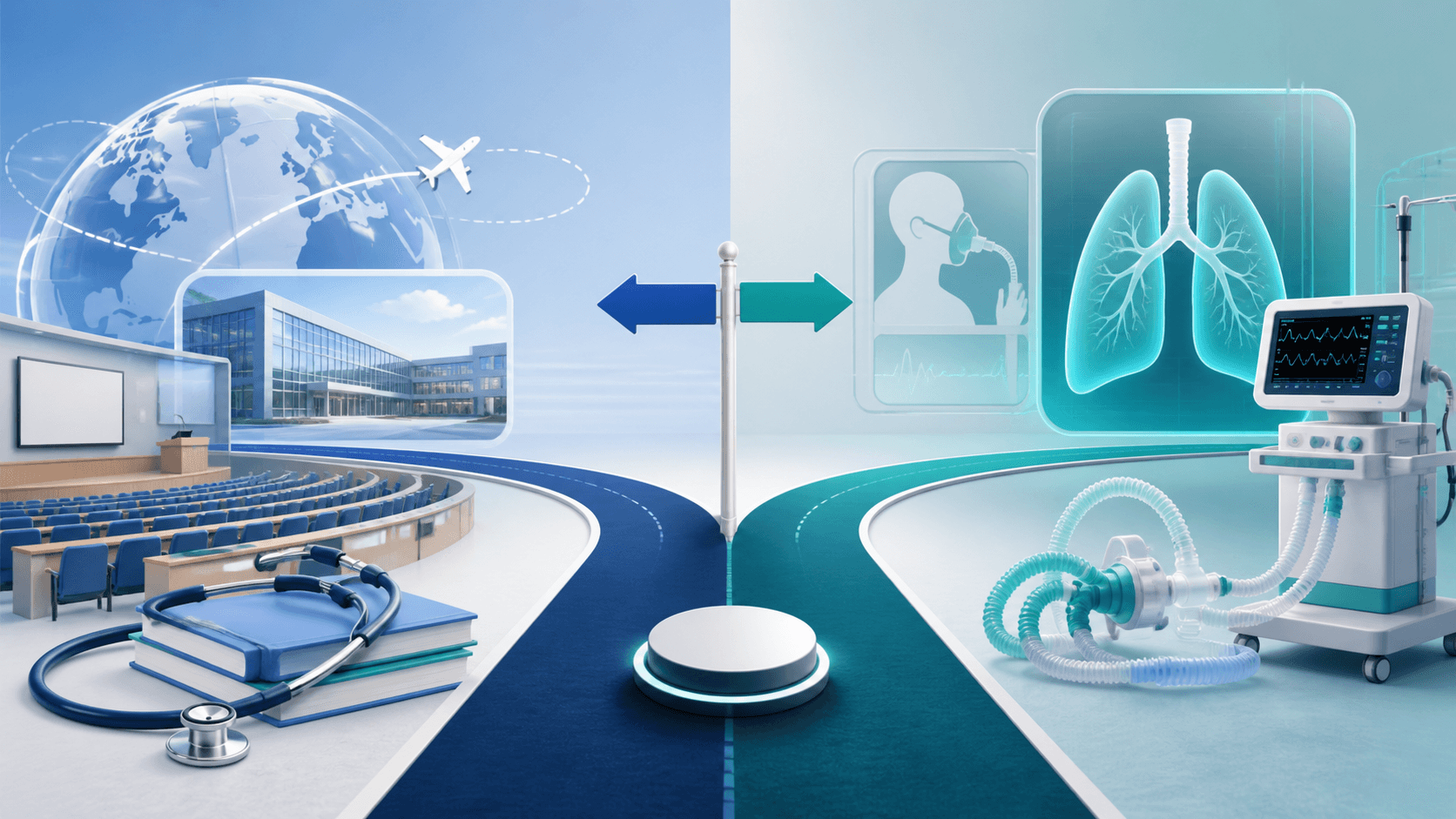
MBBS Abroad vs B.Sc. Respiratory Therapy in India 2026: Which Path Fits You?
If you want to become a doctor with authority to practise allopathic medicine, MBBS abroad is the relevant route—but it is longer, costlier to verify, and subject to the National Medical Commission's foreign medical graduate rules. If you want a focused healthcare career in breathing care, intensive care support, pulmonary function testing, and ventilator management without becoming a doctor, B.Sc. Respiratory Therapy in India may be the more direct fit.
The right choice depends on the job you want at the end, not only the country or course name. MBBS abroad leads toward medical registration, internship, and later postgraduate training if the exact foreign qualification satisfies the rules that apply to your admission. Respiratory therapy is an allied-health profession: respiratory therapists work as part of a clinical team and support diagnosis and treatment under the relevant care plan. These are different professional identities, not two versions of the same degree.
MBBS abroad vs B.Sc. Respiratory Therapy: quick comparison
| Decision factor | MBBS abroad | B.Sc. Respiratory Therapy in India |
|---|---|---|
| Professional endpoint | Physician pathway, subject to foreign qualification and India-licensing requirements | Allied-health respiratory-care pathway; not a medical licence |
| Typical study shape | Country and university specific; verify the full academic, clinical and internship structure | Official Indian programmes commonly describe 3 years of coursework plus 1 year of clinical internship |
| Clinical work | Broad medical training across multiple departments, with local-language and onsite-training questions | Focused respiratory, critical-care, pulmonary-function and ventilator-related training |
| Entry decision | Foreign university, destination rules, NMC FMGL requirements, visa and financial checks | Indian university or institution, course recognition, eligibility and hospital-training checks |
| Cost profile | Tuition plus travel, visa, accommodation, insurance, currency movement and India-return costs | Indian tuition and living costs, with the exact fee varying by institution and campus |
| Best fit | Student committed to the physician role and prepared for a high-compliance international route | Student who prefers a focused clinical specialty and earlier entry into allied healthcare |
This is a decision framework, not a promise of employment, salary, registration or migration. Fees, admissions, professional registers, course structures and regulator guidance can change. Verify the exact programme before paying.
What is the difference between a doctor and a respiratory therapist?
An MBBS graduate is trained across medicine and surgery and, after meeting the applicable licensing requirements, may pursue registration to practise as a doctor. A respiratory therapist is trained in the assessment and management of patients with breathing and cardiopulmonary problems within a healthcare team. The role can include respiratory assessment, oxygen and respiratory-gas support, pulmonary function testing, airway clearance, ventilator care, pulmonary rehabilitation and emergency support, depending on the employer, scope and local rules.
The distinction matters when a family hears that respiratory therapy is “almost MBBS” or that an MBBS graduate will automatically be licensed in India. Neither statement is safe. The National Commission for Allied and Healthcare Professions Act, 2021 defines allied-health professionals as people trained to support diagnosis and treatment and describes recognised qualifications, registers and registration privileges. It does not turn an allied-health degree into an MBBS.
Likewise, the NMC's Rules & Regulations page lists the Foreign Medical Graduate Licentiate Regulations, 2021 and later material. A foreign medical degree must be checked against the conditions applicable to your admission, including the exact qualification, duration, medium, clinical training, internship and other requirements. A university's website or an agent's statement is not a licence to practise in India.
What does B.Sc. Respiratory Therapy teach?
Respiratory therapy is a focused clinical discipline. The official Manipal College of Health Professions B.Sc. Respiratory Therapy page describes a four-year programme consisting of three years of coursework and one year of clinical rotations or internship. Its official department page lists clinical areas and competencies such as intensive-care exposure, pulmonary function testing, arterial blood-gas work, oxygen and respiratory-gas administration, airway clearance, mechanical ventilation and pulmonary rehabilitation.
That does not mean every Indian B.Sc. RT programme has the same curriculum. Before applying, download the university prospectus and ask for the academic calendar, hospital affiliations, internship structure, patient-contact opportunities, assessment method, equipment access and completion certificate. Prefer a programme that names its teaching hospitals and explains how supervised clinical skills are assessed.
This route can fit a student who enjoys physiology, technology, urgent patient care and teamwork but does not want the breadth and legal responsibility of a physician role. It may also fit a student who wants to study in India and reduce the uncertainty of foreign admission, currency conversion, visa changes and overseas clinical-language requirements.
What must an Indian student verify before choosing MBBS abroad?
The NMC's official foreign medical graduate advisory warns students to check whether a foreign medical institution follows the required curriculum, timeframe, medium and training conditions. Build a verification file with:
- the exact awarding university, medical qualification and campus;
- the current curriculum and total duration, including clinical years;
- the language of lectures, examinations, records, ward rounds and patient communication;
- physical attendance and hospital-placement evidence;
- internship structure and where each required stage occurs;
- the institution's recognition for medical practice in its own country;
- visa, accommodation, insurance, refund and emergency-support terms; and
- a written review of the NMC rules applicable to your intended admission cycle.
The NMC FMG FAQ is useful for definitions, but the regulator itself says FAQs are explanatory and should be read with the applicable legal notifications. Students should also read the latest regulator notice rather than relying on an old “FMGE guaranteed” brochure. For a practical starting point, see the existing MBBS abroad university shortlist scorecard and clinical training checklist.
Admission pathways: which is simpler?
MBBS abroad
The route normally involves academic screening, passport and identity documents, medical checks, destination-country admission requirements, visa processing and a university-specific offer. Indian students must separately confirm their eligibility under current Indian rules. The official NTA portal is the place to verify current NEET information; do not treat a “no NEET required” advertisement as an India-practice pathway.
The largest admission risk is accepting a preparatory, foundation or pre-medical offer as if it were an unconditional place on the medical degree. Read the offer letter for the awarding institution, campus, degree title, duration, tuition by year, progression conditions, refund clauses and clinical location. A careful offer-letter review can prevent an expensive misunderstanding.
B.Sc. Respiratory Therapy in India
The admission path is usually institution-specific. For example, Manipal publishes eligibility and programme information for its respiratory-therapy route, while other universities may use a different combination of PCB marks, entrance test, interview, counselling or merit. Check whether the course is a regular degree, its duration, the internship requirement, the university awarding the degree, and the hospital-training arrangement.
Do not choose a course only because its name contains “respiratory,” “critical care” or “technology.” Ask what qualification appears on the final certificate and which professional roles the institution itself lists for graduates. Compare at least two programmes using the same checklist.
Total cost: compare the route, not the headline fee
There is no honest country-wide MBBS-abroad cost and no single B.Sc. RT fee that applies to every Indian institution. Use a full-route budget:
| Budget line | MBBS abroad | B.Sc. Respiratory Therapy in India |
|---|---|---|
| Tuition | Annual fee, escalation, clinical-year changes and deposits | Annual fee, exam charges and internship-year charges |
| Living | Accommodation, food, transport, insurance and emergency reserve abroad | Hostel or local living, transport and daily costs in India |
| Compliance | Visa, health checks, translations, travel and document attestation | Admission, counselling, university and clinical documentation |
| Clinical | Hospital travel, uniforms, vaccinations, placement and internship costs | Instruments, uniforms, clinical travel and internship requirements |
| Career transition | India-return exam preparation, internship and registration planning | Further study, employer onboarding and any applicable registration steps |
An overseas offer that appears cheaper can become more expensive after adding travel, currency movement, deposits and repeated visa or documentation costs. An Indian B.Sc. RT route can reduce international living complexity, but a private institution may still have a substantial tuition bill. Ask for a written fee sheet and refund policy from the institution itself.
Scholarships should be counted only after the award letter states the amount, renewal conditions, eligible student category and exclusions. Students Traffic can conduct a scholarship-fit review and calculate the actual payable cost rather than treating a marketing discount as full funding.
Career fit: who should choose which route?
Choose MBBS abroad only if you genuinely want the physician role
This route may fit when you want broad patient diagnosis and treatment responsibilities, accept a long and demanding training pathway, can fund the full course, and are prepared to verify every compliance step before enrolment. You should be comfortable with overseas living, possible local-language learning, onsite attendance and the uncertainty of changing rules.
It is a poor fit if the real goal is simply “a healthcare job abroad,” if your family is relying on a guaranteed Indian licence, or if you dislike broad medical subjects and long clinical training. A lower headline fee does not solve a professional-fit problem.
Choose B.Sc. Respiratory Therapy when focused clinical work appeals to you
This route may fit when you are drawn to respiratory physiology, intensive care, ventilator support, pulmonary testing, emergency teamwork and technology-enabled patient care. It is also worth comparing when you prefer to study in India and want a narrower clinical specialisation from the beginning.
It is not the right substitute if you want to independently practise as a doctor, prescribe as a physician, or later claim an MBBS-equivalent qualification. Ask the university and prospective employers how the role is defined and what further study is available.
A seven-day decision plan
Day 1: Write the end role you want: physician, respiratory therapist, or still undecided. Record your budget, PCB marks, NEET position and preferred location.
Day 2: Shortlist two exact foreign MBBS programmes and two Indian B.Sc. RT programmes. Name the awarding institution and campus for each.
Day 3: Download the NMC material, university prospectuses, curriculum, fee schedules, internship details and refund terms.
Day 4: Ask each institution about recognition, language, clinical sites, attendance, internship, qualification title and progression conditions.
Day 5: Speak to current students or recent graduates from the exact programme, not only an agency reference.
Day 6: Build a full-route budget, including a reserve, and score each option for role fit, regulatory clarity, clinical depth, cost and family support.
Day 7: Have an independent counsellor review the file before a deposit. Students Traffic can help with profile evaluation, course comparison, shortlist building, scholarship-fit review and application support.
Frequently asked questions
Is B.Sc. Respiratory Therapy the same as MBBS?
No. It is an allied-health degree focused on respiratory and cardiopulmonary care; it does not qualify a graduate as an MBBS doctor.
Can a respiratory therapist become a doctor later?
Not automatically. A graduate would need to meet the eligibility and admission requirements for a separate medical degree; credits and role authority should never be assumed to transfer.
Is MBBS abroad better than B.Sc. Respiratory Therapy?
Neither is universally better. MBBS suits a student committed to the physician pathway; B.Sc. RT suits a student who prefers focused respiratory-care work in an allied-health team.
Does B.Sc. Respiratory Therapy require NEET?
Requirements vary by institution and cycle. Check the current prospectus and admission notice of the exact programme instead of relying on a general course advertisement.
Can I practise medicine in India after MBBS abroad?
Only after meeting the applicable NMC foreign-graduate requirements and completing the required licensing and internship steps. Verify the exact qualification before admission.
What does a respiratory therapist do in an ICU?
Depending on the employer and scope, the role can include respiratory assessment, oxygen and ventilator support, airway clearance, pulmonary testing and supervised critical-care teamwork.
Is B.Sc. Respiratory Therapy a good course for PCB students?
It can be a strong fit for students interested in physiology, respiratory technology and hospital teamwork. Review the curriculum and hospital exposure before deciding.
Which route is cheaper?
An Indian B.Sc. RT route often avoids overseas living and currency costs, but fees vary by institution. Compare the complete budget rather than one advertised tuition figure.
Can I work abroad after B.Sc. Respiratory Therapy in India?
Possibly, but destination-country registration, credential assessment, language and employer requirements apply. A degree is not an automatic overseas licence.
Should parents choose the country first or the course first?
Choose the professional endpoint first, then compare exact programmes, regulators, training sites, total cost and support. Country alone cannot answer a career-fit question.
What should I ask before paying an MBBS-abroad deposit?
Ask for the awarding university, full curriculum, recognition evidence, language map, clinical sites, attendance rules, internship structure, fee schedule and refund terms in writing.
Can Students Traffic compare these options for my profile?
Yes. Bring your marks, NEET details, budget, preferred location and any offer letters for a profile-based course comparison, shortlist review or application-support plan.
Sources and verification note — checked 23 August 2026: NMC Rules & Regulations, FMG FAQ and foreign medical graduate advisory; India Code NCAHP Act, 2021; National Testing Agency official portal; Manipal B.Sc. Respiratory Therapy programme, department scope and curriculum PDF. Course duration, eligibility, fees, hospital placements, professional registration, visa rules and regulator guidance can change; verify the current official documents for your intake before payment.