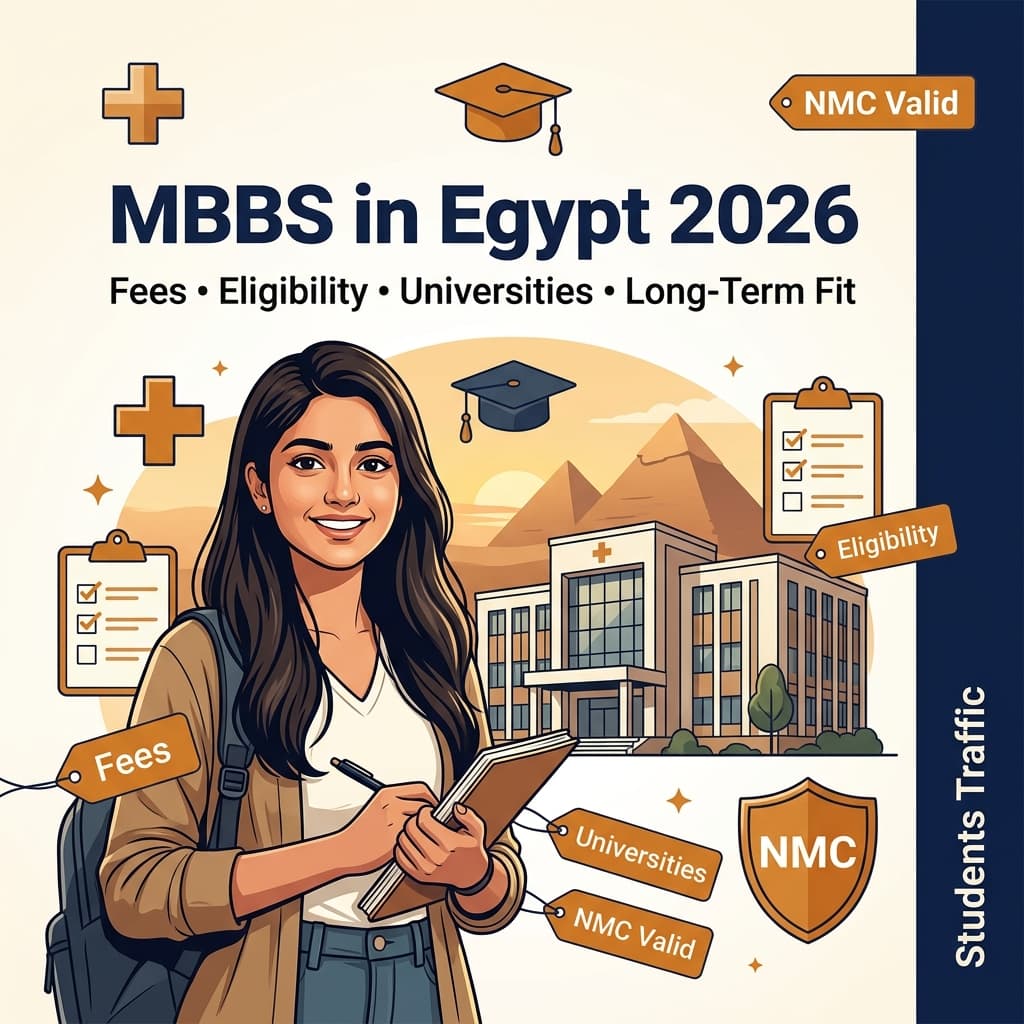
Why Egypt Has Entered the MBBS-Abroad Conversation
Egypt is one of those destinations that many Indian families did not seriously discuss a few years ago but are now hearing about more often in counselling conversations, social media lists, and "emerging country" shortlists.
Whenever a destination rises this way, two things happen at the same time:
- genuine curiosity increases
- and marketing noise increases even faster
That is exactly why Egypt needs a calm, long-form guide.
Families are often being told different stories:
- "Egypt is the next big thing."
- "Egypt is undervalued."
- "Egypt is better than the crowded traditional options."
- "Egypt gives good value if chosen correctly."
Some parts of those claims may be directionally useful. But none of them are enough on their own.
A family considering MBBS in Egypt should ask much sharper questions:
- What kind of student is Egypt actually good for?
- Is the country being chosen for real academic reasons or for novelty?
- What should we understand about university selection, language environment, and living adjustment?
- Can we sustain the budget calmly?
- Are we approaching Egypt as a serious long-term pathway or just as the latest buzzword in the market?
This guide is designed for that exact situation.
It does not assume Egypt is perfect. It also does not dismiss the destination simply because it is newer in the Indian mass-market conversation.
The goal is to decide whether Egypt is a serious fit.
The First Rule: Do Not Choose Egypt Because It Sounds Fresh
Newer or trending destinations often attract families for the wrong reasons.
The logic becomes:
- "Everyone is talking about it."
- "Maybe it is still underpriced."
- "Maybe it has less crowd."
- "Maybe it is a smarter alternative to the usual destinations."
Those can be starting points for research. They cannot be the final reason for admission.
Egypt should be chosen only when the family can explain, in writing, why the country fits the student on:
- academic temperament
- budget tolerance
- lifestyle adjustment
- city preference
- and long-term clarity
If the reason is only novelty, the decision is fragile.
Fragile decisions become dangerous in medical education because the course is long, the financial commitment is serious, and the student cannot casually "experiment" for a year and then reset without consequences.
That is why Egypt should be treated with the same seriousness as any major MBBS-abroad decision:
- verify universities
- verify cost
- verify support
- verify student fit
- and verify that the family understands the hard parts, not only the attractive parts
Who Should Review Egypt Seriously
Egypt usually appeals to families looking beyond the most over-discussed destinations.
It can become attractive for students who want:
- a destination that is not chosen only because it is ultra-cheap
- a serious academic identity rather than a pure agency-driven sales environment
- a university shortlist that feels more selective and deliberate
- and a country that the family is willing to research carefully instead of assuming it is easy
Egypt may also appeal to parents who want to avoid the impression that they are choosing a destination only because it is the cheapest available.
That said, Egypt is not ideal for every student.
It may be harder for students who:
- need heavy cultural familiarity from day one
- get unsettled quickly by environmental differences
- are choosing abroad only because a very low-cost seat is the main objective
- or expect the entire path to feel "plug and play"
The right student for Egypt is usually:
- curious but disciplined
- open to adaptation
- willing to live in a destination that may require more deliberate preparation
- and supported by a family that can think beyond brochure-level comfort
That does not mean the student needs to be extraordinary.
It simply means the family should not pick Egypt casually.
Universities Matter More Than Country Excitement
The worst way to choose Egypt is to stop at the country name.
Families say:
- "We are planning Egypt."
But that tells us almost nothing.
The real decision lives at the university level:
- which institution
- in which city
- under what academic and residential conditions
- at what real budget
- and for what kind of student profile
This is especially important in an emerging-market conversation, because many agents try to sell the destination first and reveal the university logic later.
That sequence is backward.
A better way to shortlist Egypt is:
Bucket A: Institutions you would be comfortable defending academically
These are the universities you can explain to another serious parent without sounding vague or sales-led.
Bucket B: Institutions that may be acceptable on fit and budget, but still need more verification
These require current student feedback, better paperwork, and stronger fee clarity.
Bucket C: Institutions being pushed mainly because admission is moving quickly
These are the ones to slow down on.
Whenever urgency becomes the main argument, the family should ask whether quality is being replaced by speed.
That rule alone saves many students from weak decisions.
Budget Logic: Egypt Should Be Evaluated as a Full-System Cost
Fee conversations become distorted when counsellors compare only tuition and ignore everything else.
For Egypt, the family should calculate:
- tuition
- hostel or accommodation
- food and daily living
- travel cost
- medical insurance or local administrative costs where relevant
- exam preparation support if planned later
- and a contingency reserve
The six-year view matters far more than the first payment.
Families often ask:
"Can we manage year one?"
The better question is:
"Can we manage the full journey without panic?"
This matters because even a destination that feels financially manageable upfront can become stressful if:
- annual costs rise
- travel assumptions were unrealistic
- hostel expectations were wrong
- or the family had no buffer for emergencies
That is why the safest Egypt decision is not the lowest-looking quote.
It is the quote that the family understands fully.
When in doubt, ask for a written budget line-by-line. If a counsellor cannot explain what the money covers, the family should not move forward on trust alone.
Language, Daily Life, and the Real Adaptation Question
One of the biggest mistakes Indian families make is assuming that academic fit can be evaluated without thinking about daily-life adaptation.
That is false.
A student who struggles deeply with daily life often pays an academic price later.
When evaluating Egypt, families should think through:
- climate comfort
- food adjustment
- city pace
- accommodation reality
- communication confidence
- emotional distance from India
- and the student's own psychological resilience
Some students adapt very well in destinations that initially look unfamiliar. Others struggle even when the academics are manageable on paper.
This is why student personality matters so much.
A self-driven student who can tolerate novelty, seek help, and stay organized may perform well in Egypt.
A student who needs intense day-to-day reassurance, constant home-style comfort, or a very familiar environment may find the transition harder.
That does not mean Egypt is unsuitable. It means the family must plan honestly.
One of the strongest habits is to ask current students about normal life, not just admission:
- How hard was month one?
- How did food and hostel feel after the first excitement ended?
- Did the city become easier with time?
- What do students wish they had known before arrival?
Those answers are far more valuable than generic "everything is good" sales lines.
Academic Seriousness and Clinical Training Questions to Ask
Every MBBS-abroad conversation eventually returns to one core issue:
What kind of doctoring environment is the student being trained in?
For Egypt, families should ask more than broad recognition or generic university praise.
They should ask:
- How is the academic pressure described by current students?
- Does the program feel serious or overly commercial?
- How structured is the learning environment?
- What do later years look like compared with the first year?
- What do students say about hospital exposure and practical training?
These questions matter because some destinations are sold beautifully at entry level but evaluated very differently by students once the course becomes clinically demanding.
A strong long-term decision requires hearing from:
- first-year students
- mid-course students
- and if possible, students closer to graduation
If the family hears only from new joiners, they are listening to the most optimistic layer of the story.
That is useful, but incomplete.
The later years reveal whether the institution still makes sense after the honeymoon period ends.
Egypt Is Not a "Cheap Backup" and Not a "Prestige Shortcut"
Families often distort new destinations into one of two extremes.
They say either:
- "This must be a cheap backup option."
or
- "This must be an undiscovered premium gem."
Both are lazy categories.
Egypt should be reviewed as its own decision.
It is not useful to force it into borrowed narratives.
The family should instead ask:
- What are Egypt's actual strengths for our child?
- What are Egypt's actual risks for our child?
- Which university in Egypt feels strongest?
- What would we still worry about even if we admit the student tomorrow?
That final question is powerful because it exposes unresolved truths:
- language concerns
- city comfort concerns
- hidden budget worries
- uncertainty about academic rhythm
- or simply the fact that the family still does not know enough
When those truths are written down early, the decision improves.
When they are ignored, the family buys confidence theatre.
How Egypt Compares With More Familiar Destinations
Families frequently compare Egypt against countries that already dominate the MBBS-abroad conversation.
Here is a practical comparison lens:
Compared with very low-cost destinations
Egypt should not be chosen unless the family is comfortable that the value, structure, and overall fit justify the spend relative to cheaper countries.
Compared with highly familiar destinations
Egypt may feel less naturally comfortable at first, which means the student's adaptability matters more.
Compared with over-marketed destinations
Egypt can appeal to families who want a more deliberate path and are tired of purely volume-driven counselling.
That does not automatically make it better. It simply changes the kind of family that may prefer it.
The right way to compare Egypt is to identify the family's top three priorities:
- budget
- emotional comfort
- academic seriousness
- city fit
- or long-term confidence
Then judge Egypt honestly against those priorities.
Red Flags When an Egypt Offer Is Being Pushed Too Fast
Because Egypt is still an "explore" destination for many Indian families, some admissions conversations become too persuasive too quickly.
Watch carefully for these red flags:
- pressure to pay immediately
- vague references to university quality without specifics
- unclear hostel and city details
- no written fee structure
- no discussion of who Egypt is not suitable for
- repeated emotional selling based on "future potential"
- and reluctance to connect the family with current students
Good counselling includes friction. It helps the family think.
Bad counselling tries to remove all friction because friction slows the sale.
The moment you feel hurried, step back and ask for more documentation.
If the decision remains good after slowing down, it is probably real.
If the decision collapses after slowing down, it was never strong enough.
A Better Decision Worksheet Before You Say Yes to Egypt
Before the family commits, fill out this worksheet:
| Question | Write your answer honestly |
|---|---|
| Why Egypt and not another destination? | One sentence, no vague phrases |
| Which university exactly? | Name the institution, not only the country |
| What is our all-in budget? | Include reserve, not only tuition |
| What worries us most? | Write the real concern |
| How will the student handle adaptation? | Be specific about personality |
| What evidence convinced us? | Documents, student calls, fee sheets |
Most families never write these answers down.
That is precisely why many decisions remain shallow.
Written clarity is underrated. It exposes whether the decision is built on:
- facts
- fit
- and prepared trade-offs
or only on:
- hope
- urgency
- and sales pressure
Medical admissions are too serious for the second category.
What Parents Should Ask on the First Serious Egypt Counselling Call
The first call about Egypt should not be a passive listening session.
It should be an interview.
Parents should ask:
- Which exact universities are you recommending and why those, not just Egypt in general?
- What is the written all-in cost estimate for the first year and the full course?
- What do current students say about living conditions after the first semester, not only at the time of arrival?
- Which students do not usually do well in Egypt?
- What is the family's biggest operational risk if we choose this route?
That fourth question is especially important.
Weak counsellors speak as if every destination suits every student. That is never true.
Strong counsellors are able to say:
- which type of student thrives
- which type of student struggles
- and why
That honesty makes Egypt easier to trust, not harder.
Parents should also insist on written follow-up after the call. If the information sounds good but cannot be sent clearly in writing, the process is still too loose.
A Six-Year Risk Lens Families Should Use Before Choosing Egypt
Medical education is not a one-season purchase.
It is a six-year commitment full of operational risk points:
- admission stress
- adjustment stress
- fee management
- academic pressure
- documentation discipline
- and later career planning
That is why Egypt should be evaluated through a six-year lens, not a first-year lens.
Ask:
Year 1 risks
- Will the student adapt well?
- Will the family remain calm after the initial payment?
- Was the college chosen carefully or just quickly?
Years 2 to 4 risks
- Does the university still feel right after the novelty ends?
- Is the student coping academically?
- Is the city liveable for the student's temperament?
Later-stage risks
- Has the family preserved proper records?
- Is the student's confidence in the path growing or weakening?
- Were early assumptions about cost and support actually true?
Families who think this way make fewer emotional decisions because they stop asking only:
"Can we get in?"
and start asking:
"Can we stay stable through the full course?"
That is a much better admissions question.
When Egypt Is a Better Choice Than a "Safer-Sounding" Country
Sometimes families reject Egypt only because another destination feels more familiar in Indian conversation.
That can be a mistake too.
A country that sounds safer in casual conversation is not automatically safer for your child.
Egypt may actually be the better choice when:
- the selected university case is stronger
- the family understands the costs more clearly
- the student is genuinely open to adaptation
- and the counselling process is more transparent than the alternatives
In other words, familiarity in the market is not the same as fit in reality.
This is why families should compare not only by country popularity but by:
- clarity
- fit
- and evidence
Those three filters often overturn first impressions.
The Safest Way to Use Egypt on a Shortlist
Families should not place Egypt on a shortlist merely to "keep options open."
That usually creates confusion, not flexibility.
A better approach is to use Egypt only if the family can answer three things clearly:
- what problem Egypt is solving better than the alternatives
- which exact university in Egypt is carrying the case
- what the family still considers the biggest unresolved risk
If those three lines are clear, Egypt belongs on the shortlist.
If they are still vague, Egypt should remain in the research folder, not in the payment folder.
This distinction is extremely valuable because it keeps curiosity from becoming premature commitment.
Frequently Asked Questions About MBBS in Egypt
Is Egypt a good option for Indian medical students?
It can be a strong option for some Indian students, especially families looking for a serious destination outside the most overused country lists, but it should be chosen only after careful university-level verification.
Is Egypt mainly a low-cost option?
Families should not assume that. Egypt must be evaluated on full-system cost and long-term value, not on headlines or comparisons made to unrelated countries.
What is the biggest mistake families make with Egypt?
Treating it as a trending destination instead of a long-term academic commitment.
Should parents worry about adaptation?
Yes, in the sense that adaptation should be planned honestly. The student's comfort with change, city life, and distance from India all matter.
What should be verified before paying?
The exact university, complete fee breakup, hostel or housing details, current student experience, and the real reasons the family believes Egypt fits better than the alternatives.
Final Verdict: When Egypt Makes Sense
Egypt is not the right answer because it is trending.
It becomes the right answer when:
- the selected university holds up under scrutiny
- the student can handle the adaptation curve
- the budget is understood in full
- the family is choosing based on evidence, not novelty
- and the long-term fit feels real, not decorative
For some Indian students, Egypt can become a thoughtful, serious, and worthwhile path.
For others, it will remain a destination that sounds interesting but does not actually fit their psychology, budget, or decision style.
That is completely fine.
The goal in MBBS abroad is not to choose the most fashionable country. The goal is to choose the country and university your student can live in, study in, and defend over the full duration of the course.
If Egypt survives that test, then it deserves genuine attention.
If it survives only sales language, then the family should wait.
That patience is not hesitation. It is quality control.
How Students Traffic Can Support Your Egypt Shortlist
Students Traffic supports Indian families who are exploring newer MBBS-abroad destinations such as Egypt but do not want to make a six-year decision from marketing alone. The goal is to compare universities, fee logic, language transition, city fit, and India-return paperwork before money is committed.
If you want a cleaner Egypt shortlist, use Students Traffic's counselling support and peer connect to test the option against your budget and risk tolerance before you move to application.
Related: MBBS Abroad Fees Country Comparison 2026 | MBBS Abroad Fraud 2026 | MBBS Abroad Admission Process 2026 | Career After MBBS Abroad in India