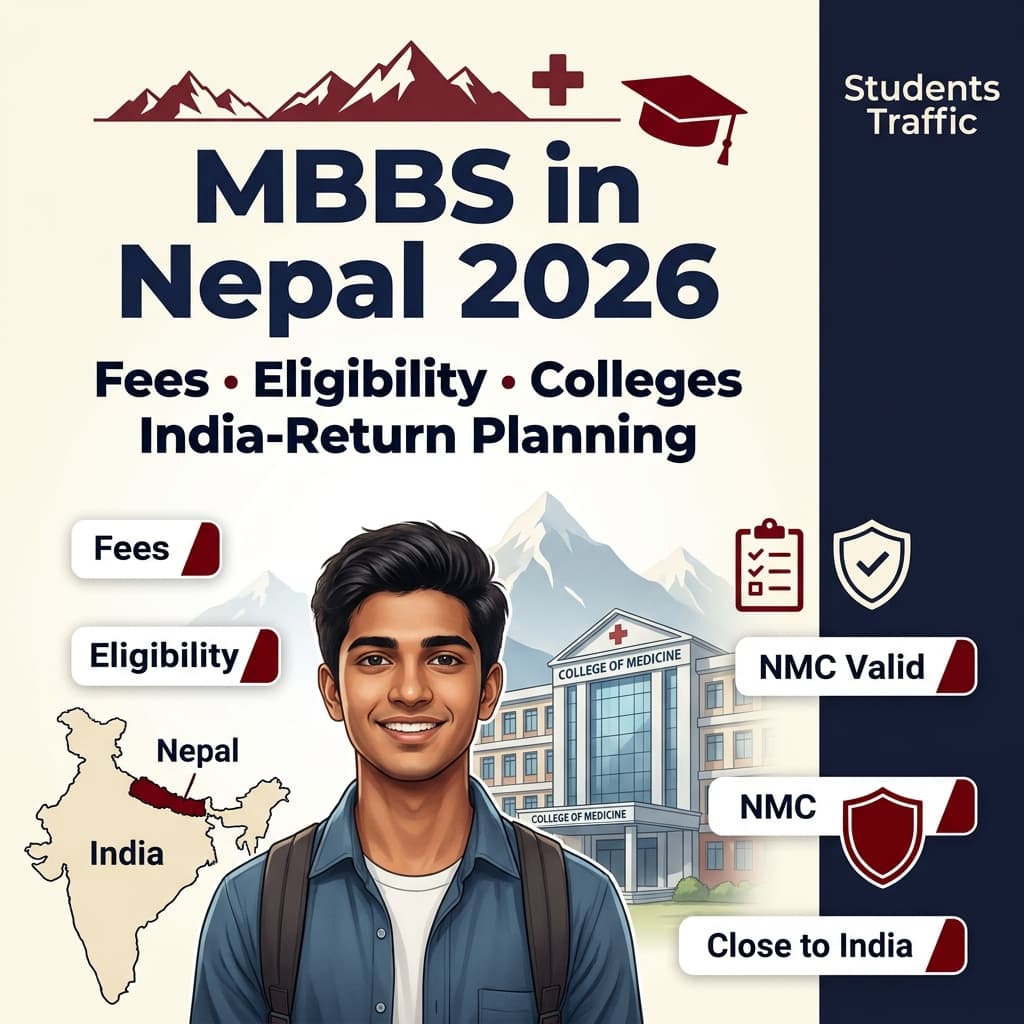
Why MBBS in Nepal Still Gets Attention From Indian Families
MBBS in Nepal has a very particular place in the mind of Indian medical aspirants.
It is rarely described as the cheapest option. It is not always marketed as the easiest option either. Yet every year, a serious set of families continues to explore it because Nepal sits in a zone that feels more familiar than many other foreign destinations.
That familiarity comes from a few obvious factors:
- geographic proximity
- cultural overlap
- food and lifestyle comfort
- shorter travel burden compared with distant countries
- and the feeling that the transition may be less intimidating for an Indian student leaving home for the first time
But familiarity can become a trap when families stop asking hard questions.
Many students hear one simplified line: "Nepal is close to India, so it must be safe and simple."
That is not a decision framework.
The real decision is more demanding:
- Which colleges in Nepal deserve serious attention?
- How competitive is the seat environment?
- What does the total budget really look like across the full course?
- Is the student choosing Nepal because it genuinely fits, or because the country feels emotionally easier to explain to relatives?
- What should families verify before paying anything?
This guide is built to answer those questions in a practical way.
The goal is not to sell Nepal as a magical solution. The goal is to help Indian families decide whether Nepal is the right six-year academic environment for their child, and if yes, how to approach it without confusion.
The First Big Truth: Nepal Is Not a Shortcut Country
One of the most useful corrections families can make early is this:
Nepal is not a shortcut route to becoming a doctor.
Students sometimes approach Nepal with the wrong assumptions:
- "Since it is nearby, admissions must be casual."
- "Since many Indians go there, selection must be automatic."
- "Since the environment feels familiar, the academic stress will also be easier."
All three assumptions can become expensive.
Nepal should be understood as a serious academic destination where the student still needs:
- proper eligibility readiness
- disciplined budgeting
- careful college selection
- and realistic expectations about seats, standards, and long-term academic pressure
Families who approach Nepal like a carefully chosen academic destination usually make better decisions.
Families who approach Nepal like a backup that will somehow take care of itself often become reactive:
- they choose the wrong college
- they underestimate the budget
- they ask too few questions
- and they confuse emotional comfort with strategic clarity
That is why the most useful mental model is this:
Nepal is a proximity advantage, not an automatic safety guarantee.
The country can be a strong fit, but only if the university, cost structure, city, and student profile line up.
Who Should Seriously Consider MBBS in Nepal
Nepal usually suits a specific kind of Indian student and family.
It tends to make more sense when the family values:
- lower adaptation stress than far-away destinations
- shorter travel time from India
- familiar food and social environment
- a setting that feels easier for parents to understand
- and a more culturally comfortable first-time move abroad
It can also suit students who are academically sincere but emotionally benefit from a destination that does not feel extremely distant or alien.
For some students, that reduction in adjustment burden matters a lot. A child who would lose months to homesickness, climate shock, or food distress in another country may preserve better academic discipline in Nepal simply because daily life feels more manageable.
That matters because the quality of a medical education is not just about tuition or brand name. It is also about whether the student can function consistently for years.
Nepal may be especially worth reviewing for families who say:
- "We want abroad, but not too far from India."
- "We care about cultural comfort and travel convenience."
- "We do not want the student to spend the first year only adjusting to weather and food."
- "We are willing to pay for a serious option if the fit is right."
At the same time, Nepal may be a weaker fit for families who are chasing only one of these:
- the absolute lowest-cost option
- the biggest international-brand marketing pitch
- or an unrealistic expectation that closeness to India eliminates all complexity
Those families should slow down. Nepal can still work for them, but not for the reasons they may currently believe.
Why Nepal Feels Safer to Parents, and Why That Feeling Should Be Tested
Parents often feel relief when Nepal enters the conversation.
Compared with many other destinations, Nepal feels easier to imagine:
- the student is closer to home
- the food system seems more familiar
- travel logistics feel lighter
- and the overall environment appears less socially distant
That parental comfort is not unimportant. In fact, it can be a real advantage.
But it should be tested, not blindly trusted.
Parents need to ask:
- Are we comfortable because Nepal genuinely fits our child?
- Or are we comfortable because we have not yet examined the academic and financial details deeply enough?
This distinction matters.
A country can feel emotionally easier while still requiring careful due diligence on:
- seat availability
- institution quality
- fee structure
- hostel life
- clinical exposure
- exam preparedness
- and long-term documentation
The strongest Nepal decisions happen when families combine both:
- emotional comfort
- and administrative discipline
That combination is powerful.
The weakest Nepal decisions happen when parents say, "At least it is Nepal," and stop the research there.
That sentence often hides the real question:
Which college in Nepal, under what budget, with what academic expectations, for what kind of student?
Until that is answered, the family does not have a decision. It only has a feeling.
Fees: The Budget Conversation Families Need to Have Early
Fee discussions around Nepal often become confusing because families mix up four different questions:
- tuition only
- first-year payable amount
- total academic cost
- complete living-inclusive cost across the course
Those are not the same thing.
A family can be comfortable with one and still struggle with the others.
When evaluating MBBS in Nepal, budget discipline should include:
- tuition across the full program
- hostel or accommodation cost
- food and day-to-day living
- books and academic incidentals
- travel between India and Nepal
- local registration or administrative costs where applicable
- emergency reserve
The biggest mistake is comparing Nepal only to the cheapest foreign destinations on headline tuition.
That comparison is usually misleading.
Nepal is often chosen for a package of value that may include:
- comfort
- proximity
- lower emotional disruption
- and smoother parent confidence
If a family wants purely minimum spend, Nepal may not always win.
If a family values stability and fewer daily-life shocks, Nepal can still be a very sensible option.
That is why the smarter budget question is not:
"Is Nepal the cheapest?"
It is:
"Is Nepal worth the total six-year spend for our child compared with India private MBBS or other abroad destinations?"
That answer depends on student profile, not only on the fee sheet.
College Selection in Nepal: Why the Country Name Is Not Enough
One of the most damaging habits in MBBS-abroad counselling is country-level thinking.
Families say:
- "We are choosing Nepal."
- "We are choosing Russia."
- "We are choosing Bangladesh."
But students do not study in countries. They study in specific colleges, in specific cities, under specific academic systems.
For Nepal, this point is critical.
Families should build their college shortlist around factors like:
- institutional credibility
- city fit
- campus environment
- hospital linkage and training depth
- hostel and student support
- batch composition
- documentation reliability
- and the family's ability to sustain the cost
A better Nepal shortlisting process looks like this:
Bucket A: Established institutions with stronger reputation pull
These attract attention because the name carries more confidence. Families who value defensibility in social and academic comparison often start here.
Bucket B: Balanced options where fit, affordability, and structure align
These can work well for families who want a serious option without treating prestige as the only variable.
Bucket C: Options considered mainly because the seat seems available
This is the danger zone. A seat that is easy to get is not automatically a seat worth taking.
If the family's final reason is only "this is what we got quickly," the decision quality is already weak.
Country comfort should never replace college-level scrutiny.
Admission Reality: What Indian Students Should Prepare For
Nepal admissions need to be treated with the same seriousness as any other international medical admission process.
Even when the country feels familiar, the family should still prepare a clean file covering:
- passport
- Class 10 and Class 12 documents
- photographs
- identity consistency
- NEET record where relevant to the student's broader pathway
- payment receipts
- offer and communication records
This file should exist in two forms:
- a digital cloud folder
- and a physical print folder
Why does this matter so much?
Because foreign medical education is a long paper trail.
Families that stay organized from day one are better prepared later for:
- visa or travel paperwork
- university registration
- semester record management
- transfer or correction issues
- and future India-return documentation
Students should also remember that an admission process has emotional stages:
- excitement
- relief
- payment urgency
- confusion over the next step
Most mistakes happen in stage three, when the family becomes afraid of losing the seat and stops asking questions.
That is the exact moment they should become more careful, not less.
Student Life in Nepal: Comfort Helps, but Routine Still Matters
Student life in Nepal is often one of the country's strongest selling points for Indian families.
Compared with more distant destinations, many students feel that the adaptation burden is lighter because of:
- more familiar food habits
- cultural overlap
- easier communication rhythms
- and a general social environment that does not feel dramatically removed from India
This can be a real advantage, especially in the first year.
But families should be careful not to over-romanticize this.
A comfortable city is not the same as a productive academic routine.
Students still need to prove they can manage:
- class attendance
- personal discipline
- budgeting
- emotional independence
- and long-term focus
Sometimes students perform worse in a "comfortable" destination because they mistakenly assume they can relax more.
That is why comfort should be used as a support factor, not as a replacement for discipline.
Parents should ask:
- Is the student self-managed enough to benefit from the comfort?
- Or does the student need a more structured environment to avoid drifting?
The right answer depends on the child, not on the marketing brochure.
Clinical Exposure and Academic Maturity: Ask Harder Questions
Medical education is not just about entering a classroom. The quality of the later years matters deeply.
When reviewing Nepal, families should not ask only:
- How close is it?
- How much does it cost?
- How many Indians are there?
They should also ask:
- How serious is the academic culture?
- What is the student's likely clinical environment?
- Is the college treated like a real medical training space or just an admissions product?
- How much hand-holding will the student actually receive?
Good colleges and good environments are rarely defined by advertising language alone.
A more useful approach is to talk with current students about:
- workload
- hospital attendance reality
- faculty accessibility
- pressure during internal assessments
- hostel conditions
- and whether the college feels better in the first year than in the later years, or the reverse
That last question matters a lot.
Some institutions look attractive at admission time but reveal weaknesses only after the student has already invested emotionally and financially.
Strong due diligence reduces that risk.
Nepal vs Other Destinations: Where It Wins and Where It Does Not
Families often need a comparison framework, not just a destination guide.
Nepal tends to win when the comparison criteria are:
- proximity to India
- travel ease
- emotional comfort for parents
- cultural familiarity
- food adaptation
- and a lighter perceived relocation burden
It may lose when the criteria are:
- absolute minimum total budget
- widest range of foreign university options
- very aggressive low-cost targeting
- or the ability to choose from a huge spread of cities and fee bands
That means Nepal should not automatically be compared only on price.
A family choosing Nepal is often buying a different kind of stability:
- emotional stability
- travel stability
- and adjustment stability
For the right student, that can be worth real money.
For the wrong student, it may become an expensive premium paid without a clear reason.
This is why the best question is:
What problem is Nepal solving for our family that another destination does not solve as well?
If the family cannot answer that clearly, the shortlist is not ready yet.
Red Flags Families Should Watch Before Choosing a Nepal College
The closer a destination feels, the easier it becomes for families to lower their guard.
That is a mistake.
Watch carefully for these red flags:
- vague fee breakup
- pressure to block a seat immediately
- no clarity on hostel quality or availability
- no serious answers about academic intensity
- no documented breakdown of what the family is paying for
- overuse of emotional lines like "This is practically India only"
- avoidance when you ask for current student conversations
- or any sign that the college choice is being driven by urgency rather than fit
A strong counsellor does not fear detailed questions.
A weak counsellor redirects everything back to comfort and speed.
That is because comfort and speed are easier to sell than academic clarity.
The right family response is simple:
slow down until the paperwork, budget, and college logic make sense.
A Practical Nepal Decision Framework for Indian Families
Before committing to Nepal, write answers to these six questions in one page:
- Why are we choosing Nepal instead of India private MBBS, Bangladesh, or another foreign destination?
- Which exact college are we comparing, and what is the case for that college specifically?
- What is the all-inclusive budget we can realistically sustain?
- What are the top three advantages for our child?
- What are the top three risks for our child?
- If something goes wrong in year one, what support system exists?
This exercise sounds simple, but it changes the quality of the decision immediately.
Why?
Because it forces the family to move from vague confidence to explicit reasoning.
Once the answers are written, weak logic becomes visible:
- "It is nearby" is not enough.
- "Our neighbour's son went there" is not enough.
- "The agent said seats are going fast" is not enough.
The decision becomes stronger only when the family's reason is durable.
A Four-Stage Nepal Planning Timeline Families Can Actually Follow
Many parents know they are interested in Nepal but do not know how to structure the research.
The easiest way to avoid panic is to break the process into stages.
Stage 1: Country fit check
At this stage, the family should ask only one question:
Why Nepal over other serious alternatives?
Possible real answers include:
- lower adaptation burden
- closer travel distance
- better emotional comfort for parents
- or a better match for the student's personality
If the answer is only "because it is nearby," the family should not move to stage two yet.
Stage 2: College shortlist check
Now the conversation becomes specific:
- which colleges
- in which cities
- under what budget
- and with what student feedback
This is where families should reduce noise and stop collecting endless options. A shortlist of three serious colleges is more useful than a list of fifteen random names.
Stage 3: Financial discipline check
At this point, the family should stop speaking in vague numbers and move to a real budget sheet:
- tuition
- hostel
- food
- travel
- emergency reserve
- and any likely extra academic or settlement costs
If the budget still depends on optimistic assumptions, the process is not mature enough.
Stage 4: Admission execution check
Only after the first three stages are reasonably clear should the family start treating the process as admission-ready.
That includes:
- final documents
- final college ranking
- payment clarity
- and a realistic conversation with the student about living away from home
This four-stage method may sound basic, but it reduces poor decisions because it forces the family to earn confidence instead of purchasing it emotionally.
FAQs Indian Students Commonly Ask About MBBS in Nepal
Is MBBS in Nepal a good option for Indian students?
It can be a strong option for Indian students who value proximity, cultural comfort, and a lower adjustment burden, but it still requires college-level due diligence and realistic budgeting.
Is Nepal the cheapest option for MBBS abroad?
Not necessarily. Families should compare Nepal on overall fit and stability, not only on headline price.
Should families choose Nepal just because it is close to India?
No. Closeness is an advantage, but college quality, total budget, and student fit matter more.
Does student life feel easier in Nepal?
For many Indian students, yes, daily-life adaptation may feel smoother. But academic success still depends on personal discipline and the quality of the selected college.
What should be verified before paying any admission amount?
Verify the exact college, fee breakup, hostel arrangement, documentation list, refund logic if applicable, and whether the student's reasons for choosing Nepal are genuinely strong.
Final Verdict: When Nepal Is the Right Answer
Nepal is rarely the right answer because it is simply "abroad but nearby."
It becomes the right answer when all of the following are true:
- the student genuinely benefits from a lower adaptation burden
- the family can sustain the budget calmly
- the selected college makes sense on its own merits
- the decision is based on paperwork and fit, not only comfort
- and the family understands that proximity does not remove the need for discipline
For the right student, Nepal can feel more liveable, less emotionally disruptive, and easier for parents to support.
For the wrong student, Nepal can become a decision made for emotional reasons without enough academic scrutiny.
That is the real takeaway.
Choose Nepal only if you can defend the exact college, the exact budget, and the exact reason it fits your child better than the alternatives.
That is how a familiar destination turns into a smart decision instead of an expensive assumption.
How Students Traffic Can Support Your Nepal Shortlist
Students Traffic helps Indian families compare MBBS in Nepal at the university level instead of buying into broad country-level assumptions. That means checking seat structure, city fit, total budget, hostel reality, documentation discipline, and how the student will handle the academic pace before any booking amount is paid.
If you want a cleaner Nepal shortlist, use Students Traffic's counselling support and peer connect to speak with students already studying abroad before you lock a college.
Related: MBBS Abroad vs Private MBBS in India 2026 | Education Loan for MBBS Abroad 2026 | MBBS Abroad Admission Process 2026 | NMC Eligibility Certificate Guide