Why This Is a Process, Not Just a Decision
Most students researching Kyrgyzstan spend weeks comparing universities, fees, and hostel photos, then rush the actual process in the last month before the intake closes. That is where avoidable mistakes happen — a missed NEET eligibility check, a document that was never apostilled, a visa application filed too late, or a student who lands in Bishkek without knowing the first thing they need to do at the airport.
This guide is not another university comparison. It walks through the actual sequence of steps — in order — that an Indian student needs to follow to study MBBS in Kyrgyzstan: who is eligible, how to shortlist and apply to a university, what documents you need and when, how the visa process works, what to expect on arrival, and what happens after you return to India and sit for the licensing exam.
If you still need to compare universities, fee structures, and city-wise costs, our complete guide to MBBS in Kyrgyzstan covers that ground in depth. This article picks up where that comparison ends — at the point where you're ready to actually apply.
Step 1: Confirm You Are Eligible Before You Do Anything Else
Before contacting any university, confirm three things. Skipping this step is the single most common reason students waste months.
1. NEET qualification
Since 2018, NMC (National Medical Commission) regulations require every Indian student pursuing MBBS abroad — including in Kyrgyzstan — to have qualified NEET-UG. There is no exception route. If you study MBBS abroad without a qualifying NEET score, you will not be allowed to register with any State Medical Council in India, regardless of how good your foreign degree is.
The qualifying standard is a percentile, not a fixed mark:
- 50th percentile for General/EWS category
- 40th percentile for SC/ST/OBC category
Because NEET is scored on a curve, the raw marks corresponding to these percentiles shift slightly every year. As a reference point, the qualifying cutoff for General/EWS in NEET 2025 was reported at 144 out of 720, and around 113 out of 720 for reserved categories — but always confirm the current year's cutoff directly from the NTA/NEET result portal rather than relying on last year's number.
Your NEET scorecard itself now functions as your eligibility document — NMC does not require a separate "eligibility certificate" application before you go, since the scorecard already confirms your qualifying status. Keep both your admit card and scorecard; universities and visa processing will ask for them.
Validity window: a qualifying NEET score is generally usable for admission for a few subsequent academic years (commonly cited as up to 3 years), so students who qualified in an earlier NEET attempt can still use that score for a later intake — but reconfirm this with your chosen university, since interpretation can vary.
2. Academic eligibility (12th grade)
You need Physics, Chemistry, and Biology (PCB) in your 12th grade (or equivalent), with:
- Minimum 50% aggregate in PCB for General category
- Minimum 40% aggregate in PCB for SC/ST/OBC category
3. Age requirement
You must be at least 17 years old by December 31 of the admission year. There is no NMC-imposed upper age limit for foreign MBBS admission.
If you meet all three, you are eligible to move to the next step. If you have not yet appeared for NEET, or did not clear the qualifying percentile, this is the point to stop and re-plan — no university abroad can substitute for this requirement, and no admission consultant can legally bypass it.
Step 2: Choose the Right University for You
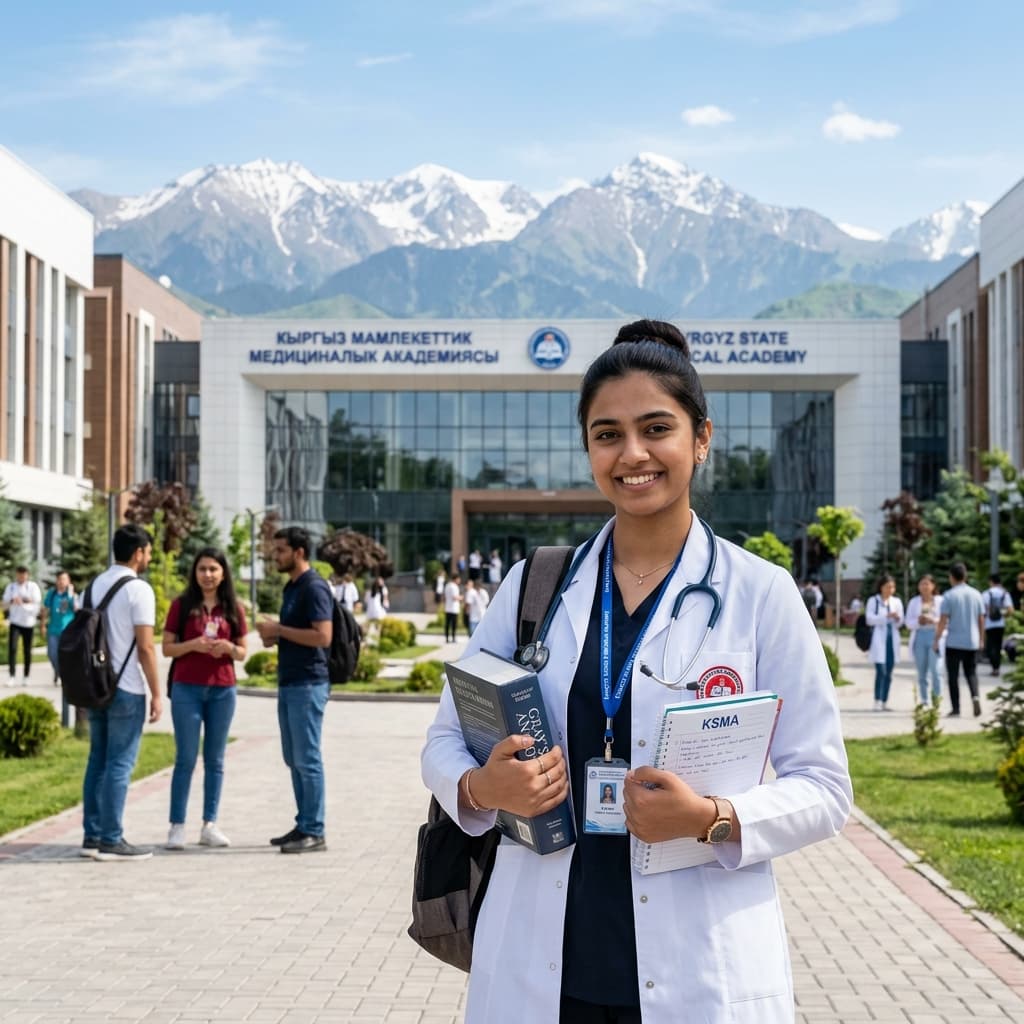
Kyrgyzstan has several NMC-recognized medical universities — Osh State University, Kyrgyz State Medical Academy (KSMA) in Bishkek, Jalal-Abad State University, Kyrgyz-Uzbek International University, and others. Rather than repeating that comparison here, see our complete MBBS in Kyrgyzstan guide for a full breakdown of each university's strengths, city, fee range, and clinical exposure.
What matters procedurally at this stage:
- Verify current NMC/WDOMS status directly. Before shortlisting any university, check its current listing on the NMC website and the World Directory of Medical Schools (WDOMS/FAIMER). Recognition is university-specific and can change — never rely on a brochure or agent's word alone.
- Decide city vs. cost trade-off. Bishkek (capital) offers more infrastructure and a bigger hospital network; Osh and Jalal-Abad are more affordable with a large, well-established Indian student community.
- Talk to current students if possible. Ask specifically about hostel conditions, mess quality, clinical rotation access, and how responsive the university's international office is — these vary more than fee sheets suggest.
- Shortlist 2–3 universities, not one. Having a backup avoids losing an admission cycle if your first choice's seats fill or documentation gets delayed.
Step 3: The Application — Documents and Sequence
Once you've shortlisted a university, the application itself is comparatively simple — most Kyrgyz medical universities accept direct applications with no separate entrance exam, though some conduct a basic screening interview.
Documents checklist
| Document | Notes |
|---|---|
| 10th and 12th mark sheets & certificates | Original + scanned copies |
| NEET admit card and scorecard | Proof of qualifying percentile |
| Passport | Valid for at least 18–24 months; apply now if you don't have one |
| Passport-size photographs | Per university's specific format |
| Birth certificate | Some universities require this at enrollment |
| Medical fitness certificate | From a certified doctor; HIV and general fitness tests are typically required |
| Bank statement / proof of funds | Parent/guardian statement showing ability to fund tuition and living costs |
| Travel and health insurance | Often arranged through the university or a partner agency |
| Passport-size photo-matching application form | University-specific admission form |
Application sequence
- Submit the university application form along with scanned copies of your documents (10th/12th marksheets, NEET scorecard, passport).
- Receive conditional acceptance/offer from the university's admissions office — usually within a few weeks.
- Pay the initial tuition installment (or admission confirmation fee, depending on the university's policy) to confirm your seat.
- Receive the official Invitation Letter from the university. This is the single most important document in the entire process — it is what your student visa application is built around.
- Begin document attestation (see Step 4) in parallel with visa preparation, so you are not scrambling to get documents ready after receiving the invitation letter.
Step 4: Document Attestation — Don't Underestimate the Timeline
This is the step students most often leave too late. Indian educational documents typically need to be authenticated before they carry weight for a foreign university/visa file. The standard chain is:
- State HRD attestation — your state's Human Resource Development department verifies and attests your 10th/12th certificates (this itself may first require university-level verification for degree certificates, though for MBBS admission it's usually your school-leaving certificates that need this).
- MEA Apostille — once HRD-attested, the Ministry of External Affairs applies the Apostille (India has been a member of the Hague Apostille Convention since 2005, so an Indian apostille is recognized in member countries without further embassy legalization in many cases — but always confirm Kyrgyzstan's specific requirement, since not all bilateral document rules are identical).
- Notarized translation, if required — some Kyrgyz institutions or immigration authorities want key documents translated into Russian or Kyrgyz and notarized locally or by an approved translator.
Budget 3–5 weeks for the HRD + MEA apostille chain alone, longer if your state's HRD office is backlogged. Start this the moment you decide to apply — do not wait for the invitation letter to arrive first.
Step 5: Intake Timeline — When to Do What
Kyrgyzstan's medical universities primarily run a single main intake starting in September, with classes typically commencing around September–November. Some universities may accommodate limited late admissions into a spring intake, but September remains the primary cycle for Indian students. Always confirm current-year deadlines directly with your shortlisted university, since exact dates shift slightly year to year.
A realistic planning timeline looks like this:
| Phase | Approximate window | What happens |
|---|---|---|
| Research & university shortlisting | March – May | Compare universities, verify NMC/WDOMS status, shortlist 2–3 options |
| Application submission | April – June | Submit forms and scanned documents; receive conditional offer |
| Fee payment & Invitation Letter | June – July | Pay confirmation fee; receive official university invitation |
| Document attestation (HRD + MEA apostille) | Run in parallel, ideally starting May–June | Get school certificates HRD-attested and apostilled |
| Visa application | July – August | Submit to Kyrgyzstan Embassy (Delhi) or Consulate; 10–20 working days processing is typical |
| Travel & arrival | Late August – September | Fly in ahead of the university's registration deadline |
| Local registration | Within ~72 hours of arrival | University registers you with local migration authorities — mandatory, not optional |
| Orientation & classes begin | September – November | Academic year starts |
If you are reading this outside the main window, don't panic — but treat every stage above as something to start earlier rather than later. Visa and apostille delays are the two most common reasons students miss an intake entirely.
Step 6: The Visa Process
Kyrgyzstan issues a long-term student visa (categorized as a study/student visa, sometimes referenced as Type "S" or "D" depending on current classification) tied directly to your university's invitation letter. In practice:
- University issues the Invitation Letter — this must exist before you can apply for the visa; there is no way to shortcut this step.
- Submit your visa application to the Embassy of the Kyrgyz Republic in New Delhi (or the relevant consulate, if applicable) with your passport, invitation letter, medical fitness certificate, and proof of funds.
- Processing time is typically 10–20 working days, though this can vary — apply with buffer time rather than assuming the shortest estimate.
- Pay the visa fee as specified by the embassy at the time of application.
- Collect your visa and confirm your flight booking only after the visa is in hand, unless your university/agent has explicitly advised otherwise.
Keep physical and scanned copies of every document you submit for the visa — you will need most of them again at arrival and for local registration.
Step 7: Arrival and Settling In
Once you land in Kyrgyzstan, there are a few procedural things to get right in the first week:
- Airport pickup: most universities arrange or coordinate airport pickup for new international students — confirm this in advance so you know exactly who to expect and where to meet them.
- Local registration: Kyrgyz immigration rules require the university to register new foreign students with the local authorities, generally within about 72 hours of arrival. This is a legal requirement, not paperwork you can defer — make sure your university's international office actually processes it and don't assume it happens automatically.
- Hostel/accommodation check-in: carry copies of your invitation letter, passport, and admission documents — hostel administration will typically ask for these at check-in.
- SIM card and banking: getting a local SIM is usually straightforward with just your passport. International debit/forex cards work for larger payments; don't expect to find Indian banks locally.
- Orientation week: use this period to understand the academic calendar, locate the Indian student association or representative council (most universities with a significant Indian population have one), and get a sense of the mess/food arrangements before committing to a monthly plan.
Step 8: What Happens During the Course
The MD/MBBS-equivalent program in Kyrgyzstan generally runs 6 years, including a clinical internship year, aligned to the 12-semester structure common across Central Asian medical universities. During this period, the procedural milestones that matter for your eventual return to India are:
- Keep your academic transcripts organized semester by semester — you will need these later for degree verification and NMC-related documentation.
- Track your internship documentation carefully in the final year — the 12-month clinical internship needs to be properly recorded on your transcript/certificate, since NMC's Foreign Medical Graduate Licentiate (FMGL) Regulations require this to be verifiable.
- Start preparing for the Indian licensing exam early, ideally from your clinical years onward, rather than waiting until you graduate (see Step 9).
Step 9: Coming Back — FMGE/NExT and Indian Licensing
This is the step many students underestimate, and it's the one that actually determines whether your six years abroad translate into a license to practice in India.
Current status (2026)
As of 2026, the National Exit Test (NExT) — which is meant to eventually serve as the unified licensing exam for both Indian and foreign medical graduates — has been deferred for foreign medical graduates. The FMGE (Foreign Medical Graduate Examination) remains the operative licensing exam for students returning with a foreign MBBS/MD degree. Students graduating and appearing for FMGE in 2026 will do so under the existing FMGE system; NMC has indicated NExT implementation for foreign graduates will follow at a later date, so treat this as a moving target and reconfirm the current rule shortly before you graduate, not based on what was true when you enrolled.
What you need to clear FMGE (or NExT, once applicable)
- Your foreign medical degree must come from a university listed in the WDOMS and satisfy NMC's FMGL Regulations 2021 — course duration (minimum 54 months of academic study), a 12-month internship, 100% English medium instruction, and host-country licensing eligibility.
- You register for and appear in the FMGE, conducted twice a year, through the National Board of Examinations.
- On clearing FMGE, you're eligible to register with a State Medical Council or the National Medical Register and begin practicing/pursuing further studies in India.
- If NExT for foreign graduates comes into effect before you graduate, expect a two-part structure — a theory step (NExT-1) that must be cleared before your internship, and a practical/clinical step (NExT-2) after — but do not plan your final years around this until NMC issues a confirmed applicability date for your graduating batch.
Practical advice for the process
- Start structured FMGE/NExT-oriented preparation from your 3rd or 4th year onward, alongside regular coursework — don't wait until after graduation.
- Keep every academic document, semester mark sheet, and internship record backed up (digital + physical) through all six years. Reconstructing lost records after leaving the country is far harder than keeping them organized as you go.
- Budget for a second attempt. FMGE pass rates for foreign graduates have historically been moderate, not guaranteed — plan preparation and finances with that reality in mind.
A Quick Reality Check Before You Start
None of the steps above are difficult individually. Where students actually get stuck is sequencing — starting the visa process too late, discovering an apostille backlog right when the invitation letter arrives, or realizing in year 5 that internship documentation wasn't tracked properly. Treat this as a project with a timeline, not a single decision made once and forgotten.
If you've already decided Kyrgyzstan is the right country and now need help comparing specific universities, verifying current fee structures, or a second review of your NEET eligibility before you commit, talk to Students Traffic for admissions guidance, or use peer connect to hear directly from students currently studying in Bishkek, Osh, or Jalal-Abad about what the process actually felt like from the inside. We can also help you build a realistic document and visa timeline so nothing gets rushed in the final month before intake.
Frequently Asked Questions
Q: Do I need to qualify NEET to study MBBS in Kyrgyzstan?
Yes. NMC regulations make NEET qualification (50th percentile for General/EWS, 40th percentile for SC/ST/OBC) mandatory for any Indian student pursuing MBBS abroad, including Kyrgyzstan. Without a qualifying score, you will not be able to register to practice in India regardless of your foreign degree.
Q: Is there an entrance exam for Kyrgyz medical universities?
Most Kyrgyz medical universities do not require a separate entrance exam for international students — admission is generally based on your 12th-grade PCB marks and NEET qualification. Some universities may conduct a basic screening interview.
Q: How long does the whole admission-to-departure process take?
Realistically, plan for 3–5 months from application to departure once you account for document attestation, visa processing, and university confirmation timelines. Starting early — ideally by March–April for a September intake — gives you the most buffer.
Q: When is the intake for MBBS in Kyrgyzstan?
The primary intake is in September, with classes typically starting between September and November. Some universities may offer limited flexibility for late admissions, but September remains the main cycle.
Q: What is the visa processing time for Kyrgyzstan?
Typically 10–20 working days once your invitation letter and complete documentation are submitted to the embassy or consulate, though this can vary — apply with buffer time.
Q: Will I need to appear for FMGE or NExT after returning from Kyrgyzstan?
As of 2026, FMGE remains the applicable licensing exam for foreign medical graduates, since NExT implementation for this group has been deferred. Reconfirm the current rule close to your graduation year, as this is expected to change over time.
Q: Is my NEET score still valid if I qualified a year or two ago?
Qualifying NEET scores are generally usable for admission for a few subsequent years, but validity interpretation can vary by university and current NMC guidance — confirm directly with your shortlisted university before assuming your score is still applicable.
Q: What documents need apostille for MBBS in Kyrgyzstan?
Typically your 10th and 12th certificates go through state HRD attestation followed by MEA Apostille. Budget 3–5 weeks for this chain, and start it as soon as you decide to apply rather than waiting for your invitation letter.
Q: Can I switch universities within Kyrgyzstan after starting?
This is possible in principle but administratively complex, and can affect your academic continuity and internship documentation. It's far better to shortlist carefully upfront (see Step 2) than to plan on switching later.
Q: Where can I compare specific Kyrgyz universities and their fees?
See our complete MBBS in Kyrgyzstan guide for university-by-university profiles, itemized living costs, and curriculum breakdowns.