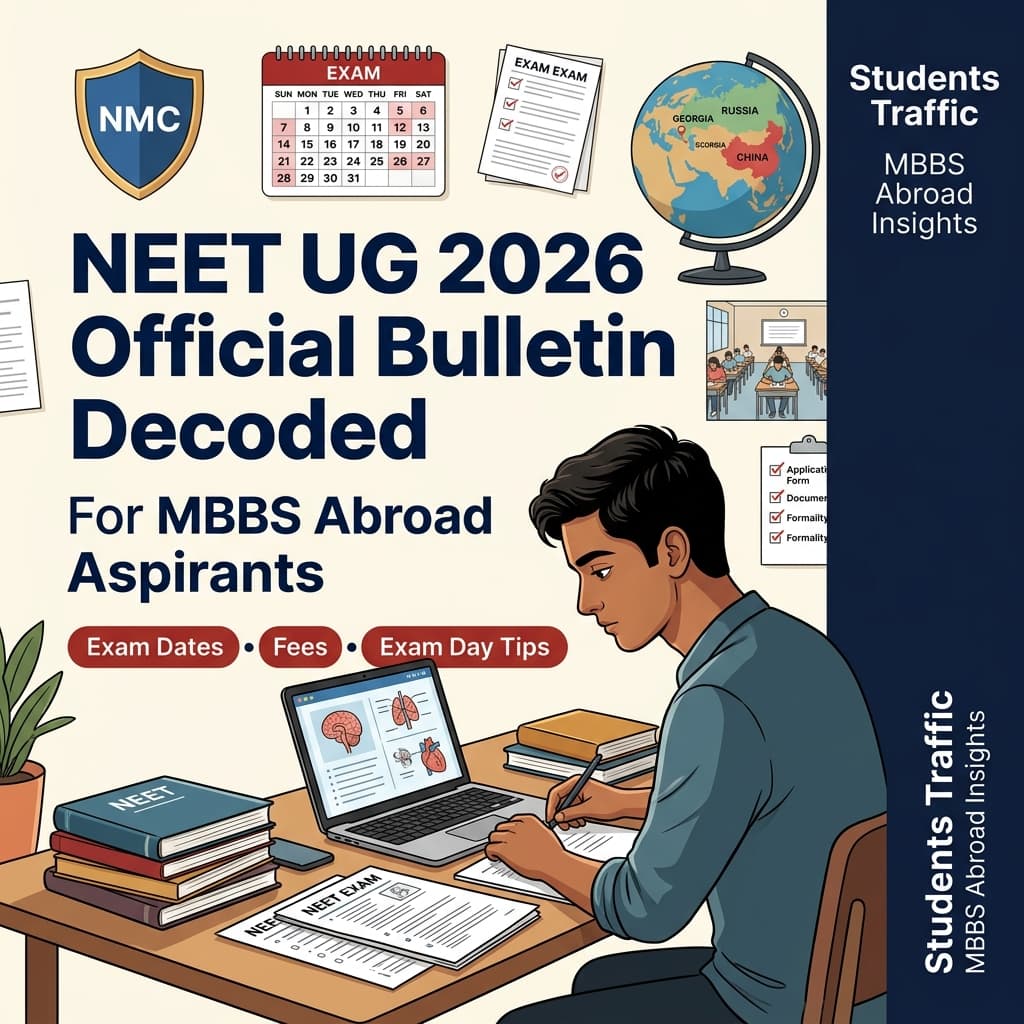
NEET UG 2026 Official Bulletin Decoded for MBBS Abroad Aspirants
The NEET UG 2026 information bulletin matters to every MBBS abroad aspirant even if the family is still emotionally undecided between India and overseas options.
Why?
Because for Indian students, NEET is not a decorative formality before going abroad. It is the gateway condition that shapes what happens later when the student wants to return, pursue licensure, and build a legitimate medical career in India.
And because the official bulletin is now available, families no longer need to plan from rumours.
The official bulletin published on the NEET website shows these key dates:
- online application window: 08 February 2026 to 08 March 2026 up to 9:00 PM
- last date for successful fee transaction: 08 March 2026 up to 11:50 PM
- correction window: 10 March 2026 to 12 March 2026
- exam date: 03 May 2026 (Sunday)
- exam timing: 2:00 PM to 5:00 PM IST
The same bulletin also notes that city intimation, admit card download, response sheet release, answer keys, and results will be announced later on the official websites.
That combination tells families something important:
the fixed part of the NEET 2026 cycle is already clear, but the student still needs to stay alert for later notices rather than assuming everything important is already known.
This article is a practical guide for MBBS abroad aspirants and their parents. It explains what the official bulletin says, what it means in plain language, and what you should do next if you are trying to protect both the student's exam attempt and the larger admissions decision.
Why This Bulletin Matters Specifically for MBBS Abroad Students
A lot of families still make this mistake:
they treat NEET seriously only if the target is MBBS in India, but treat it casually if the target is abroad.
That is poor planning.
For MBBS abroad aspirants, NEET matters because:
- it is a qualifying filter tied to future India-return legitimacy
- it influences how calmly the family can choose between India and abroad later
- it affects the student's confidence and bargaining power during counselling
- it helps prevent desperate, rushed, sales-driven admission decisions
Students who qualify NEET keep more doors open.
Students who fail to qualify do not just lose one exam attempt.
They often lose clarity, become vulnerable to misinformation, and start hearing dangerous half-truths such as:
- "Abroad ke liye itna important nahi hai"
- "First year join kar lo, baad mein de dena"
- "Documentation manage ho jayega"
Families should be very careful with such claims.
The safer mindset is:
NEET is part of the foundation, not an optional accessory.
The Official Timeline, in Plain English
Let us decode the exact schedule from the bulletin.
1. Application window
The bulletin states that the NEET UG 2026 application form opened on 08 February 2026 and closed on 08 March 2026 at 9:00 PM.
For families reading this now on 10 April 2026, that means the application phase is over.
So if a student did not apply at all, the question is no longer "What documents do I upload?"
The question becomes:
"What is the plan for this year if NEET application was missed?"
That is a much more serious situation than a small form mistake.
2. Fee payment window
The last date for successful fee payment was 08 March 2026 up to 11:50 PM.
This matters because some families think submitting the form is enough.
It is not.
Successful transaction is part of valid submission.
3. Correction window
The bulletin gives a correction period of 10 March 2026 to 12 March 2026.
That means as of 10 April 2026, the correction window is also over.
So if a student is now discovering an application mistake, the family should stop assuming there is still time to correct it casually.
They should watch for any specific NTA public notice, but they should not assume the official correction facility remains open.
4. Exam date and timing
The exam is scheduled for 03 May 2026, a Sunday, from 2:00 PM to 5:00 PM IST.
For an aspirant reading this in mid-April, this changes the planning conversation.
The admission season is no longer a distant idea.
It is now a countdown.
The Official Fee Structure From the Bulletin
The bulletin lists these NEET UG 2026 application fees:
| Category | In India |
|---|---|
| General | Rs 1700 |
| General-EWS / OBC-NCL | Rs 1600 |
| SC / ST / PwBD / PwD / Third Gender | Rs 1000 |
For candidates applying from outside India, the bulletin lists the fee as Rs 9500.
These figures matter less for total career planning than tuition decisions do, but they still matter because they confirm that the official process should be read from the bulletin itself, not from random coaching graphics or reposted screenshots.
Even small inaccuracies in exam planning usually point to a larger habit:
the family is relying on second-hand information.
That same habit becomes dangerous later during MBBS-abroad admissions.
What the Bulletin Does Not Yet Give You
Families should notice what is still marked as "to be announced later on the website":
- city intimation
- admit card availability
- recorded responses and answer keys
- result date
This is why candidates should keep monitoring the official NEET website instead of mentally switching off after filing the form.
In practice, many students become passive after the correction window closes.
That is a mistake.
Between now and the exam, the student should expect at least these practical checkpoints:
- city intimation slip
- admit card release
- exam-day instructions reinforced through notices
And after the exam:
- provisional answer key process
- challenge window, if announced
- final result
Every one of those moments affects stress levels.
Prepared students handle them better because they know the sequence in advance.
What MBBS Abroad Aspirants Should Be Doing Right Now
As of 10 April 2026, MBBS abroad aspirants are in a very specific phase.
The form and correction stages are over.
The exam is less than a month away.
So the student should not be doing random activities.
The student should be doing the right things in the right order.
Priority 1: Protect the exam attempt
Right now, the student's first duty is still NEET performance.
Not country selection.
Not university fantasy.
Not brochure browsing for six hours a day.
The exam attempt is the most valuable short-term asset.
A calm NEET attempt gives the family more control later.
Priority 2: Clean up the document file
Even before results, every family should keep a disciplined admissions file ready:
- passport or passport application status
- Class 10 and 12 documents
- NEET application details
- category certificate if relevant
- identity documents
- parent income and address documents
Families who prepare this early make better decisions later because they are not operating in chaos.
Priority 3: Build a shortlist logic, not a final shortlist
This is the right time to think about how you will compare options later.
For example:
- budget ceiling
- willingness to consider India private MBBS
- need for city safety and support
- importance of hostel discipline
- tolerance for language transition
This is not the time to emotionally commit to a random country because an agent says "this is the best option for 2026."
A 3-Phase Plan From Now Until the Exam
Families handle NEET better when they know what to focus on week by week.
Phase 1: Stabilize
From now until the city-intimation and admit-card window, the student should stabilize routine:
- fixed mock-test rhythm
- sleep timing close to exam hours
- revision pruning
- reduced distraction
This is not the moment to chase twenty new sources.
It is the moment to improve reliability.
Phase 2: Operational readiness
Once the admit card and city information are available, practical readiness matters:
- confirm exam center city
- understand travel time
- verify allowed documents
- keep backup transport planning
Too many families create avoidable exam-day stress because operational planning begins too late.
Phase 3: Psychological discipline
The final two weeks should not be consumed by panic-scrolling.
Students should reduce exposure to:
- rank predictor noise
- cut-off fear threads
- agent pressure
- endless comparison with other candidates
The exam is already stressful enough.
Do not add commercial noise to academic pressure.
The Bigger Strategic Mistake: Deciding Abroad Before the Score
Some families decide too early that the student will definitely go abroad, no matter what.
Others decide too early that private MBBS in India is the only respectable option.
Both extremes reduce decision quality.
Before the NEET score is known, the family should preserve optionality.
That means:
- do not overspend emotionally on a single path
- do not pay a registration amount to create artificial certainty
- do not confuse counselling calls with real decision-making
The most mature posture before the exam is:
prepare hard, keep options open, decide after evidence arrives.
That evidence includes:
- NEET performance
- likely counselling position
- private-college affordability
- abroad shortlist quality
How MBBS Abroad Aspirants Should Read Their Result Later
The result phase is where many families lose discipline.
They react emotionally to a score without understanding what the score really means for the next step.
In broad terms, students should interpret the result through four practical lenses:
Lens 1: Did the student qualify?
For MBBS abroad planning, qualifying is the first structural question.
If the student does not qualify, the family should slow down immediately and reassess the whole year's plan carefully.
Lens 2: Is India still realistically in play?
Qualification alone is not the same as having a strong India option.
Families should examine whether:
- government MBBS is realistic
- dental or allied options enter the conversation
- private MBBS is financially realistic
Lens 3: What is the real budget?
This is where many families become inconsistent.
They say the student "must become a doctor this year" but the budget reality does not support the premium choices they are imagining.
The result should trigger an honest budget conversation, not a dramatic one.
Lens 4: What kind of student is the child?
Result interpretation should also include profile fit:
- can the student live away from family for six years?
- is the student disciplined enough for long-term licensing preparation?
- is the student better served by a highly structured environment?
The same score can lead two different families to two different correct decisions.
That is normal.
What Parents Should Not Do After the Exam
There are several predictable mistakes after NEET:
Mistake 1: Paying to reduce anxiety
Families often pay a registration amount not because the option is best, but because the payment creates temporary emotional relief.
That is not strategy.
That is stress management disguised as decision-making.
Mistake 2: Believing urgency lines without evidence
Common examples:
- "Seats are almost full."
- "If you don't block now, fees will go up."
- "This university is closing admissions in two days."
Some urgency can be real in later admission stages.
But immediately after NEET, much of this language is simply used to stop the family from comparing properly.
Mistake 3: Confusing country popularity with student fit
The loudest country in the market is not automatically the best country for your child.
The right choice depends on:
- budget
- language tolerance
- academic maturity
- hostel expectations
- India-return planning
A Smarter Post-NEET Workflow for Families
If the student sits for NEET on 03 May 2026, this is the calmer workflow families should follow afterward:
- finish the exam without turning the same evening into a counselling circus
- wait for a stable self-assessment instead of reacting to rumor keys
- prepare the financial and document file
- compare India and abroad honestly
- speak with current students, not only admissions reps
- shortlist universities only after budget and profile fit are clear
That order protects families from manipulative sales behavior.
Why the Official Bulletin Should Change the Tone at Home
One underrated function of the bulletin is psychological.
It makes the process real.
Once the dates are official, the family should stop speaking in vague future tense.
Not:
- "Dekhenge"
- "Ho jayega"
- "Abhi time hai"
Instead:
- the application window is over
- the correction window is over
- the exam is on 03 May 2026
- admit-card and city updates still need to be tracked officially
This sharper language improves discipline.
Students usually study better when the adults around them become clearer too.
An Exam-Day Readiness Checklist for MBBS Abroad Aspirants
Even though NEET is an academic test, exam-day logistics still matter because one avoidable mistake can damage the entire year's planning.
Students should prepare a simple checklist:
- admit card once released
- valid photo identity
- photo and other bulletin-required items
- travel route and reporting-time buffer
- sleep routine aligned to a 2:00 PM to 5:00 PM exam
This matters because many students from anxious households lose energy on the day for non-academic reasons:
- late travel start
- confusion about center location
- wrong document assumptions
- poor meal timing
- too much last-minute discussion about "what happens if score is low"
Families should protect the student's exam-day calm.
That means the home environment in the final 48 hours should become quieter, not louder.
A Post-Result Decision Matrix Families Can Use
When the result eventually comes, parents should not jump straight from score to payment.
They should use a decision matrix.
Decision question 1: Is India government MBBS realistically in the picture?
If yes, the family should compare that route seriously before discussing expensive alternatives.
Decision question 2: If India private MBBS is possible, is it financially wise?
Possible and wise are not the same thing.
Families must compare:
- total tuition
- hostel and living cost
- debt burden
- quality of the actual college available
Decision question 3: If abroad is the main route, what is the right budget band?
Not:
"Which country is best?"
But:
"Which country-university band is actually supportable for this family without creating damaging financial pressure?"
Decision question 4: What kind of environment suits the student?
The student who needs intense support, lower emotional disruption, and closer supervision may need a different shortlist from the student who adapts quickly and works independently.
This matrix turns the NEET score into a usable decision instead of an emotional trigger.
Why This Update Should Reduce Panic, Not Increase It
Some parents read official notices and become more anxious because the dates make everything feel immediate.
But the bulletin should actually reduce panic.
Why?
Because official information replaces guesswork.
You now know what is fixed and what is still pending.
You know the application and correction windows have passed.
You know the exam is on 03 May 2026.
You know later steps such as admit card, city intimation, and result still need official monitoring.
This is useful clarity.
Families who accept the timeline usually make better choices than families who keep hoping for unofficial flexibility or secret shortcuts.
The Real Link Between a Good NEET Attempt and a Better Abroad Decision
Families sometimes assume that if the likely destination is abroad, the exact quality of the NEET attempt is less important.
That is a mistake.
A stronger NEET attempt improves the student's position in several ways:
- it keeps more India options alive
- it reduces desperation in counselling conversations
- it makes the family less vulnerable to "take this seat right now" pressure
- it strengthens the student's own confidence during the admission season
Even when the final destination becomes abroad, a serious NEET attempt often leads to a better-quality final decision because the family is choosing from a position of control rather than fear.
That is one reason this bulletin should be treated as more than a notice.
It is a planning anchor.
What This Means for Students Still Unsure About MBBS Abroad
If you are still unsure about MBBS abroad, that uncertainty is not a problem.
What would be a problem is using that uncertainty as an excuse to become passive.
At this stage, you do not need to know your final country.
You need to know your process.
That process is:
- give NEET your best attempt
- preserve documentation
- understand your real budget
- refuse pressure-based admissions tactics
- compare options only after enough evidence exists
That is how strong families stay in control.
Final Practical Verdict
The official NEET UG 2026 bulletin has already given families the most important fixed anchors:
- application window: 08 February 2026 to 08 March 2026
- correction window: 10 March 2026 to 12 March 2026
- exam date: 03 May 2026
- exam time: 2:00 PM to 5:00 PM IST
For MBBS abroad aspirants, the lesson is simple:
this is no longer the stage for vague intentions.
It is the stage for disciplined execution.
Protect the exam attempt first.
Protect future optionality second.
And when the score arrives, convert it into a calm, budget-aware, document-driven admissions decision instead of an anxious one.
How Students Traffic Can Help After NEET 2026
The biggest mistake after NEET is letting urgency replace clarity. Students Traffic helps families convert the score into a realistic plan: India counselling possibility, budget fit, country shortlist, documentation readiness, and the gap between a marketed university and a workable six-year pathway.
If you want your NEET result translated into a calmer MBBS-abroad decision, use Students Traffic counselling support and peer connect before paying any registration amount or booking a seat in haste.
Related: MBBS Abroad | Contact Students Traffic | Talk to Students Abroad