MBBS Abroad vs BDS in India 2026: Which Is Better for You?
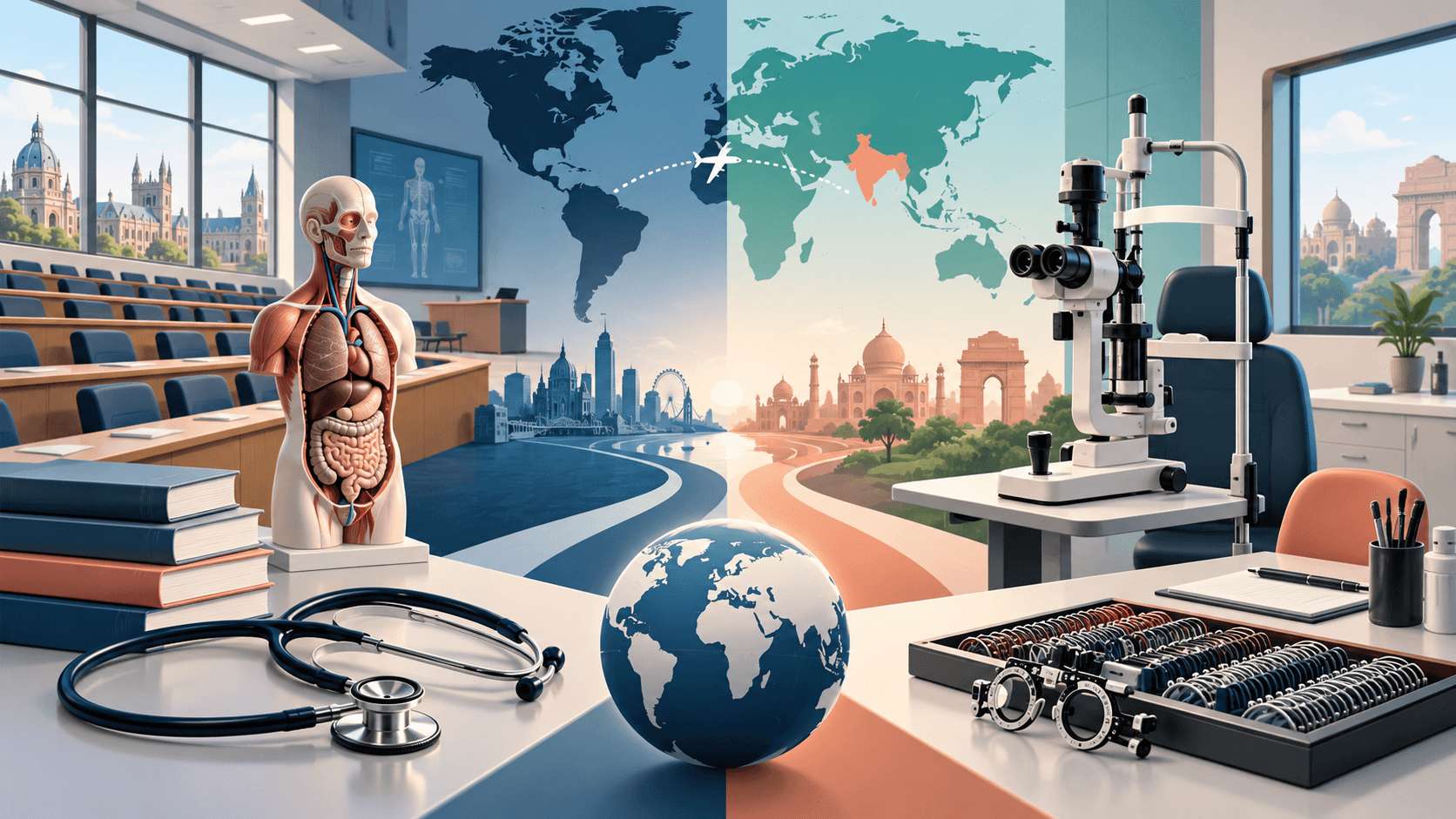
If your choice is between MBBS abroad and BDS in India, the better option depends on the kind of clinician you want to become, the total budget your family can sustain, and where you want to practise after graduation. MBBS abroad is the route toward becoming a physician, but it adds foreign-university verification, overseas living, and India-return licensing requirements. BDS in India is a focused dental degree with a more familiar admission and registration pathway, but it does not lead to work as a general medical doctor.
The short answer is simple: choose MBBS abroad only when you genuinely want whole-body medicine and have verified a compliant university, a realistic six-year budget, and a plan for NExT/India registration. Choose BDS in India when you are comfortable building a career around oral health, enjoy precise clinical work, and want to study and begin registration within India. Do not choose BDS merely as a consolation prize, and do not choose an overseas MBBS seat merely because it sounds like a shortcut.
MBBS abroad vs BDS in India: quick comparison
| Decision factor | MBBS abroad | BDS in India |
|---|---|---|
| Professional direction | Physician and medical specialties | Dentist and dental specialties |
| Academic commitment | At least 54 months of foreign medical education under the NMC FMGL framework, plus required internship and India-return steps | Four-year BDS course followed by a one-year rotating internship under the applicable dental framework |
| Admission | NEET qualification, university eligibility, document checks, visa and foreign-institution verification | NEET-UG and Indian counselling/admission rules for the selected college and quota |
| Location risk | Overseas university, city, language, banking, visa and travel conditions | Indian college, state counselling, hostel and local cost conditions |
| Licensing in India | Must satisfy rules applicable to foreign medical graduates and complete registration | Must complete BDS and internship, then follow dental registration procedures |
| Cost pattern | Tuition plus living, travel, insurance, visa, currency and support costs; varies by country and university | Tuition, hostel and living costs in India; varies by government, aided, deemed and private college |
| Best fit | Student who wants medicine, can manage uncertainty, and accepts a longer India-return pathway | Student who wants dentistry, prefers India-based training, and is ready for an oral-health career |
This is a decision framework, not a fee promise. A college’s official fee notice and a foreign university’s current written fee schedule should replace online estimates before payment.
What is the real difference between MBBS and BDS?
MBBS trains you to assess and manage patients across the body: history-taking, diagnosis, medical treatment, emergency care, surgery-related learning, and later specialisation. BDS trains you to prevent, diagnose and treat diseases and conditions of the teeth, gums, mouth and related oral structures. Dentists also work with systemic health connections, but a BDS degree does not grant the scope of an MBBS physician.
That professional identity matters more than the country name. If you are excited by internal medicine, paediatrics, surgery, anaesthesia, radiology or emergency medicine, BDS will not be an equivalent substitute. If you enjoy procedures, head-and-neck anatomy, restorative work, oral surgery, orthodontics, prosthodontics or building a dental practice, BDS may be the more coherent choice.
Which course is longer?
The planning horizon is usually longer for MBBS abroad. NMC’s Foreign Medical Graduate Licentiate Regulations, 2021 specify a minimum foreign medical course duration of 54 months and require the foreign programme to meet other conditions, including English-medium instruction and clinical training. India-return planning can add internship and registration stages, and the exact process must be checked against the rules applying to the student’s admission year.
The Indian BDS framework is commonly planned as four academic years plus a one-year rotating internship. The National Dental Commission’s current notices and the published BDS regulations should be checked for the applicable batch and institution. In either route, budget time for examinations, internship completion, document issuance and registration—not just classroom years.
Which option is more affordable?
There is no honest one-number answer. BDS in India can be less expensive when the student secures a government or lower-fee seat, lives at home, or chooses an affordable Indian city. Private, deemed and management-route BDS fees can be much higher, and hostel, instruments, clinical materials and living costs still matter.
MBBS abroad can look cheaper on tuition but become expensive in total. Add accommodation, food, local transport, insurance, visa renewals, flights, currency movement, medical tests, university charges, emergency travel and India-return preparation. A low advertised tuition figure is not a total cost of education.
Use this calculation:
Total planned cost = tuition + accommodation + food + transport + visa/insurance + travel + books/equipment + application charges + emergency buffer.
Ask for a year-wise schedule in writing. Convert foreign currency using a conservative buffer, and ask what happens if fees rise, a student repeats a year, or hostel arrangements change. Students Traffic can help families build a comparable shortlist and review scholarship or affordability fit before an application is submitted.
Which admission pathway is safer?
For BDS in India, the student applies through the applicable central or state counselling process, verifies the college’s approved intake and fee notice, and checks the university affiliation, internship arrangements and registration pathway. Never rely only on a counselling agent’s verbal assurance about a seat or refund.
For MBBS abroad, NEET qualification is only one part of the decision. Before paying, verify the university and programme against current NMC requirements, inspect the actual curriculum and clinical years, confirm the medium of instruction, understand internship arrangements, and obtain a transparent fee and refund policy. The NMC’s FMGL FAQ is useful public guidance, but the regulations and official notifications are the controlling documents.
An offer letter is not proof that a course will be suitable for India-return practice. Recognition, compliance and the student’s own documentation must be assessed together.
Which route is better for recognition and licensing in India?
For an Indian BDS graduate, the pathway is domestic: complete the approved course and internship, then apply through the relevant dental registration system and State Dental Council process. Current National Dental Commission notices should be checked because regulatory structures and implementation guidance can change.
For an Indian student graduating from a foreign medical institution, the NMC FMGL framework and related official notices determine the conditions for India-return registration. Requirements can cover course duration, clinical training, internship, examinations and documentation. The rules can depend on the date of admission and later updates. No consultancy can guarantee a licensing result, and no university should be evaluated using an agency’s claimed pass rate unless the underlying cohort data is available and clearly defined.
Read our NMC Eligibility Certificate guide and MBBS abroad return-to-India process guide alongside current NMC notices. Our MBBS abroad fees country comparison explains why tuition alone is a poor filter.
What are the career trade-offs?
MBBS abroad career direction
MBBS abroad keeps the physician route open, but it does not remove competition. After graduation, a student may plan for practice in India subject to the applicable licensing route, or investigate postgraduate and licensing pathways elsewhere. Each destination has its own exams, language rules, registration requirements and immigration conditions.
The biggest advantage is professional scope: medicine spans many specialties and healthcare settings. The biggest trade-off is execution risk. A student must manage a foreign institution, maintain academic performance away from home, build clinical confidence, and prepare early for India-return examination and registration requirements.
BDS in India career direction
BDS offers a defined dental career with options such as general practice, public-sector roles where eligible, hospital dentistry, dental clinics, public health, academics, research and MDS specialisation. Some graduates build practices gradually; others work in clinics to develop speed, patient communication and business skills.
The trade-off is that BDS is a narrower profession and early income is not guaranteed. College clinical exposure, location, mentorship, postgraduate plans and entrepreneurial ability can affect outcomes. A student who dislikes dentistry may struggle even if the college is convenient.
Which option is better for safety and family support?
BDS in India usually reduces cross-border risks: no foreign visa, fewer long-distance travel issues, easier family visits and a more familiar food and language environment. It still requires college-level checks for hostel security, ragging prevention, transport, emergency care and grievance systems.
MBBS abroad requires a more detailed safety audit. Ask where the hostel is, who manages it, what happens during an emergency, how students access Indian food and banking, whether the university provides arrival support, and what the local Indian community is actually like. Check current travel advisories and whether geopolitical or banking conditions can disrupt student life. Our MBBS abroad safety guide for Indian female students is a checklist, not a substitute for destination-specific verification.
A decision framework for students and parents
Score each statement from 1 (not true) to 5 (very true):
- I want to diagnose and treat whole-body medical conditions, not only oral conditions.
- I can accept living abroad for several years and managing homesickness, language and travel.
- My family can fund the full MBBS plan, including an emergency buffer.
- I am willing to track NMC rules, keep documents carefully and prepare for India-return licensing.
- I have compared specific universities, not just countries or agent brochures.
- I genuinely enjoy dentistry, fine-motor procedures and repeated patient interaction.
- I want undergraduate training and initial registration to remain in India.
- I would be satisfied with a dental career even if I never become an MBBS doctor.
Scores 1–5 favour deeper MBBS-abroad research; scores 6–8 favour a BDS conversation. This is not a scientific test. Its purpose is to expose a mismatch between motivation and a family’s preferred label. If the student scores high on both, compare specific colleges, budgets and career plans—not abstract prestige.
What should you verify before accepting an offer?
For MBBS abroad, request the current curriculum, fee schedule, refund policy, hostel terms, clinical training details, admission eligibility, internship structure and written India-return compliance information. Cross-check claims with NMC materials and the university itself. Do not pay a large amount under pressure because an “early seat” is about to expire.
For BDS in India, verify the college’s current approval or recognition status, counselling route, total fee including instruments and hostel, teaching hospital or clinical facility, internship completion process, university affiliation, refund policy and registration guidance. Ask current students how much hands-on clinical work they actually receive.
FAQs: MBBS abroad vs BDS in India
Q: Is MBBS abroad better than BDS in India?
Neither is automatically better. MBBS abroad fits a student who wants to become a physician and can manage overseas study plus India-return licensing. BDS in India fits a student who genuinely wants dentistry and prefers an India-based training and registration pathway.
Q: Can BDS replace MBBS for becoming a doctor?
No. BDS is a dental degree and qualifies the graduate for dentistry after the applicable internship and registration steps. It does not provide the professional scope of an MBBS physician.
Q: Is NEET required for both MBBS abroad and BDS in India?
Indian students should check current NTA, NMC and counselling rules for their admission year. NEET-UG is central to undergraduate medical and dental admissions, while foreign MBBS also requires the destination university’s rules and NMC requirements.
Q: Is MBBS abroad cheaper than BDS in India?
Sometimes overseas tuition is lower than a particular private Indian dental seat, but the comparison is incomplete without living, travel, visa, insurance, currency and India-return costs. Compare the full course cost for specific offers.
Q: How long is BDS in India?
The published BDS framework describes four academic years followed by a one-year rotating internship. Confirm the current structure, batch rules and internship implementation with the college and National Dental Commission.
Q: How long does MBBS abroad take for an Indian student?
It varies by country and university. NMC’s FMGL framework specifies a minimum foreign medical education duration of 54 months, but the full India-return timeline also includes internship, examinations, documentation and registration steps.
Q: Can an MBBS-abroad graduate practise in India immediately after graduation?
Not automatically. A foreign medical graduate must satisfy the regulations and registration requirements applicable to their course and admission year. Treat licensing as a planned pathway, not an assumption.
Q: Does BDS have good career scope in India?
BDS can lead to clinical practice, hospitals, public health, academics, research, dental technology work and MDS specialisation. Results vary with clinical exposure, skills, location, mentorship, postgraduate plans and patient trust.
Q: Should I choose BDS if my NEET score is not enough for MBBS?
Choose BDS only if you can accept dentistry as your career, not merely as a temporary label. If your goal is physician practice, compare a verified MBBS-abroad route, another eligible pathway, or a planned repeat year.
Q: What is the biggest mistake in this comparison?
The biggest mistake is comparing course names instead of the end-to-end pathway. Check the exact college or university, total cost, clinical training, recognition, internship, licensing, safety and professional motivation.
Practical next steps
- Write down whether your real goal is physician practice or dental practice.
- Set a maximum total budget, including a contingency reserve.
- Shortlist two or three specific BDS colleges and two or three verified foreign MBBS universities.
- Request current written fee, internship, refund and registration information.
- Check the latest NMC, National Dental Commission, NTA and counselling notices before payment.
- Have one family decision meeting using the same comparison table for every option.
If you want a second opinion, Students Traffic can review your NEET profile, compare a realistic MBBS-abroad shortlist with Indian BDS options, check scholarship or affordability fit, and map the documents and next steps before you commit. Start with counselling or shortlist help rather than an irreversible payment.
Sources and verification note
Verified on 12 July 2026 against the NMC rules and regulations page, the NMC FMGL FAQ, the NMC public notice on foreign medical graduates, and the National Dental Commission/erstwhile DCI gazette and notices. Fees, counselling schedules, recognition notices, visa rules, examination policies and licensing requirements can change; verify the latest official notice for your admission year and institution before paying.