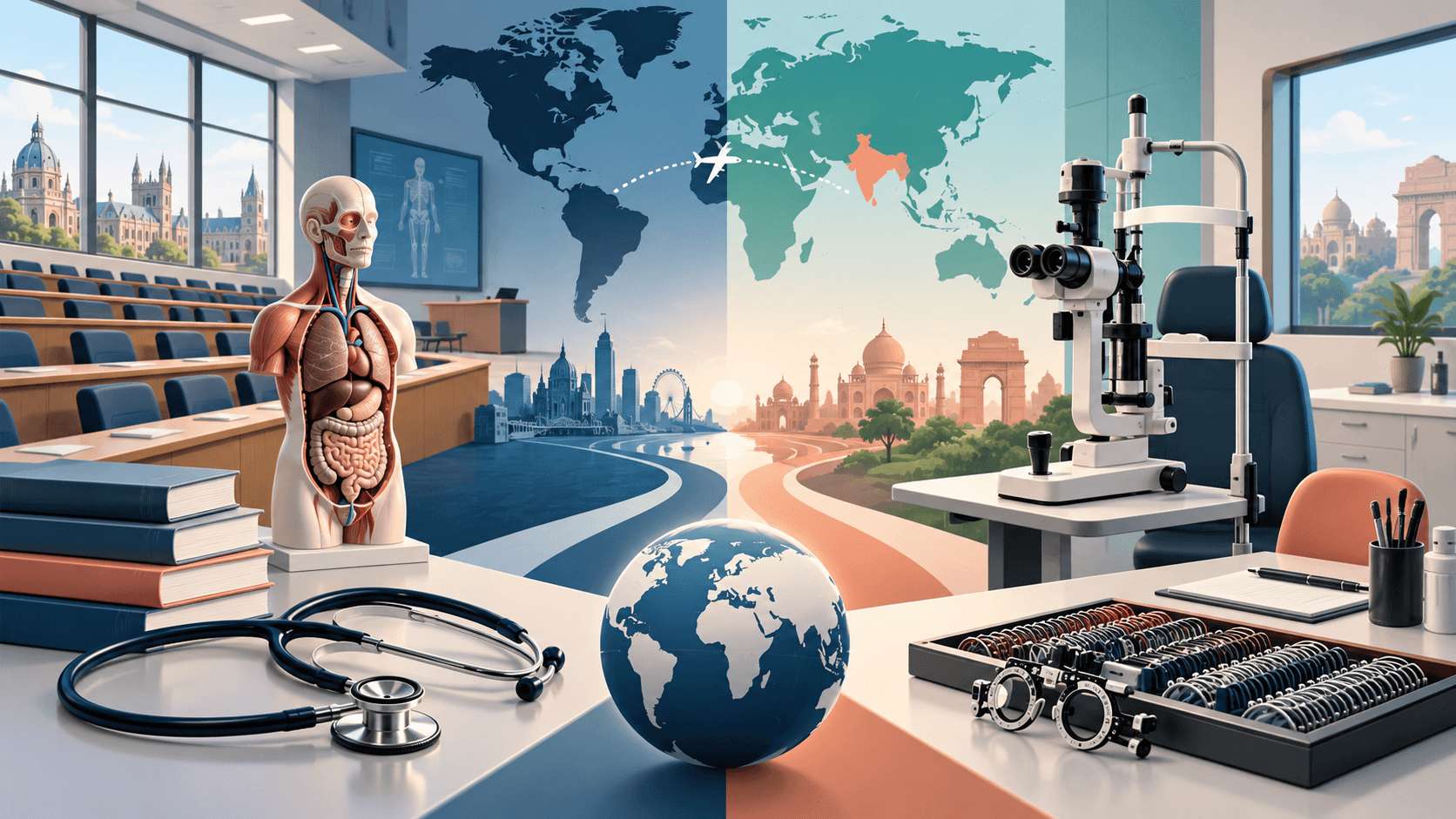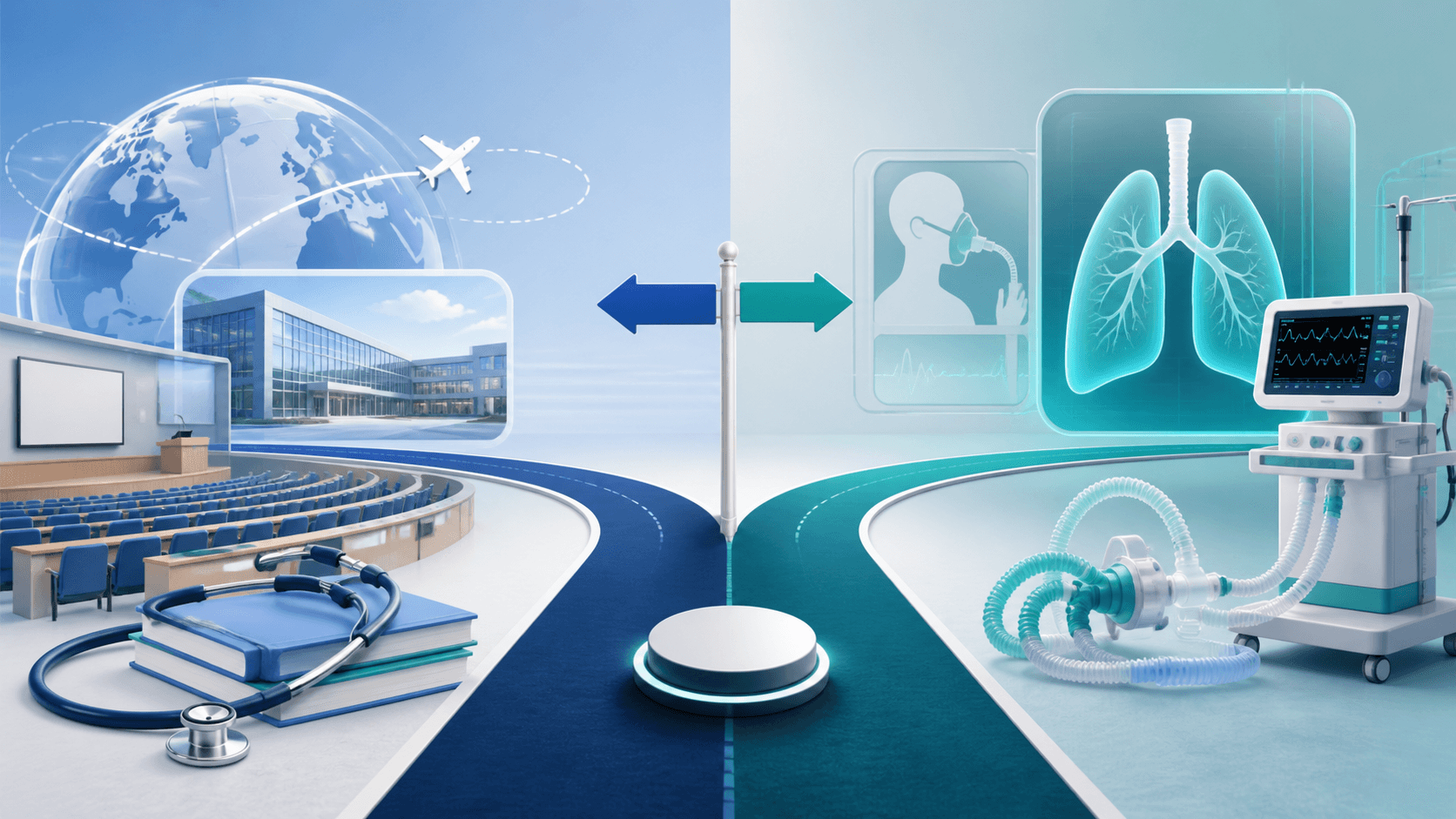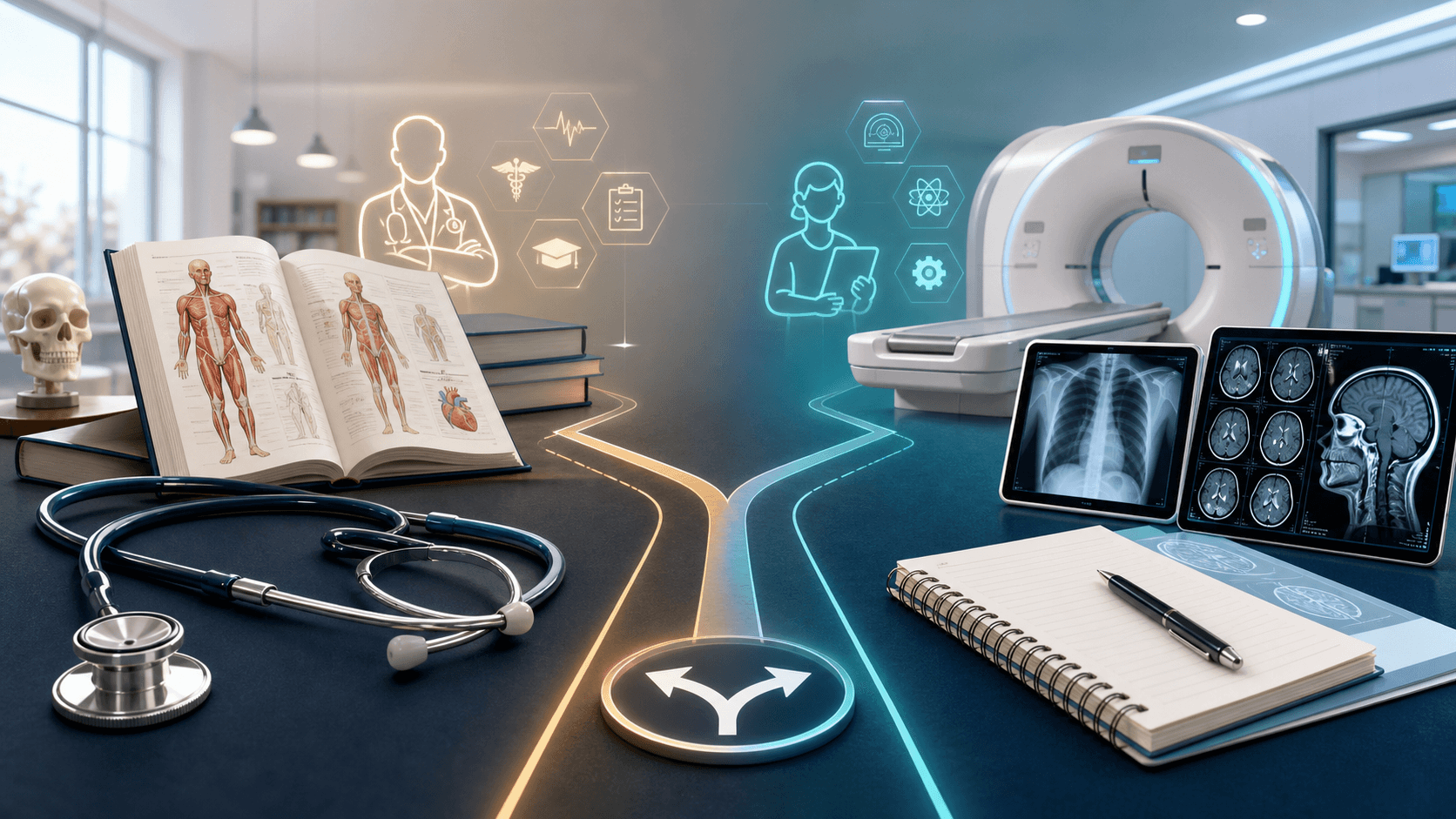
MBBS Abroad vs Medical Imaging in India 2026: Which Path Fits You?
Short answer: Choose MBBS abroad only if your goal is to become a physician, you can fund and complete a carefully verified foreign medical programme, and you accept the India-return licensing pathway. Choose a B.Sc. Medical Imaging Technology, B.MRIT, or similarly named allied-health programme in India if you want a faster, India-based route into diagnostic imaging, radiography, CT, MRI, or hospital technology work without becoming a doctor. These are not two versions of the same career. They lead to different professional roles, education timelines, costs, and regulatory outcomes.
MBBS abroad involves medical education, clinical training, graduation from a foreign institution, and the requirements that apply to foreign medical graduates seeking registration in India. Medical imaging programmes train allied-health professionals who support diagnosis by acquiring and processing images, operating equipment under institutional protocols, following radiation-safety procedures, and working with radiologists and clinical teams. A medical imaging technologist does not become a physician simply because the work takes place in a hospital.
This guide is for Indian students and parents deciding after Class 12, a NEET result, or an unsuccessful domestic MBBS attempt. It uses the current rules and official pages checked on 27 July 2026. Admission criteria, course names, fees, licensing arrangements, and NMC implementation can change, so verify the exact programme before paying.
MBBS abroad vs medical imaging: comparison at a glance
| Decision factor | MBBS abroad | Medical Imaging Technology in India |
|---|---|---|
| Main professional goal | Physician/medical doctor, subject to registration rules | Allied-health imaging technologist supporting diagnostic services |
| Typical study setting | Foreign university and affiliated teaching hospitals | Indian university/college and affiliated hospitals or diagnostic centres |
| Course structure | Foreign medical degree with theory, practical, clinical training and internship requirements | B.Sc., B.MRIT, B.Sc. Radiography, or similar programme; duration varies, often includes clinical training |
| Admission filter | University rules plus Indian eligibility and NMC checks | Institution, university, state or counselling rules; PCB and English are common requirements |
| NEET relevance | Indian students must check current NTA/NMC requirements before foreign medical admission | Depends on the institution and admission route; do not assume MBBS rules apply |
| India-return licensing | Foreign medical graduate pathway, screening/licensing and internship requirements may apply | Allied-health registration and employer requirements apply; it is not medical registration |
| Clinical work | Patient assessment, diagnosis and treatment training as part of medical education | Image acquisition, equipment operation, patient positioning, safety and technical support |
| Cost risk | Higher international, currency, travel and compliance risk | Usually a more predictable India-based budget, but compare the full programme cost |
| Best fit | Student committed to physician training and long-term licensing | Student interested in imaging technology, hospital work and a shorter local route |
The table is a decision filter, not a promise about every college. The exact course title and internship design matter.
What is the real difference between a doctor and an imaging technologist?
An MBBS graduate is trained across medicine, surgery, pathology, pharmacology, community medicine and clinical disciplines. The intended career involves assessing patients, forming diagnoses, prescribing or administering treatment within legal scope, and continuing into registration and possibly postgraduate specialisation. The path is demanding and regulated; the foreign location does not remove the need to meet Indian requirements if the student wants to practise in India.
Medical imaging technology is a technical and patient-facing allied-health field. The curriculum can include anatomy, physiology, radiation physics, radiographic positioning, imaging techniques, CT, MRI, ultrasound or related modalities, patient care, equipment handling, quality assurance and radiation safety. The technologist produces or supports diagnostic images and works with doctors and radiologists. The role is essential, but it is not the same legal or clinical role as a physician.
This distinction should come before comparing salary claims, college brochures or country lists. Ask the student which daily work sounds right: making a medical diagnosis and carrying responsibility for treatment, or operating imaging systems and producing high-quality diagnostic studies as part of a clinical team.
Which course is longer?
Foreign medical programmes must be assessed against the current NMC Foreign Medical Graduate Licentiate Regulations and related notices. The NMC's official FAQ says a foreign medical course covered by the FMGL framework has a minimum duration of 54 months, with English as the medium of instruction and theory, practical and clinical training equivalent to Indian MBBS. The overall journey can be longer once the foreign internship, India-return requirements, screening or licensing examination, and any required internship in India are considered.
Medical imaging courses do not have one universal title or one universal duration. Official Indian programme pages show examples of three academic years plus one year of internship, or four-year undergraduate structures. The NCAHP framework and the institution's affiliating university are important checks. A three-year classroom label is not enough: ask whether clinical rotations, internship, examinations and registration steps are included.
If the family needs the shortest route into healthcare employment, medical imaging may be more suitable. If the student wants to practise as a doctor, a shorter course cannot substitute for MBBS.
Recognition and licensing: what does each route lead to?
MBBS abroad and India-return planning
The NMC defines the foreign medical graduate route and publishes the FMGL Regulations, FAQs and public notices. The current framework includes requirements around course duration, English instruction, equivalent theory/practical/clinical education, internship and the route to registration. NMC notices also distinguish students admitted before and after 18 November 2021, so families must use the rule set applicable to the student's admission date.
An offer letter or an agent's phrase such as “NMC approved country” is not enough. Verify the exact awarding institution, degree, curriculum, language of instruction, clinical locations, internship arrangement, and whether any transfer, online, twinning or cross-border component changes the programme. The NMC's March 2026 public notice and 2026 FAQ are especially useful reminders that implementation and evidence matter.
Medical imaging and allied-health registration
The Ministry of Health and Family Welfare's Allied and Healthcare Professionals Registry FAQ identifies Medical Radiology, Imaging and Therapeutic Technology professionals and lists radiology and imaging technologist roles such as diagnostic medical radiographer, MRI, CT, mammographer and diagnostic medical sonographer. The National Commission for Allied and Healthcare Professions Act, 2021 provides the statutory framework for allied and healthcare professions.
That does not mean every course with “radiology” in its title has identical recognition. Check the university affiliation, the programme's approval or statutory basis, clinical training partner, internship, examination authority, and the current registration process in the state or national system. Confirm the role the qualification permits; do not rely on “radiologist” being used casually in marketing copy.
Which route is more affordable?
There is no honest single price for MBBS abroad or medical imaging in India. Model the complete cost.
For MBBS abroad, include tuition for every year, hostel or rental, food, visa and residence charges, insurance, flights, books, equipment, currency movement, remittance fees, emergency travel, clinical-year living costs, India-return travel, exam preparation and registration-related expenses. Ask whether fees rise annually, which deposit is refundable, and what happens if a student cannot continue at the original campus.
For medical imaging in India, include tuition, university and examination charges, hostel or transport, uniforms, equipment, clinical placement costs, books, registration, internship-period living costs and any entrance or counselling fee. A local course generally reduces foreign exchange and travel exposure, but a low headline fee is not proof of value. A college without adequate CT/MRI or hospital exposure may leave the graduate with a weaker practical foundation.
Compare verified completion cost and training quality, not the first payment. A cheaper route is not a good route if the qualification, clinical access or registration outcome is unclear.
Admissions: what should Indian students check?
MBBS abroad admission pathway
The foreign university may review Class 12 subjects, academic marks, English evidence, passport documents, an interview and its own admission conditions. Indian eligibility and NEET requirements are separate. NTA and NMC guidance must be checked for the relevant admission cycle, and an overseas university offer does not override Indian law or professional registration rules.
Before paying, request the official curriculum, degree-awarding institution, recognition evidence in the study country, teaching-hospital plan, internship terms, fee schedule, refund policy, accommodation terms and visa process. Ask the university—not only an intermediary—to answer in writing.
Medical imaging admission pathway
Many Indian medical imaging programmes require 10+2 or equivalent with Physics, Chemistry and Biology and English, but thresholds and selection routes vary. Some institutions use merit, some use an entrance test or interview, and some follow university or state counselling. Examples from official university pages also show that course duration and internship arrangements differ.
Do not assume that a NEET score is automatically required or automatically irrelevant. Check the exact college prospectus and the applicable state or university admission notice for 2026-27. Confirm whether the programme is a degree, diploma, honours degree or certificate, and whether the clinical year is compulsory.
What is the day-to-day work like?
An MBBS student should expect broad medical subjects, long clinical phases, patient responsibility, examinations and a career that remains competitive after graduation. A foreign student must also manage language and cultural adaptation, travel, accommodation, and the possibility of returning to India for additional steps.
An imaging student spends more time around equipment, image quality, positioning, radiation protection, patient preparation, workflow, records and clinical protocols. The work can be technical and patient-facing at the same time. It may suit a student who enjoys physics, anatomy, technology and precise procedures but does not want the responsibility of diagnosing or prescribing.
The best college is the one that can show real clinical exposure. Ask how many hours students spend in imaging departments, which modalities are available, how supervision works, whether students rotate through CT and MRI, and how radiation safety is taught. A brochure photograph is not evidence of hands-on access.
Career progression and higher study
The MBBS route can lead toward general medical practice after the applicable registration process and later specialisation through postgraduate training. The timeline is longer and the outcome depends on completing the required education, examinations, internships and registrations. No counsellor or university can guarantee a licence, examination result or postgraduate seat.
Medical imaging graduates can build experience in hospitals, diagnostic centres, imaging departments, healthcare technology, quality and safety functions, applications support, education or research, depending on their qualification and local rules. Higher study may include postgraduate imaging, healthcare administration, public health, education or related allied-health fields. Exact job titles and scope depend on the employer, state requirements and the qualification's recognition.
This is why “which has a better salary?” is the wrong first question. The first question is whether the student wants physician practice or a technical allied-health career. The second is whether the college provides recognised education and supervised clinical work. Only then should the family compare budgets and job offers.
Who should choose MBBS abroad?
MBBS abroad is worth serious consideration when the student:
- wants physician training rather than a technical hospital role;
- understands that the foreign degree does not automatically create Indian registration;
- can afford the full verified cost, including a financial reserve;
- is prepared for a long course and a demanding India-return pathway;
- has a university-specific compliance file covering language, curriculum, clinical training and internship; and
- has a realistic backup plan if the chosen programme, visa, finances or licensing rules change.
Reject the option if the university cannot explain its awarding authority, clinical training, internship or refund terms in writing.
Who should choose medical imaging in India?
Medical imaging is often the better fit when the student:
- wants to enter healthcare without pursuing the physician route;
- is interested in imaging equipment, anatomy, physics and patient workflow;
- prefers to study and complete clinical training in India;
- wants a shorter and more predictable undergraduate pathway;
- accepts that the role is allied-health and does not include diagnosing or prescribing as a doctor; and
- has shortlisted a programme with proper hospital exposure, equipment access, internship and recognition evidence.
Do not choose it as a “temporary MBBS substitute” if the student will feel dissatisfied without becoming a doctor. Choose it because the work itself fits.
A practical decision framework for families
Score each route from 0 to 2 on these questions: 0 means no evidence or poor fit, 1 means uncertain, and 2 means strong written evidence or clear fit.
| Question | MBBS abroad | Medical imaging in India |
|---|---|---|
| Does the daily professional role fit the student? | ||
| Is the full course and clinical pathway documented? | ||
| Is recognition and registration clear for the exact qualification? | ||
| Can the family fund completion, not just admission? | ||
| Does the student accept the time commitment? | ||
| Is the college's practical training verifiable? | ||
| Is there a sensible fallback plan? |
Treat a zero on professional-role fit or recognition as a stop sign. A high total score cannot compensate for a qualification that does not lead to the intended role.
FAQs
Q: Is medical imaging the same as MBBS?
No. MBBS is physician education. Medical imaging programmes train allied-health professionals who operate or support diagnostic imaging services within their permitted scope.
Q: Can a B.Sc. Medical Imaging graduate become a doctor later?
Not automatically. The graduate would need to meet the eligibility and admission requirements for an MBBS programme and complete medical education; the imaging degree does not convert into MBBS registration.
Q: Is NEET required for MBBS abroad?
Indian students must check the current NTA and NMC requirements for the relevant admission cycle. A foreign university offer does not replace Indian eligibility rules.
Q: Is NEET required for B.Sc. Medical Imaging Technology?
It depends on the institution, state and admission route. Check the exact 2026-27 prospectus; do not copy MBBS admission rules onto allied-health programmes.
Q: How long is a medical imaging course in India?
Course titles and structures vary. Official programme pages show examples of three academic years plus one year of internship and four-year undergraduate formats. Verify the exact curriculum and clinical year.
Q: Can medical imaging technologists operate MRI and CT machines?
Many imaging programmes prepare students for modalities such as CT and MRI, but the exact scope depends on the programme, training, employer and applicable rules. Check the curriculum and clinical exposure before enrolling.
Q: Does an imaging technologist diagnose cancer or other diseases?
The technologist acquires and processes images and supports the clinical service. Diagnosis and treatment decisions belong to authorised medical professionals within their scope.
Q: Is MBBS abroad cheaper than medical imaging in India?
Usually the comparison is not meaningful without a full cost model. MBBS abroad carries tuition, living, travel, currency and India-return costs; medical imaging in India has its own tuition, hostel and clinical costs.
Q: Is a foreign MBBS degree automatically valid in India?
No. The exact degree and programme must be assessed under the NMC framework and the applicable registration, examination and internship requirements.
Q: What should parents verify before paying for medical imaging?
Verify the awarding university, affiliation or approval, course level, clinical partners, equipment access, internship, examination authority, fee/refund policy and the current allied-health registration route.
Q: Can Students Traffic help us choose between these routes?
Yes. Students Traffic can review the student's academic profile, budget, career preference and shortlist, then help with counselling, programme comparison, scholarship-fit review and application planning.
Next steps
Write down the role the student wants to perform five years after Class 12: physician, or imaging technologist. Then shortlist two or three exact programmes and request the official curriculum, recognition or affiliation evidence, clinical-training plan, internship rules, full fee schedule and admission requirements. For MBBS abroad, add an NMC/FMGL review before any deposit. For medical imaging, confirm the course's allied-health standing and the local registration pathway.
If the decision is still unclear, Students Traffic can compare a realistic MBBS-abroad shortlist with recognised medical-imaging options in India, review scholarship or affordability fit, and identify the questions a family should ask before signing an offer.
Sources and verification note
Checked on 27 July 2026: the NMC Rules & Regulations page, the NMC FMGL FAQ dated 22 February 2022, the NMC March 2026 FMG public notice, the MoHFW Allied and Healthcare Professionals Registry FAQ, and the National Commission for Allied and Healthcare Professions Act, 2021. For programme-structure examples, we also reviewed official admissions pages from Symbiosis Institute of Health Sciences, Dayananda Sagar University, and A.J. Institute of Medical Sciences. NTA and institution-specific admissions rules should be checked for the student's actual cycle.
Fees, eligibility, course names, recognition, registration procedures and NMC implementation can change. Confirm the live official terms for the exact intake, university and intended practice location before making a financial or academic commitment.