CRMI Slots for Foreign Medical Graduates in 2026: What the NMC March 13 Circular Means
One of the biggest anxiety points for foreign medical graduates and MBBS abroad families is internship in India.
The fear is understandable.
A student may complete years of study abroad, come back with serious plans, and then discover that the post-return pathway is not just about exams and documents. It is also about where the student will actually do the required supervised clinical training in India if that step becomes applicable.
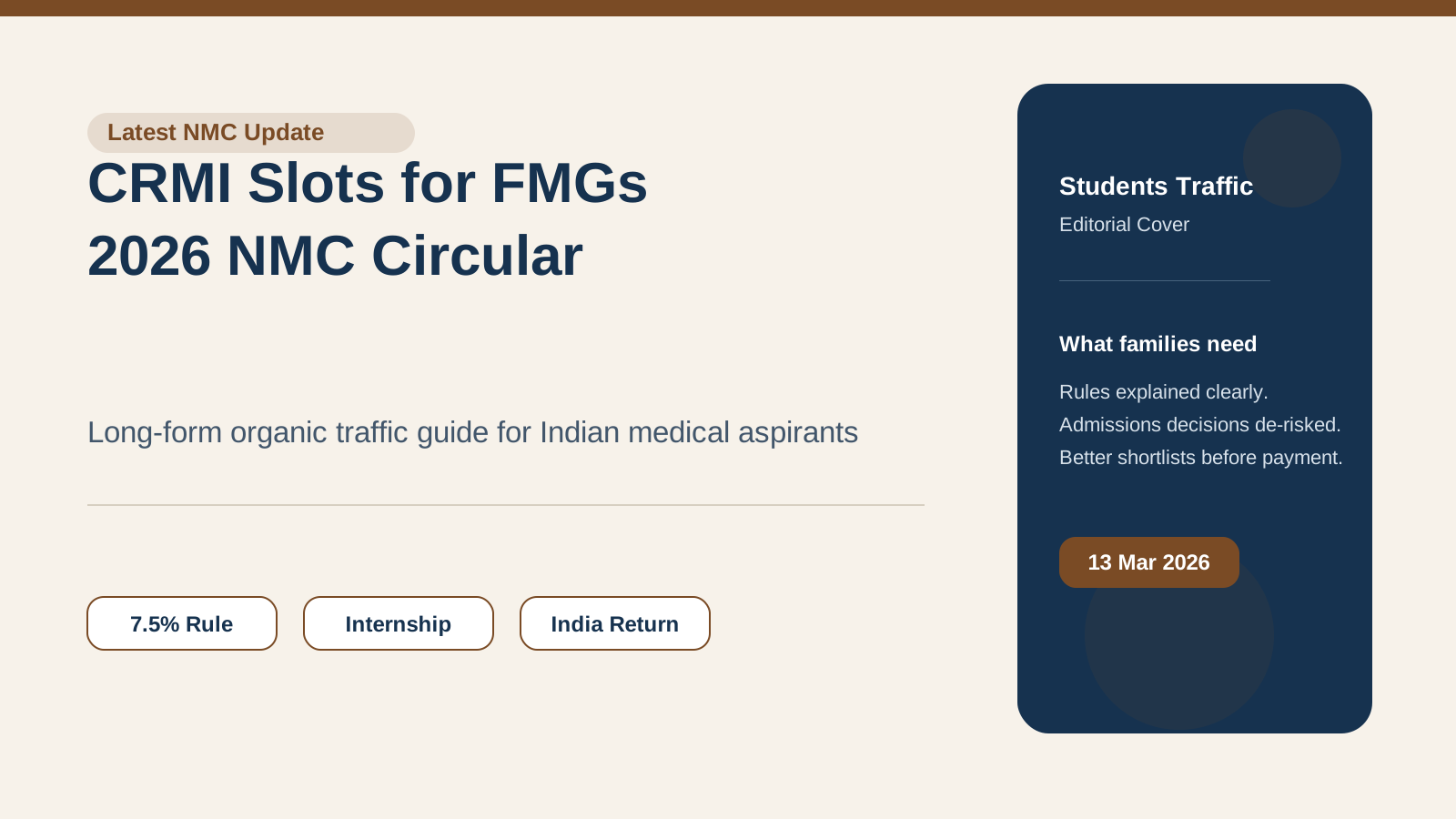
That is why the National Medical Commission's circular dated March 13, 2026 on allocation of Compulsory Rotating Medical Internship, or CRMI, slots for foreign medical graduates matters.
The circular did not make MBBS abroad risk-free. It did not erase all state-level implementation problems. It did not mean every FMG will now automatically get a perfect internship slot on time.
But it did matter.
According to the publicly indexed NMC circular, the regulator indicated that State Medical Councils, in consultation with the Directorate of Medical Education, should allot CRMI slots to foreign medical graduates using a defined capacity logic, including a 7.5% benchmark of the permitted intake of interns in established medical colleges and institutions. That is a concrete signal, and it deserves a careful interpretation.
This article explains what that signal means, what it does not mean, and how families should think about it if they are deciding on MBBS abroad in 2026.
Why this circular matters in the first place
Families often think of the MBBS abroad journey in three broad stages:
- admission abroad
- study abroad
- return to India
But the return stage is not a single step. It is a chain.
That chain may involve:
- degree completion
- internship documentation
- attestation and apostille
- examination pathway
- provisional registration logic
- CRMI placement, where applicable
- permanent registration
When even one link is weak, the entire return timeline becomes unpredictable.
In recent years, one of the most painful issues for many foreign graduates has been the gap between having theoretical eligibility for internship-related progress and actually obtaining a slot in India without massive delay or confusion.
That is why a circular on allocation is important. It addresses not only a bureaucratic procedure but also a real emotional and financial problem for students.
Delay in internship allocation can mean:
- delay in earning
- delay in registration
- delay in exam planning
- delay in PG planning
- prolonged dependence on family finances
- a mental-health hit after years of already difficult study
So even though the circular language may look administrative, the real-world impact is personal.
What the March 13, 2026 circular appears to say
The NMC circular dated March 13, 2026, as publicly indexed, references discussions with State Medical Councils regarding issues being faced by foreign medical graduates, including non-allotment and shortage of internship slots. It then indicates that CRMI slots should be allotted by the states using a benchmark that includes 7.5% of the permitted intake of interns in established medical colleges and institutions.
In practical terms, the circular is doing at least four things.
1. It formally acknowledges the slot-shortage problem
That matters because once the regulator names a problem, it becomes harder for local authorities to pretend the issue is invisible or purely anecdotal.
2. It tries to standardize state action
Instead of leaving everything entirely ad hoc, the circular signals that states should allocate using a framework.
3. It introduces capacity language that can actually be discussed
The 7.5% number is not just a sentiment. It is a planning benchmark.
4. It creates a reference point for students and families
Students now have an official document to cite when asking what is happening with FMG internship allocation.
That does not solve every problem, but it changes the conversation from vague pleading to document-backed follow-up.
What CRMI means for MBBS abroad families
Before we go deeper into the circular, we need to slow down and clarify something very important.
Not every MBBS abroad discussion about internship in India should be handled in the same way.
Families often hear:
- "You will have to do internship in India."
- "You do not have to do internship in India."
- "It depends on the country."
- "It depends on the documents."
- "It depends on NMC."
Those statements can all be partly true in different contexts, which is why families get confused.
The correct approach is not to memorize one slogan. It is to understand the student-specific pathway.
Questions that matter include:
- Was the foreign internship completed properly?
- Is it documented properly?
- How is the student's foreign qualification being viewed in the regulatory flow?
- Is India-side internship being required in the student's case?
- Which state and which institutions are involved in allocation?
This is why a CRMI circular cannot be read in isolation. It has to be read as part of the broader return-to-India pathway.
The biggest misunderstanding: the circular did not erase all bottlenecks
This is the first hard truth families need to accept.
Whenever an official circular is released, the market immediately creates two unhealthy reactions.
One group says:
"See, issue solved. Everything is easy now."
Another group says:
"Nothing changes. Ignore it."
Both reactions are too shallow.
The March 13 circular matters because it creates a formal allocation instruction. But it does not automatically guarantee:
- instant slot availability in every state
- uniform implementation across all colleges
- zero waiting time
- no local paperwork friction
- no communication gap between state bodies and institutions
In India, a regulator-level instruction and a ground-level student experience are related, but they are not identical. Implementation capacity still matters.
Families should therefore use the circular as a positive structural development, not as a license to stop asking practical questions.
What the 7.5% benchmark likely means in practice
The publicly indexed circular refers to 7.5% of the permitted intake of interns in established medical colleges and institutions. Even if a family is not used to administrative language, the practical logic is fairly understandable.
The regulator is trying to create defined room inside existing internship capacity for FMGs rather than leaving every institution or state to improvise from scratch.
That is important because the old pattern in many places felt uncertain:
- no one clearly explained how many FMGs could be accommodated
- students did not know which institutions were actually taking them
- state-level coordination could be inconsistent
- students were pushed from one office to another
The 7.5% benchmark introduces a capacity reference that is easier to discuss, monitor, and escalate around.
That does not mean every student will like the allotted institution or that all slots will appear instantly. But a benchmark is still far better than vacuum.
Why foreign graduates should still plan for delay even after the circular
Good planning is not pessimism. It is maturity.
Even after a favorable circular, students should build their life plans assuming there can still be:
- administrative lag
- state-level batching
- document rechecking
- communication gaps between councils and colleges
- reporting-date changes
- internship-start uncertainty
This matters because the family's financial and emotional plan should not depend on fantasy speed.
A smart family budget after graduation should include:
- a living buffer
- exam-preparation buffer
- document-attestation buffer
- delay buffer
If the student gets the slot fast, good. If not, the plan should still survive.
What students should do now if they are already in the India-return phase
For students who are already graduating or returning, the circular is not just background information. It is something they should actively use.
The right next steps usually include:
- keeping copies of the circular and related official updates
- tracking state medical council communications
- staying alert to institution notices
- keeping the degree and internship documentation in order
- documenting every submission and acknowledgment
- following up in writing where possible
Students often lose months because they follow up orally and keep no record of what was said, submitted, or promised. That is a mistake.
Every step in the return process should create a paper trail.
What current aspirants should learn from this update
The circular is also important for students who have not yet gone abroad.
Why?
Because it reminds them that the MBBS abroad decision is not only about:
- tuition
- hostel
- food
- city
- visa
It is also about what the India-return infrastructure looks like later.
Families often ask:
"Which country has low fees?"
The better question is:
"Which pathway gives my child the strongest chance of a smooth seven-year journey from admission to registration?"
That broader question naturally includes the internship reality.
The March 13 circular is therefore not only relevant to final-year graduates. It should also influence how first-year aspirants compare destinations and universities.
Why the circular should not be used as an excuse to choose weak universities
This point is crucial.
Some counsellors may try to use the circular as a sales shield:
"See, India internship issues are being handled now, so do not worry too much about the quality of the university you choose abroad."
That is bad advice.
An allocation circular does not make a weak academic pathway strong.
Families should still heavily prioritize:
- course structure
- documentation quality
- clinical exposure
- medium of instruction clarity
- internship reality abroad
- university seriousness
If a student joins a poorly chosen university and later faces avoidable regulatory or documentation trouble, a better CRMI-allocation mechanism in India can only solve so much.
The best strategy is still to reduce avoidable risk before admission.
Why state variation will still matter
India's medical education and registration environment is not experienced by students as one uniform national machine.
State-level implementation matters.
Some states may move faster. Some institutions may communicate better. Some students may have stronger follow-up support. Some local systems may still be slow, confusing, or uneven.
This means students should not base expectations on one success story from another state, another batch, or another college.
Instead, they should ask:
- Which state will likely handle my case?
- What has been the recent experience there?
- Which medical colleges have actually been allotting FMG internship slots?
- What is the reporting process?
- What documents are being insisted upon locally?
Local reality can differ meaningfully even under a national circular.
What medical colleges and councils now need to do better
Students are not the only ones with responsibilities here.
If the circular is to make a real difference, medical colleges, state councils, and directorates also need to reduce the old pattern of opacity.
Three improvements matter most.
Clear publication of capacity and process
Students should not have to guess which institutions are taking FMGs, how many slots may be available, or which documents are needed before allotment. Even where exact numbers shift, the process should be explained publicly and consistently.
Faster communication after document submission
Many delays become psychologically exhausting because students hear nothing. Even a short, formal acknowledgment with expected timelines is better than silence. Administrative silence creates rumor markets, and rumor markets create panic.
Better coordination between the bodies involved
The biggest practical bottlenecks often arise not because one body refuses to act, but because multiple bodies assume someone else is responsible. If the circular is to work well, the chain between the State Medical Council, Directorate of Medical Education, and allotted institution has to feel like one process from the student's perspective.
This is why families should read the circular not only as a student relief measure but also as a systems-improvement signal.
Why this matters for 2026 admission decisions right now
Some parents may wonder why a student in Class 12 or a student about to join MBBS abroad should spend time reading about CRMI allocation years before graduation.
The answer is simple: because wise admissions decisions start at the end and work backward.
If a family only looks at:
- admission ease
- brochure quality
- low first-year fees
- city comfort
and ignores the later India-return architecture, they are making an incomplete decision.
The March 13, 2026 circular should remind families that the return path is a serious operational pathway with real institutions, real capacity questions, and real documentation demands. That means the best admission decisions are the ones that reduce friction before the student even leaves India.
Students should therefore use this latest update to ask better early-stage questions:
- Will this university give me a clean document trail later?
- Is the internship structure abroad clearly explained?
- Is the course being sold honestly, or with hidden assumptions?
- Will I likely return with a file that Indian authorities can evaluate cleanly?
Those are better questions than "Which country is trending this year?"
A practical checklist for final-year FMGs and recent returnees
If you are already near graduation or have recently returned to India, use the current moment carefully. A strong checklist can save months.
Build a master return file
Create one folder with:
- degree certificate
- final-year marksheets
- internship completion proof
- passport and visa pages
- EC and NEET records
- apostille and attestation papers
- council application receipts
- screenshots and PDFs of every portal submission
- copies of relevant NMC circulars and public notices
Track dates, not just documents
Keep a running timeline for:
- graduation date
- internship completion date
- attestation date
- return to India date
- application dates
- council communication dates
- follow-up dates
Students often remember events loosely but not precisely. Regulatory processing usually respects exact dates.
Follow up like a professional, not like a desperate caller
Whenever possible:
- write concise emails
- preserve ticket numbers or acknowledgments
- note the name of the office or officer spoken to
- summarize what was said
This creates a credible record if escalation becomes necessary.
Stay connected with student networks, but do not replace official channels
Peer groups are useful for learning patterns. They are dangerous when they become the only source of truth. Use student communities to understand ground reality, but use official notices for action.
How this update changes the counselling conversation
Before this circular, many discussions about FMG internship slots felt vague and reactive.
Now a better conversation is possible.
Students and parents can ask more specific questions:
- How is the 7.5% benchmark being applied in this state?
- Which institutions are part of the allocation pool?
- What is the recent average waiting time?
- How should the student prepare the document file?
- What additional state-level documents are usually requested?
This is healthier than emotional conversations that reduce everything to:
- "Will internship happen or not?"
Medicine is too important for binary oversimplifications.
What the circular does not change about the student's responsibility
Even with better slot allocation language, the student's own responsibilities remain serious.
The student still needs:
- complete academic records
- internship completion records, where relevant
- attestation discipline
- licensing-exam planning
- registration readiness
- persistence with follow-up
No circular can compensate for a messy documentation history.
Students who reach the India-return stage with missing records, inconsistent names, weak internship proof, or unclear university communication may still face problems even in a more allocation-friendly environment.
The circular improves structure. It does not excuse poor preparation.
How families should compare this issue across destinations
Different countries are often marketed on surface features:
- Russia for scale and legacy
- Georgia for comfort and city appeal
- Kyrgyzstan for cost
- Uzbekistan for emerging value
- Bangladesh for proximity
- Nepal for familiarity
But no family should compare destinations only at the marketing level.
They should also compare:
- how predictable the full course and internship pathway is
- how clean the document trail tends to be
- how easy it is to explain the student's academic history later
- how much additional dependence the student may face on Indian-side post-return correction mechanisms
In simple language:
The more corrections a pathway seems to require later, the more carefully it should be judged now.
What students should keep ready if they expect India-side internship allocation questions
A practical document pack should usually include:
- passport copies
- NEET proof
- EC-related records if applicable
- degree certificate
- final marksheets
- internship completion certificate from abroad
- attestation and apostille records
- identity and address proof
- council-related receipts and acknowledgments
- every official communication related to return processing
The families who do best are not always the ones with the strongest contacts. They are often the ones with the strongest files.
A calmer way to interpret the current moment
Students do not need to read every regulatory development as either catastrophe or salvation.
The March 13, 2026 circular should be read in a balanced way:
- it is meaningful
- it is useful
- it is not magic
That is the mature interpretation.
If a family uses the circular to become more organized, ask better questions, and plan more realistically, then it becomes a real advantage.
If they use it to switch their brain off and assume internship problems are permanently gone, then they are misusing good news.
Frequently asked questions
Did the NMC circular solve the FMG internship-slot problem completely?
No. It improved the structure of allocation by acknowledging shortages and giving a benchmark, but implementation still matters.
What is the key number families should know from the circular?
The publicly indexed circular refers to a 7.5% benchmark of permitted intern intake in established colleges and institutions for FMG slot allocation.
Does this mean every FMG will now get an immediate slot?
No. It creates a stronger policy basis, but timing and execution may still vary by state and institution.
Should new aspirants ignore internship concerns now?
Definitely not. The circular makes planning better, but university choice, course structure, and documentation quality still matter enormously.
What should returning students do with this circular?
Use it as a reference point in their follow-up, keep documentation strong, and stay engaged with state-level updates instead of waiting passively.
Final take
The NMC's March 13, 2026 CRMI circular is one of the more meaningful recent developments for foreign medical graduates because it addresses a real operational bottleneck rather than just offering abstract reassurance.
It recognizes that slot shortage and non-allotment were serious enough to require direction. It introduces a capacity benchmark that can be discussed concretely. It gives students and families a document-backed basis for follow-up.
That is real progress.
But the circular should strengthen planning, not replace planning.
The right lesson for 2026 aspirants is not:
"Everything is easy now."
The right lesson is:
"The India-return pathway is becoming more structured, so we should make even more disciplined decisions from day one."
That is how smart MBBS abroad planning works.
How Students Traffic Can Help You Interpret the New CRMI Slot Reality
Many families now hear fragments about internship slots for foreign medical graduates and assume the latest circular solved everything. It did not. The real work is still student-specific: documentation, timing, state-level follow-up, and choosing a university abroad that does not leave avoidable internship complications later.
If you want help planning your India-return path from day one instead of after graduation, use Students Traffic counselling support and peer connect to build a cleaner MBBS-abroad strategy before you finalize your seat.
Related: MBBS Abroad Return to India | NMC Eligibility Certificate Guide | Talk to Students Abroad