Why Thousands of Indian Students Choose to Study Medicine Abroad Every Year
In India, the dream of wearing a white coat is shared by millions but realised by a select few. The gap between aspiring medical students and the capacity of Indian medical education is widening every year.
Each cycle, roughly 23–25 lakh students appear for NEET-UG. Only around 1.18 lakh MBBS seats exist across all government and private colleges combined. Government seats are fiercely competitive, and private or deemed university seats carry tuition fees of ₹70 lakh to ₹1.7 crore — a financial barrier that simply shuts out the majority of middle-class families.
For these families, studying MBBS abroad is not a compromise. It is a highly logical, financially structured, and globally recognised pathway. Countries like Vietnam, Russia, Georgia, and Uzbekistan offer top-tier infrastructure, state-of-the-art simulation labs, global clinical rotations, and internationally recognised medical degrees — at a total all-inclusive budget ranging from ₹18 lakh to ₹55 lakh over six years.
1. The NMC 2026 Regulatory Reality Check
Before you look at any country profile or university brochure, you must understand the Foreign Medical Graduate Licentiate (FMGL) Regulations set by the National Medical Commission (NMC). A degree that does not strictly comply with these rules will not allow you to practise medicine in India.
The Four Non-Negotiable Requirements
NEET Qualification You must qualify for the NEET-UG exam in the year of your admission, or have qualified in the preceding two years. Without a valid NEET-UG scorecard, your foreign medical degree carries no legal weight in India.
Course Duration The academic course must span a minimum of 54 months (4.5 years) of continuous theoretical and practical study. Short-track degrees are automatically rejected.
Same-Institution Internship You must complete a compulsory 12-month clinical internship at the same foreign university where you completed your degree. You cannot transfer mid-programme or return to India early to complete your internship.
100% English Medium The entire curriculum, clinical training, and examinations must be conducted in English. Programmes marketed as "bilingual" or conducted partly in a local language directly violate NMC rules.
The Licensing Mandate: The medical degree must grant you the official licence to practise medicine in the country where it is awarded. Premier destinations like Vietnam, Georgia, and Uzbekistan feature structured, state-approved registration pathways that fully satisfy this requirement.
2. Academic Eligibility and Admission Requirements
To secure an MBBS seat in an accredited foreign medical university, Indian students must meet these criteria:
- Age: Minimum 17 years old by 31 December of the admission year
- Academic Score: Minimum 50% in Class 12 PCB (Physics, Chemistry, Biology) — 40% for SC/ST/OBC categories
- NEET Qualification: Mandatory, with a scorecard valid for up to three years for foreign admissions per NMC guidelines
Unlike private Indian colleges, foreign government-run and accredited private universities work on a merit-cum-first-come-first-served basis. No donation or capitation fees are charged.
3. The NExT Exam: What It Means for Foreign Medical Graduates
For years, foreign medical graduates cleared the FMGE (Foreign Medical Graduate Examination) to practise in India, with historical pass rates averaging 15–25%. The NMC is now fully transitioning to the NExT (National Exit Test), which replaces both the FMGE and the NEET-PG.
What NExT does: It acts as the uniform licensing examination for both Indian and foreign medical graduates, and simultaneously serves as the entrance test for MD/MS postgraduate seats.
- Step 1: Theoretical computer-based test — 540 MCQs focused on clinical problem-solving
- Step 2: Practical, clinical, and oral examination taken after completing the internship
The critical implication for foreign graduates: There is no longer a distinction between studying in India and studying abroad when it comes to licensing. Every student — Indian or foreign graduate — clears the exact same examination. This levels the playing field entirely for graduates who secure high-quality clinical training abroad.
At Students Traffic, we solve the preparation challenge by providing 100% free FMGE/NExT coaching for all students who secure admission through us, running in parallel with their degree from Year 1.
4. Best Countries for MBBS Abroad in 2026
Vietnam — The Emerging Leader
Vietnam has become the most recommended destination for Indian medical students seeking the best combination of modern infrastructure, clinical relevance, proximity, and cost.
Estimated total cost (6 years): ₹25 lakh – ₹45 lakh (all-inclusive) Medium of instruction: 100% English NMC compliance: Fully compliant — 5 years academic study + 1-year integrated internship Top universities: Can Tho University of Medicine and Pharmacy, Dai Nam University, Phan Chau Trinh University, Nam Can Tho University, Hong Bang International University
Why Vietnam makes clinical sense for Indian students:
Vietnam's tropical climate produces identical disease patterns to India — Dengue, Malaria, Typhoid, Tuberculosis. Students study and practise on the exact conditions they will treat throughout their career in India, making clinical skills directly transferable from Day 1.
Top universities feature 3D anatomy dissection tables, virtual reality simulation systems, and active access to human cadavers for intensive hands-on training — infrastructure that rivals the best private medical colleges in India at a fraction of the cost.
The flight from most Indian cities to Ho Chi Minh City or Hanoi takes 4–5 hours and costs less than a domestic flight to Delhi. Students can travel home during every major vacation without financial strain.
Vietnam consistently ranks among the safest countries in the world. Universities operate dedicated Indian hostels serving authentic regional Indian food, with Indian coordinators on campus year-round.
The only adjustment: While the academic curriculum, textbooks, and all examinations are 100% in English, students learn basic conversational Vietnamese to communicate confidently with local patients during hospital rotations — a skill that takes a few months to develop.
Russia — The Established Powerhouse
Russia remains one of the largest destinations for Indian medical students, hosting over 30,000 active Indian students. The Russian government heavily subsidises international medical education, resulting in premier infrastructure at an accessible cost.
Estimated total cost (6 years): ₹25 lakh – ₹45 lakh Medium of instruction: English Historical FMGE/NExT pass rate: ~32% Top universities: Kazan State Medical University, First Moscow State Medical University (Sechenov), Perm State Medical University, Volgograd State Medical University
Russian state universities offer high-tech simulation labs, massive teaching hospitals, and highly qualified faculty. Living costs remain low — approximately ₹1.5 lakh to ₹2.5 lakh per year covering hostel, food, and transport.
The primary challenges are the extreme winter climate (temperatures in parts of Russia can drop below −30°C) and the need to develop basic conversational Russian for clinical rotations, even though the academic curriculum is entirely in English.
Georgia — The European Standard
Positioned at the intersection of Eastern Europe and Western Asia, Georgia offers a premium medical education environment with European-standard infrastructure, high safety, and a strictly English-medium curriculum.
Estimated total cost (6 years): ₹35 lakh – ₹55 lakh Medium of instruction: English Historical FMGE/NExT pass rate: ~35.65% Top universities: Tbilisi State Medical University (TSMU), David Tvildiani Medical University, New Vision University, European University
Georgia is one of the safest countries in the world and offers a clean, European-style urban lifestyle. The Georgian medical curriculum closely aligns with European (ECTS) and US standards, making it an excellent choice for students who may consider postgraduate residency in the UK or USA.
Indian students should be aware that tuition fees and living costs in Tbilisi have risen significantly in recent years, and that graduates must clear the local Georgian state licensing exam to satisfy the NMC's country-of-origin practice registration rule.
Uzbekistan — Budget-Friendly and Fully Compliant
Uzbekistan has emerged as the most popular affordable NMC-compliant destination in Central Asia. Government-regulated tuition fees, direct flights from major Indian cities, and highly structured English-medium programmes make it a secure option for budget-conscious families.
Estimated total cost (6 years): ₹18 lakh – ₹30 lakh Medium of instruction: English Historical FMGE/NExT pass rate: ~22%–28% Top universities: Fergana Medical Institute of Public Health, Tashkent Medical Academy, Samarkand State Medical University, Navoi State University (Faculty of Medicine)
Tuition at public institutions starts from as low as ₹2.5 lakh per year. The 6-year structure (5 academic years + 1 integrated internship) is fully NMC-compliant and exceeds the 54-month minimum requirement. Direct flights from Delhi and Mumbai reach Tashkent in under 4 hours.
One important note: In 2026, the NMC issued specific administrative advisories warning students against over-enrolment and unverified sub-agents at certain Uzbek universities. Students Traffic exclusively partners with institutions maintaining verified intake capacities and full NMC compliance. We help students avoid the high-risk options and enrol only in fully approved institutions.
Kyrgyzstan — The Ultra-Budget Entry Point
For students operating on the tightest budget, Kyrgyzstan offers the most cost-effective pathway into a global medical career.
Estimated total cost (5–6 years): ₹15 lakh – ₹25 lakh Medium of instruction: English (always choose the 100% English-medium course) Historical FMGE/NExT pass rate: ~10%–15% Top universities: Kyrgyz State Medical Academy, Osh State University, International School of Medicine
The primary challenge in Kyrgyzstan is that the lower pass rate reflects variable hospital access and large student intakes. Passing the NExT requires intensive self-study from early years. Students Traffic addresses this by providing our enrolled students with a free NExT/FMGE coaching programme starting from the first year of study.
5. Country Comparison at a Glance
| Country | Duration | Est. Cost (₹) | Climate vs. India | Language in Clinics | Best For |
|---|---|---|---|---|---|
| Vietnam | 6 years | ₹25L–₹45L | High match (tropical) | Minimal (English + basic Vietnamese) | Best all-rounder — clinical exposure, modern labs, proximity |
| Russia | 6 years | ₹25L–₹45L | Low (extreme cold) | Moderate | High infrastructure at accessible cost |
| Georgia | 6 years | ₹35L–₹55L | Moderate (European) | Moderate | Students eyeing UK/US postgraduate pathways |
| Uzbekistan | 6 years | ₹18L–₹30L | Moderate (continental) | Moderate | Best cost-to-compliance balance |
| Kyrgyzstan | 5–6 years | ₹15L–₹25L | Low | High | Absolute lowest budget |
6. Education Loans for MBBS Abroad
Funding is one of the most common sources of anxiety for families. Leading Indian public and private banks offer structured education loan facilities specifically designed for recognised medical colleges abroad.
Secured loans (with collateral):
- Available from nationalised banks — SBI, Bank of Baroda, PNB
- Loan limits up to ₹1.5 crore – ₹3 crore
- Interest rates: 8.5%–10.5% (floating)
- Collateral accepted: land, home, fixed deposits, government bonds
Unsecured loans (collateral-free):
- Available from private lenders and NBFCs
- Loan limits up to ₹40 lakh – ₹75 lakh
- Interest rates: 11%–14.5%
- Basis: parents' stable CIBIL score and income documentation
Key features families should understand:
The moratorium period: Most reputable banks provide a grace period covering the entire course duration plus 6–12 months after graduation. You do not pay full EMIs during this period — only simple interest is calculated or deferred.
What loans cover: A standard international education loan covers 100% of university tuition, hostel accommodation, student health insurance, visa renewals, and one economy-class return airfare per year.
Tax benefits under Section 80E: Parents can claim income tax deductions on loan interest payments for up to 8 continuous financial years.
Students Traffic assists families by providing verified university fee structures, authenticated admission invitation letters, and direct coordination with nationalised banks and premier NBFCs to streamline loan approval.
7. Other Healthcare and Medical Courses Abroad
While MBBS sees the largest enrolment, many other healthcare disciplines attract Indian students for the advanced research infrastructure, higher clinical pay scales, and clear immigration pathways they offer abroad.
Nursing (B.Sc / M.Sc Nursing) Top destinations: Canada, Australia, United Kingdom, Ireland. Critical nursing shortages in these countries mean immediate post-study work visas and highly competitive starting salaries. Advanced clinical training in tertiary hospitals is a standard feature of these programmes.
Physical Therapy and Rehabilitation Sciences (BPT / MPT) Top destinations: Australia, the UK, Canada. Specialisations in sports medicine, paediatric rehabilitation, and robotic prosthetics are far more developed abroad than in India, creating strong career differentiation.
Dentistry (BDS / DDS) Top destinations: USA, Canada, UK. BDS graduates increasingly move to the USA to complete the INBDE examination and join an Advanced Standing DDS programme, which grants full clinical licensure and access to highly competitive North American dental salaries.
Master of Public Health (MPH) and Healthcare Administration (MHA) Top destinations: USA, UK, Ireland, Sweden. These programmes focus on global healthcare management, epidemiology, health policy, and biostatistics — opening leadership roles at the WHO, healthcare technology companies, global consulting groups, and hospital networks.
8. How to Protect Yourself from Fraudulent Agents
The admissions landscape for MBBS abroad is unfortunately filled with misleading practices. Knowing the red flags is essential before committing any money.
The "bilingual course" trap: If an agent tells you the university "teaches in English" but exams or clinical rotations are in a local language, that programme violates NMC's 100% English-medium requirement. Always demand a written confirmation of English-medium instruction from the university directly.
Hidden expenses: A quote of "complete your MBBS for ₹15 lakh" almost always covers only basic tuition. Request a complete written fee structure covering visa renewals, health insurance, hostel charges, laboratory fees, clinical rotation fees, and local utility costs before making any payment.
Unaccredited universities: Verify that any institution you consider is listed in the World Directory of Medical Schools (WDOMS) and that its graduates are eligible to practise medicine in the host country. If these two conditions are not met, you will not be allowed to sit for the NExT exam.
The post-graduation abandonment: Many agents close their relationship with students once they land on campus. Getting your MBBS degree is only 50% of the journey. Clearing the licensing exam, securing clinical observerships, and navigating State Medical Council registration paperwork are where genuine support is needed — and where most agents disappear.
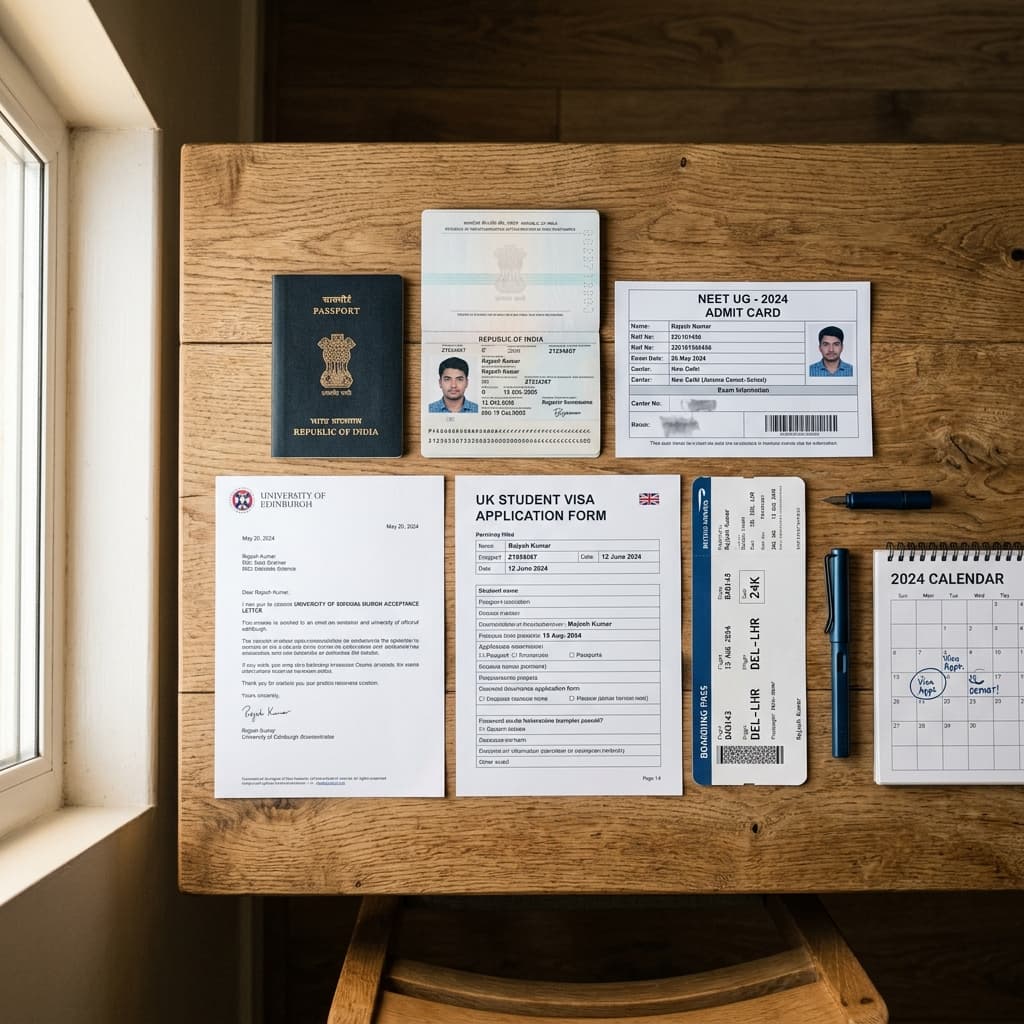
9. Document Checklist for Overseas Medical Admissions
Academic records:
- Class 10 marksheet and passing certificate
- Class 12 marksheet and passing certificate (must reflect Physics, Chemistry, Biology, and English)
Identity documents:
- Valid Indian passport — minimum 18 months validity from travel date
- Birth certificate (translated to English if in a regional script)
- 15–20 passport-size photographs (white background, standard matte finish)
Medical and regulatory documents:
- NEET-UG qualifying scorecard (2024, 2025, or 2026)
- Medical fitness certificate including blood test reports, HIV-negative report, and chest X-ray
- Police Clearance Certificate (PCC) from Passport Seva Kendra — mandatory for Russian, Georgian, and European student visas
- MEA apostille and certified translation of transcripts (requirements vary by destination country)
10. How Students Traffic Supports You from Admission to State Registration
At Students Traffic, getting you an admission letter is not the finish line. The goal is a practising medical career in India. Trusted by over 3,000 students and parents, we are a comprehensive medical career mentoring platform led directly by FMGE-cleared doctors and clinical specialists.
Free FMGE / NExT Coaching
Every student securing admission through Students Traffic gets access to a fully integrated FMGE/NExT preparation programme at no cost — valued at ₹1,50,000 and provided free of charge. You learn in parallel with your university semesters from Day 1, with access to high-yielding medical lectures, mock papers, and system-wise clinical tests designed specifically to ensure you pass your licensing exam on the first attempt.
Mentorship by FMGE-Cleared Doctors
Your mentors at Students Traffic are actual medical professionals who have cleared the FMGE/NExT themselves and are currently practising in India. They provide first-hand guidance on navigating foreign university exams, clinical rotations, and patient-care environments abroad — not scripted advice from consultants who have never sat in a medical school.
Post-Degree Clinical Observership Support
Returning to India with a foreign degree requires hands-on local clinical exposure before sitting for licensing tests. Students Traffic actively places graduates in clinical observership programmes at trusted Indian healthcare institutions, helping them understand the workflow of Indian hospitals and build the local experience that supports the State Medical Council registration process.
End-to-End State Medical Council Registration
From managing the complex documentation required by State Medical Councils to guiding you through verification processes, we handle the administrative and legal workload until your State Medical Registration is active and you are cleared to practise.
Your Pathway from Decision to Degree
Choosing where to study medicine is one of the most important decisions of your life. The right choice depends on your NEET score, your family's budget, your preferred climate, your long-term career goals, and the country's NMC compliance track record.
At Students Traffic, we begin with a free personalised profile evaluation — reviewing your NEET score, budget range, and career expectations — before recommending any country or university. No hidden markups. No sub-agent commissions. Direct admissions at the universities' published fee structures.
Talk to a Students Traffic medical consultant today for your free profile evaluation.
Call or WhatsApp: +91 91761 62888 Email: hello@studentstraffic.com