Kaunas University of Technology (KTU)Kaunas, LithuaniaB.E./B.Tech Aerospace · Public€4,201/yrSKVC (Centre for Quality Assessment in Higher Education, Lithuania) — 7-year institutional accreditation
B.E./B.Tech Aerospace at Kaunas University of Technology (KTU) — 12 questions answered
These are the most common questions Indian students and families ask before applying for B.E./B.Tech Aerospace at Kaunas University of Technology (KTU), Kaunas. Covering admissions, fees, recognition, eligibility, hostel, career outcomes, and the India-return pathway — everything you need before making your decision.
Is Kaunas University of Technology (KTU) a public or private university?
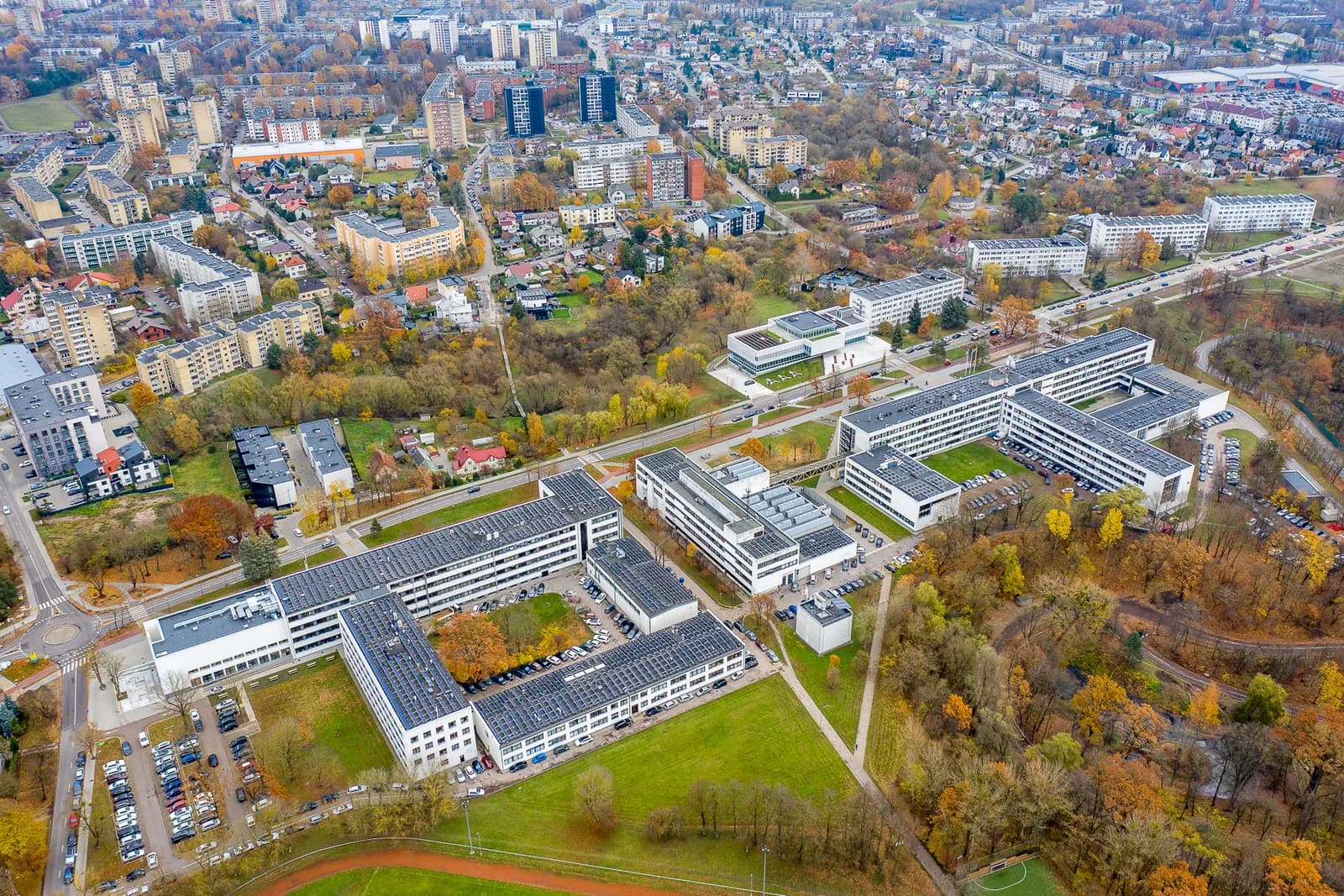
KTU is a public technical university in Kaunas, Lithuania. It traces its origin to the technical faculties of the University of Lithuania, founded on 16 February 1922, was reorganised into Kaunas Polytechnic Institute (KPI) from 1950-1990, and regained university status under its current name in 1990. More than 157,000 graduates have completed studies there since 1922, and Times Higher Education's most recent world rankings describe KTU as Lithuania's strongest technical university.
Are Mechanical Engineering, Mechatronics, Electrical Engineering and the other programmes here taught fully in English?
Yes. All eight programmes profiled here — Mechanical Engineering, Mechatronics, Electrical Engineering, Electronics and Electrical Engineering, Aviation Engineering, Industrial Engineering, Artificial Intelligence and Informatics — are full-time Bachelor's degrees delivered in English at KTU's Kaunas campus. Not every KTU Bachelor's programme is English-medium, though: Civil Engineering and several other fields remain Lithuanian-taught only, so check the language tag on each specific programme page before applying.
Can I get direct admission straight after Class 12 / high school?
Yes, if you meet KTU's published bar: a secondary-school certificate with a minimum average grade (CGPA) above 60% in each required entry subject, no more than 3 years since graduating high school, and (for non-native English speakers) English proficiency at IELTS 5.5+, TOEFL iBT 75+, CEFR B2 or an equivalent test taken within the last two years. The Artificial Intelligence programme additionally requires passing KTU's own online Mathematics entrance examination.
What does one year actually cost, beyond tuition?
Tuition for all eight programmes here is a flat EUR 4,201 per year (EUR 70.02 per credit), plus a one-time, non-refundable EUR 100 application fee. Add roughly EUR 110-300/month for a KTU dormitory room (singles EUR 195.75-300.67, doubles EUR 109.62-253.69, plus a EUR 160-330 deposit); Lithuania's 2026 immigration guidance sets minimum subsistence proof for a student residence permit at about EUR 577/month.
How do I apply, and is admission currently open?
Applications go through apply.ktu.edu. For the 2026/27 intake (studies starting 1 September 2026), the application window ran from 15 October 2025 to 1 June 2026 — that window has already closed as of this writing. KTU typically reopens its next international-admissions cycle around mid-October for the following September intake, so confirm the current cycle's exact dates at apply.ktu.edu or via [email protected] before planning around a specific year.
What documents do Indian applicants specifically need to prepare?
Alongside a passport copy, photo and secondary-education certificates, non-EU applicants including those from India must have academic documents apostilled by India's Ministry of External Affairs (India is a Hague Convention member, so apostille rather than full consular legalisation applies) and translated into English or Lithuanian if not already. A Police Clearance Certificate covering all countries lived in for 6+ months, ideally obtained within a month of departure, is also required.
Are scholarships or tuition waivers available?
Every applicant who submits through apply.ktu.edu is automatically considered for KTU's merit-based partial or full tuition-fee waivers, decided on academic record; full-waiver results are typically announced by mid-July. Enrolled students with strong results can also apply for KTU's Talent Scholarship (EUR 250/month, EUR 1,000/semester), and Electronics and Electrical Engineering applicants can separately apply for a Litgrid-funded scholarship of EUR 375/month during their first year.
What kind of practical training do these programmes include?
Mechanical Engineering and Aviation Engineering students can earn Dassault Systèmes CAD/CAE certificates and work with GUNT, Mitutoyo and Festo equipment; Aviation Engineering offers an optional two-full-semester placement track developed with input from Lithuania's Transport Competence Authority; and Electronics and Electrical Engineering closes with a mandatory 15-credit Professional Internship alongside a 15-credit Bachelor's Degree Final Project in the last semester.
What does KTU's accreditation and ranking status mean for students?
KTU holds a 7-year institutional accreditation from SKVC, Lithuania's national Centre for Quality Assessment in Higher Education, and has its own profile on the European Quality Assurance Register (EQAR). KTU is Lithuania's only member of the ECIU University alliance (joined 2016, partnering with institutions such as the University of Twente and University of Strathclyde), and placed 243rd of 958 universities in the QS World University Rankings: Europe 2026, published January 2026.
How does KTU compare with other Lithuanian universities in your catalogue?
KTU is a separate institution from Vilnius Gediminas Technical University (VILNIUS TECH, based in the capital Vilnius) and from Kauno Kolegija/Kaunas University of Applied Sciences, a Kaunas-based university of applied sciences offering professional-bachelor programmes such as nursing rather than full university-level engineering degrees. KTU is the dedicated technical university physically located in Kaunas and, per Times Higher Education's latest rankings, Lithuania's strongest technical university.
What is Kaunas like as a city for international students?
Kaunas is Lithuania's second-largest city and rose to 142nd out of the cities ranked in the QS Best Student Cities 2026 index (up from 147th the year before), scoring highest on desirability. It was Lithuania's temporary capital from 1920-1939, holds UNESCO World Heritage status for its interwar 'Modernist Kaunas' architecture (inscribed 2023), and was a joint European Capital of Culture in 2022 — with generally lower living costs than the capital, Vilnius.
What accommodation options does KTU offer, and are they guaranteed?
KTU operates 12 dormitories across its Kaunas campus, with Dormitory No. 5 designated an International Residence since 2013 (international students also live in Dormitories No. 2, 3, 7 and 8). Monthly rent ranges from about EUR 109.62 for a shared double room up to EUR 300.67 for a single room, plus a EUR 160-330 refundable deposit; bedding service costs an extra EUR 15/month. Confirm current room availability directly with KTU before travel.
Applying to Kaunas University of Technology (KTU)?
Students Traffic verifies seat availability, checks current recognition status, and prepares your complete application for Kaunas University of Technology (KTU). The consultation is free.