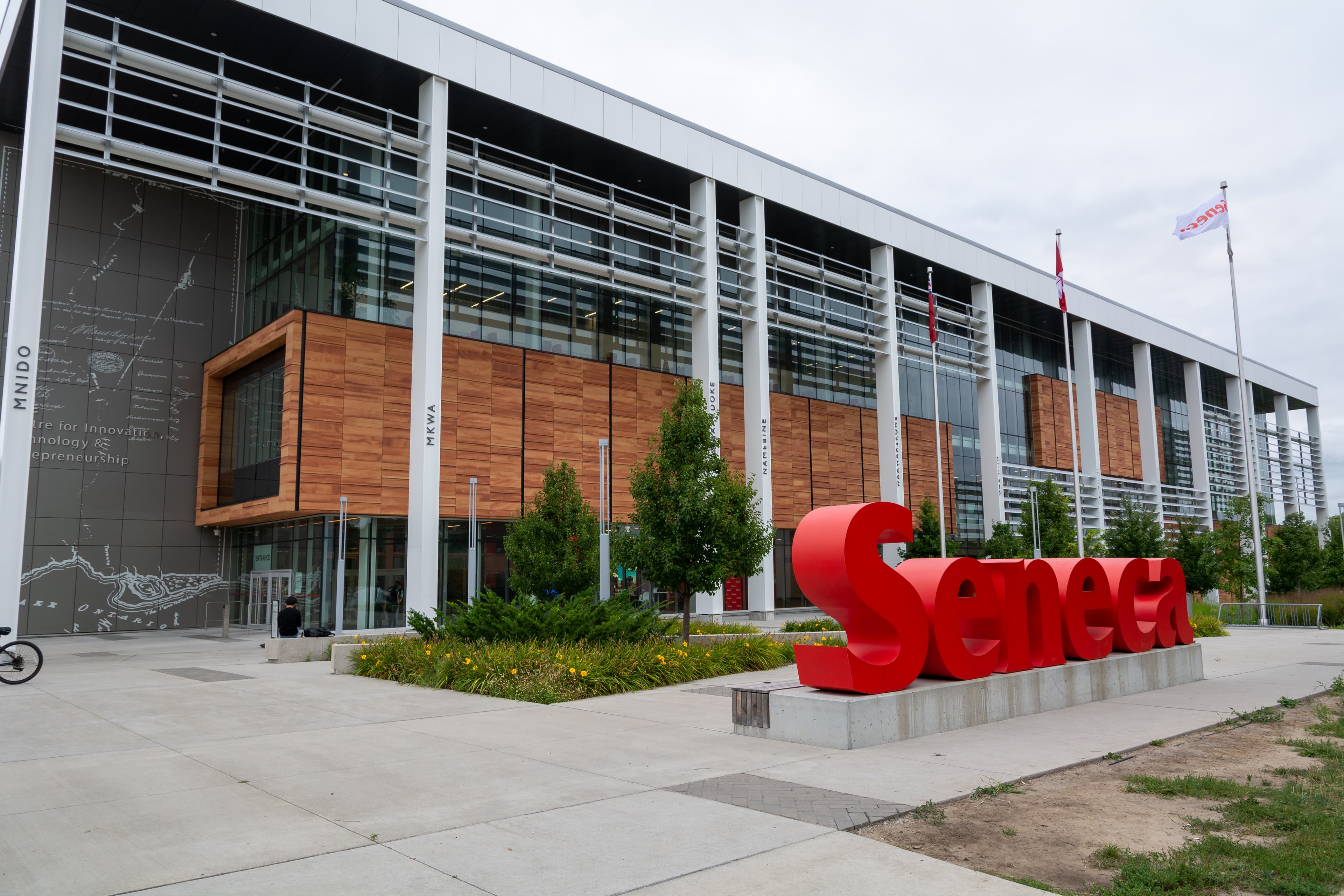
B.Sc. Nursing at Seneca Polytechnic — 18 questions answered
These are the most common questions Indian students and families ask before applying for B.Sc. Nursing at Seneca Polytechnic, King City. Covering admissions, fees, recognition, eligibility, hostel, career outcomes, and the India-return pathway — everything you need before making your decision.
Where is Seneca Polytechnic's nursing programme located?
At King Campus in King City, York Region — approximately 40 minutes north of downtown Toronto in the Greater Toronto Area. The campus is Seneca's health-sciences home, housing nursing and allied health programs, with clinical placements across the GTA hospital and community healthcare network.
What is the Seneca Nanji Foundation School of Nursing?
The dedicated nursing school within Seneca Polytechnic, named after a philanthropic gift from the Nanji family. It delivers the Honours BScN (standard, Fast Track, and Bridge streams) and the Practical Nursing diploma, with state-of-the-art patient care simulation labs at King Campus.
Is Seneca Polytechnic a recognised institution for study permit and PGWP?
Yes. Seneca Polytechnic is an IRCC-designated Designated Learning Institution (DLI No. O19395536013) — the mandatory status for a valid study permit and Post-Graduation Work Permit eligibility. Without DLI status, a PGWP cannot be issued.
What is CNO preliminary approval and does it affect my ability to register as an RN?
CNO preliminary approval means the College of Nurses of Ontario has confirmed that Seneca's BScN graduates will be eligible to apply for RN registration. Full approval follows after a comprehensive review in the year after the first graduating class completes the programme. This is a standard status for newer Ontario nursing degrees — it does not prevent graduates from applying for CNO registration or writing the NCLEX-RN.
What Class 12 subjects and marks do I need for the BScN?
English, Mathematics, Biology, and Chemistry — all four, at a minimum of 75% each. This is a hard requirement: a mark below 75% in any single subject disqualifies the application outright, regardless of overall average. In practice, competitive applicants typically present 80%+ in the sciences. The minimum overall average is 75% across six Grade 12 U/M equivalent courses.
Do I need NEET, SAT, or ACT to apply to Seneca's BScN?
No. NEET is an Indian entrance exam with no role in Canadian nursing programme admission. SAT and ACT are not required by Seneca for Indian undergraduate applicants. Admission is based entirely on your Class 12 marks (English, Mathematics, Biology, Chemistry at 75%+) and an accepted English proficiency test.
What English test do I need?
An accepted English test: IELTS Academic, TOEFL iBT, PTE Academic, Duolingo, or CAEL. IELTS Academic is the most common choice for Indian students. Check Seneca's current nursing-specific minimum score — degree programmes typically require IELTS 6.5 overall with no band below 6.0, but confirm the exact nursing requirement before applying.
How competitive is the BScN at Seneca?
Very competitive. It is a limited-enrollment programme in one of Canada's most internationally-attended polytechnics (80% of tuition from international students). Meeting the 75% minimum does not guarantee a seat — applicants typically need above-minimum marks in the four core subjects. Apply early in each intake cycle and do not rely on any agent who claims to 'guarantee' a nursing seat.
When are the intake windows for the BScN?
September and January — Seneca's BScN has two intakes per year, which is a genuine flexibility advantage over programmes with a single annual intake. Students who miss September can target January without waiting a full year.
What is the difference between the standard BScN, Fast Track, and Bridge streams?
Standard BScN: 4 years, 8 semesters with summer breaks — the primary pathway for Indian Class 12 students. Fast Track: 3 years, 8 consecutive semesters with no summer breaks — same curriculum and CNO eligibility, compressed calendar. Bridge: designed for CNO-registered Registered Practical Nurses (RPNs) completing a bridge into Years 3–4 — not applicable to Indian students arriving from Class 12. All three streams have CNO preliminary approval and 3-year PGWP eligibility.
What are the clinical requirements I must complete before placements?
Before entering clinical placements, students must complete Seneca's Clinical Preparedness Permit: current BLS certificate (in-person course, renewed annually — online not accepted), standard first aid (in-person, valid 4 years), immunisation records per the Canadian Immunization Guide for healthcare workers (including Hepatitis B series, varicella, MMR bloodwork for immune status), TB test or chest X-ray, mask fit test (every 2 years), and an annual Criminal Record Check with Vulnerable Sector Screening from a Canadian police service. Individuals with unresolved criminal charges or convictions may be prohibited from placement — review this requirement carefully before applying.
What is the annual tuition for international students in the BScN?
Approximately CAD 23,944–25,068 per year for international students in the BScN. Seneca updates fees each academic year — always confirm the current figure directly from Seneca's official fee schedule before making financial commitments.
What is the total 4-year cost for Indian students?
Including tuition, ancillary fees, health insurance, clinical requirements, and GTA living costs, roughly CAD 175,000–235,000 (approximately INR 1.07–1.48 crore). An Ontario RN earns an average of CAD 103,274/year — the investment is typically recoverable within two to three years of CNO registration.
Are scholarships available at Seneca for international nursing students?
Yes. Seneca offers up to CAD 5,000 entrance scholarships for new students starting in 2026 intakes (January, May, or September), and a renewable degree scholarship of up to CAD 1,000 per year for students in full-time bachelor's degree programmes who maintain the required GPA. Additional academic excellence and financial hardship awards are available.
What happened to the SDS (Student Direct Stream) fast-track process?
The Student Direct Stream was permanently discontinued on November 8, 2024. All Indian study permit applications now go through the standard stream — 8–14 weeks processing, Provincial Attestation Letter (PAL) required, full documentation upfront including an upfront Immigration Medical Examination. Outdated articles describing SDS are no longer accurate.
How do I become a Registered Nurse in Ontario after graduating from Seneca?
Graduate from Seneca's Honours BScN → apply to the College of Nurses of Ontario (CNO) for RN registration → pass the NCLEX-RN → pass the Ontario Jurisprudence Examination → receive your CNO Certificate of Registration as an RN. As a Canadian-educated graduate, you take the direct route — no NNAS internationally-educated-nurse credential assessment, no competency gap review, and no bridging programme. Canadian-educated graduates have substantially higher first-time NCLEX-RN pass rates than internationally educated nurses.
What is the Post-Graduation Work Permit (PGWP) for Seneca BScN graduates?
A 4-year Honours BScN from Seneca earns the maximum 3-year PGWP. As a bachelor's degree graduate, you are automatically exempt from the PGWP field-of-study requirement — no nursing-specific field exemption needed. The PGWP is an open work permit: any employer, anywhere in Canada, no job offer or LMIA required. Apply within 180 days of graduation, before your study permit expires.
What are my PR pathways after graduating from Seneca?
Two primary routes: (1) Express Entry category-based healthcare draws — Canada runs draws specifically for healthcare occupations (NOC 31301 Registered Nurse) at CRS scores of approximately 462–476 in 2026, well below the general 500+ threshold; (2) Ontario Immigrant Nominee Program (OINP) — Ontario nominates healthcare workers; an OINP nomination adds 600 CRS points, effectively guaranteeing an Invitation to Apply for permanent residence. Your Canadian BScN, Ontario RN registration, and Canadian work experience on the PGWP all build your CRS score. Students Traffic monitors these pathways and advises enrolled students as they approach graduation.
Applying to Seneca Polytechnic?
Students Traffic verifies seat availability, checks current recognition status, and prepares your complete application for Seneca Polytechnic. The consultation is free.