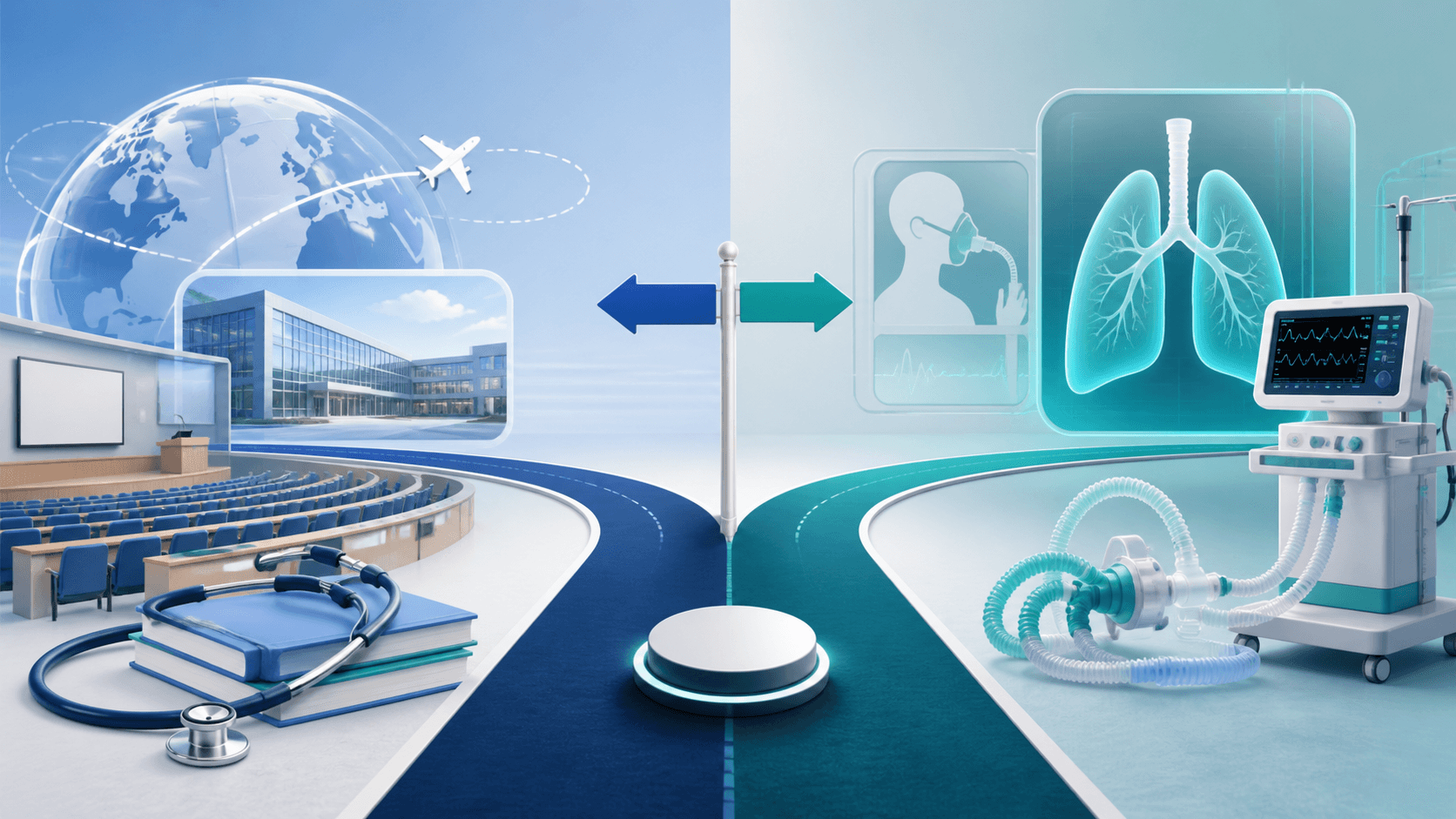
MBBS Abroad vs B.Sc. Anaesthesia in India 2026: Which Path Fits You?
Short answer: Choose MBBS abroad only if your goal is to become a doctor and you are ready for a longer, higher-risk licensing pathway that must be checked against the National Medical Commission (NMC) rules for your admission date. Choose a B.Sc. in Anaesthesia and Operation Theatre Technology in India if you want a shorter, India-based allied-health route focused on supporting anaesthesia teams, operating theatres and perioperative care. These are not two versions of the same degree: an anaesthesia technologist does not become a medical doctor through the B.Sc. route.
For an Indian student or parent deciding after Class 12 or NEET, the right comparison is not simply “which course is cheaper?” Compare the professional role, legal registration, length, clinical exposure, total cost, admission route, tolerance for relocation and the career you actually want to practise.
MBBS abroad vs B.Sc. Anaesthesia: quick comparison
| Decision factor | MBBS abroad | B.Sc. Anaesthesia and Operation Theatre Technology in India |
|---|---|---|
| Core outcome | Primary medical qualification; later licensing is required to practise in India | Allied-health degree for anaesthesia and operating-theatre support roles |
| Typical route checked | Foreign medical degree plus required internship, registration and India-return steps | Indian undergraduate programme, usually with practical training and internship |
| Role boundary | Doctor assesses, diagnoses, treats and takes medical responsibility within the licence | Technologist supports the anaesthesia and surgical team within defined scope |
| Location | Requires living and studying abroad; clinical language and hospital verification matter | India-based study and clinical training, although city and campus still matter |
| Entry | Indian eligibility rules plus the foreign university’s requirements; NEET may be relevant for Indian citizens | Institution-specific eligibility and selection; do not assume every programme uses NEET |
| Time and cost pattern | Longer and usually more expensive overall, with travel, visa and currency exposure | Shorter and often more manageable, but compare tuition, hostel and internship terms |
| Best fit | Student committed to becoming a physician and accepting a regulated return-to-India pathway | Student interested in operating rooms, equipment, patient monitoring and team-based care |
This is a framework, not a promise about admission, recognition, salary or employment. Programme names and rules change; verify the exact institution before paying.
What is the difference between an MBBS doctor and an anaesthesia technologist?
An MBBS is a primary medical qualification. A doctor studies medicine broadly—anatomy, physiology, pathology, pharmacology, medicine, surgery, community medicine and clinical disciplines—then completes the applicable licensing pathway. A doctor who later specialises in anaesthesiology follows postgraduate training after the medical degree and required registration steps.
An anaesthesia and operation-theatre technology degree is an allied-health programme. The student learns how to prepare equipment and the operating theatre, assist the anaesthesia team, monitor equipment and support safe perioperative workflows under the direction of qualified clinical professionals. The exact scope depends on the programme, hospital and applicable professional rules.
The NCAHP Act, 2021 describes allied-health professionals as people trained to perform technical and practical tasks that support diagnosis and treatment and the implementation of a healthcare plan recommended by a medical or other healthcare professional. That legal definition makes the boundary important: a B.Sc. AOTT graduate supports care; the qualification is not an MBBS and does not independently confer a doctor’s licence.
Which course is longer and more demanding?
There are two different kinds of difficulty. MBBS abroad is longer, broader and more exposed to regulatory, language and relocation risk. The current NMC FMGL FAQ says the foreign medical degree route covered by the 2021 regulations requires a minimum course duration of 54 months, English-medium instruction, medical education equivalent to the Indian MBBS course and other conditions including internship and registration requirements. Treat that FAQ as explanatory guidance and read the underlying regulations and later notices for your admission cohort.
The final route can also include a foreign-country internship, an India-based compulsory rotating medical internship where applicable, and the required licensing or exit examination pathway. The exact process can change, so a university’s “FMGE eligible” marketing line is not enough.
The official Manipal College of Health Professions page presents its Bachelor of Anaesthesia and Operation Theatre Technology as 3 years plus 1 year of internship. Other Indian universities may use different names, semester structures or internship arrangements. Ask whether the internship is embedded, where it occurs, how attendance is recorded and what qualification is awarded.
For both routes, clinical workload matters more than a brochure’s course title. Ask for the curriculum, practical hours, teaching hospitals, rotation plan, assessment method and student-to-supervisor arrangements.
What are the admission pathways in 2026?
MBBS abroad admission
For an Indian applicant, start with personal eligibility: Class 12 subjects, NEET position where applicable, passport, academic records and the rules that apply to your intended admission year. Then evaluate the foreign university. A responsible file should show:
- the legal name of the awarding institution and campus;
- the programme title, duration and language of instruction;
- the national licence or authorisation to teach medicine;
- hospital affiliations and the location of clinical training;
- internship terms, including who awards it and where it happens;
- student visa, accommodation, refund and fee-payment conditions.
The NMC guidelines for MBBS abroad and clinical-training checklist are useful starting points, but official NMC material remains the authority for Indian regulatory questions.
B.Sc. Anaesthesia admission in India
Entry varies by university. Some institutions use merit, an entrance test or counselling; some set PCB marks or other Class 12 requirements. A 2026 admissions document from Manipal describes its AOTT programme as a four-year structure including internship, while its fee document is a university-specific example rather than a national fee rule.
Do not assume that a B.Sc. AOTT seat uses NEET just because the course is taught in a hospital. Read the current prospectus for the exact institution. Confirm eligibility, selection, admission deadline, internship, hostel, clinical-site access and whether the programme is regular and recognised by the awarding university.
Which option costs less?
The answer depends on the university, country, city and financing—not just tuition. For MBBS abroad, calculate:
- tuition for every academic year;
- hostel or rent, food, insurance and local transport;
- visa, residence, flights, document translation and currency costs;
- books, equipment, examination and internship expenses;
- possible India-return costs, including examination and internship-related expenses;
- a contingency reserve for delays or a repeat year.
For the Indian B.Sc. route, compare tuition, hostel, transport, uniforms, instruments, examination charges and the opportunity cost of four years. Manipal’s 2025–26 general-category fee sheet lists a four-year B.Sc. Anaesthesia & Operation Theater Technology example with total tuition and other fees of ₹619,000, plus a refundable caution deposit. This is a dated, institution-specific illustration—not an average, a quote for every campus or a guarantee that the 2026–27 amount is unchanged.
The MBBS abroad fees comparison can help a family build a country-level budget, while a university’s own fee schedule should control the final decision. Never compare one foreign tuition figure with one Indian tuition figure while ignoring living costs and professional licensing steps.
Which route has the clearer recognition pathway?
Recognition is not a single badge.
For MBBS abroad, the key question is whether the exact foreign medical qualification and the student’s complete route satisfy the NMC framework applicable to the admission date and support lawful practice in the country awarding the qualification. Check course duration, medium, clinical training, internship, local registration and India-return requirements together. A university may be authorised in its own country without automatically giving an Indian licence.
For B.Sc. AOTT, check the awarding university, the programme’s regular status, the curriculum, clinical training and the applicable allied-health registration or state-employer requirements. The NCAHP framework provides for professional councils, central registration and state registration mechanisms, but implementation and professional requirements can evolve. Do not claim that every B.Sc. AOTT programme has the same registration outcome.
The practical test is simple: ask the institution to name the awarding body, regulator, register and job scope in writing. If the answer is vague, pause before paying.
What is clinical training like?
MBBS abroad exposes students to a wide range of medical specialties and patient populations. That breadth is necessary for a physician, but the quality can vary by university. Verify who teaches clinical subjects, whether patients are available, which language is used in wards, whether rotations happen on campus or at external hospitals, and whether the written programme matches actual student practice.
B.Sc. AOTT is narrower but can be highly practical. The student should learn theatre preparation, sterile technique, equipment checks, anaesthesia machine and monitoring support, airway and emergency support within scope, patient positioning, documentation and post-operative workflows. These are examples of areas to ask about, not a guarantee that every syllabus includes every competency.
In either route, a hospital logo or a photograph of an operating theatre is not proof of meaningful clinical access. Request a rotation schedule, attendance rules, supervision model, assessment log and internship completion document.
Which path suits your career goal?
MBBS abroad may fit you if:
- you want the legal and professional identity of a doctor;
- you are prepared for a longer course and India-return licensing steps;
- you can fund the full route without relying on an unconfirmed scholarship;
- you will learn the local clinical language where needed;
- you can verify the exact institution before committing;
- you are comfortable with academic uncertainty, relocation and currency risk.
B.Sc. AOTT may fit you if:
- you enjoy operating-room environments, technology and precise protocols;
- you want to study and begin your professional route in India;
- you prefer allied-health teamwork rather than independent medical diagnosis;
- you want a shorter route than MBBS and a focused clinical curriculum;
- you are ready for shift work, theatre discipline and close supervision;
- you will verify the programme’s registration and employer expectations.
Pause and reassess if:
- you are choosing only because of a promised salary or guaranteed job;
- you do not know the role boundary after graduation;
- you are comparing a foreign university’s brochure with an Indian university’s official fee sheet;
- you expect B.Sc. AOTT to lead automatically to an MBBS or doctor’s registration;
- you have not asked who provides clinical training and internship.
A six-question decision framework for Indian families
Score each option from 0 to 2 on six questions: desired professional role, regulatory clarity, clinical evidence, total affordability, admission certainty and personal readiness. A 2 means documented and acceptable, 1 means partly verified, and 0 means unresolved.
Do not average away a zero in role, recognition or clinical training. A cheaper course with an unclear qualification is not an affordable plan. Assemble your NEET result if relevant, Class 10 and 12 records, budget, preferred city, health-science interests and five-year career goal before counselling.
Students Traffic can help compare the two routes, shortlist suitable institutions, review scholarship or affordability fit and organise application documents. Counselling can clarify the decision, but no adviser can guarantee admission, registration, employment or a particular income.
FAQs
Q: Is B.Sc. Anaesthesia the same as MBBS?
No. B.Sc. Anaesthesia and Operation Theatre Technology is an allied-health qualification. It prepares graduates to support anaesthesia and theatre teams; it does not confer an MBBS or a doctor’s licence.
Q: Can an anaesthesia technologist administer anaesthesia independently?
Do not assume independent practice. The exact scope depends on law, institutional policy, professional rules and supervision. Ask the university and prospective employers for the written role description.
Q: Is MBBS abroad better than B.Sc. AOTT?
Only if becoming a doctor is your actual goal and you accept the longer foreign-study and licensing pathway. B.Sc. AOTT is a better fit for a student who wants focused allied-health work in operating-theatre and anaesthesia support.
Q: Is NEET required for B.Sc. Anaesthesia in India?
Not universally. Eligibility and selection vary by institution. Read the current prospectus; do not infer the rule from the course name or from MBBS admission requirements.
Q: Is NEET required for MBBS abroad?
Indian eligibility rules and university admission rules are separate. Indian applicants should verify the current NMC and NTA position for their category and admission year before applying.
Q: How long is B.Sc. Anaesthesia and Operation Theatre Technology?
One official Manipal programme page lists 3 years plus 1 year of internship. Other universities may use a different structure, so confirm the exact programme duration and internship in the prospectus.
Q: Which course is cheaper?
An Indian B.Sc. route is often easier to budget because it avoids foreign living, visa and currency costs, but fees vary. Compare the complete four-year Indian budget with the complete foreign MBBS budget, including licensing and return costs.
Q: Can B.Sc. AOTT graduates become doctors later?
The B.Sc. does not convert into an MBBS. A student who later wants to become a doctor must meet the separate medical-admission requirements and complete a recognised medical degree and licensing pathway.
Q: Does MBBS abroad guarantee registration in India?
No. A foreign degree must be assessed against the NMC framework applicable to the student’s route, including course, clinical training, internship and registration conditions. A consultant’s guarantee is not regulatory approval.
Q: What should I verify before joining B.Sc. AOTT?
Verify the awarding university, current recognition or approval information, eligibility, curriculum, practical hours, affiliated hospitals, internship, fee refund policy, role scope and the registration or employer requirements relevant to the state where you plan to work.
Q: Can Students Traffic compare MBBS abroad and B.Sc. AOTT for my profile?
Yes. Students Traffic can review your academic profile, budget and career preference, then help with shortlist building, scholarship-fit review and application support.
Sources and verification note (checked 20 August 2026): This article was checked against the NMC Rules & Regulations page, NMC FMGL FAQ, India Code text of the NCAHP Act, 2021, Manipal Bachelor of Anaesthesia & Operation Theatre Technology page, Manipal 2025–26 general-category fee sheet, and NTA’s official portal. Fees, admissions, professional registers, licensing rules, programme structures and employer requirements can change; re-check the exact official sources before applying or paying. This is educational guidance, not legal, regulatory or employment advice.