This guide is part of the Re-NEET 2026 Survival Blueprint. For confirmed dates, city slip downloads, and a 21-day study plan, start at The Ultimate Re-NEET 2026 Survival Blueprint.
This page is for students who are being honest with themselves.
Not students who are giving up. Not students who are not preparing hard for 21 June. Students who are preparing and are also allowing themselves to think: "What if the score lands where it has been landing — and is that the end of the road?"
It is not the end of the road.
But the students who navigate this well are not the ones who discover their options in the 48 hours after results. They are the ones who understood the landscape before results day — so when the score appears, they have a clear head and a real framework, not panic and an agent's phone number.
That is what this page is for.
Should I Drop Another Year or Study MBBS Abroad?
Here is the Indian MBBS seat market for a student scoring between 150 and 450 in Re-NEET 2026. No softening.
Government medical college seat (General category): Requires approximately 600+ in NEET UG to correspond to a competitive All India Rank for government colleges in most states. A score in the 150–450 range makes a government seat statistically very unlikely. Not impossible in every edge case — but unlikely enough that planning around it as a primary expectation would be a mistake.
Private MBBS in India at an established college: Costs between ₹70 lakh and ₹1 crore for the full 5.5-year programme, depending on institution and state. Management quota seats in some colleges go significantly higher. If your family's realistic education budget is below this range, a private Indian seat is not accessible regardless of whether you clear the admission cutoffs.
Another drop year: Adds a minimum of 12 months of preparation cost, coaching fees, and living expenses. NEET scores across drop-year candidates do not uniformly improve — they go up, flat, and down. The 2026 cancellation also demonstrated that the exam calendar itself carries disruption risk, which a drop year exposes you to again. And for a student who has now sat the 3 May exam followed by the June 21 re-exam, the psychological cost of a third preparation cycle is real and not trivial.
That is the Indian-seat landscape for this score bracket. The question becomes: what else is available, and what does it actually look like?
What MBBS Abroad Is — And Is Not
Before anything else, separate the reality from what agents in a post-cancellation market will tell you.
What MBBS abroad is: A 6-year MBBS programme at an internationally located, NMC-compliant, English-medium medical university — which, if completed correctly and followed by clearing the NExT examination in India, leads to a valid Indian medical licence and the right to practise.
What MBBS abroad is not: A shortcut. A guaranteed admission. A NEET-free path. Or a way to bypass the final examination that actually determines your Indian medical career.
What NMC Rules Actually Require — Read This Before You Talk to Anyone
The National Medical Commission (NMC) is the regulatory body that governs medical education and licensing in India. Its rules for students seeking foreign medical degrees are not optional, not negotiable, and not something any agent can work around later.
Requirement 1: A valid qualifying NEET UG score. The NMC requires Indian students to clear NEET UG at the qualifying cutoff before enrolling in any foreign medical university. The 3 May 2026 exam cancellation did not remove this requirement. Your Re-NEET 2026 score is the document that unlocks this eligibility.
Q: What is the minimum NEET score required to study MBBS abroad?
The qualifying cutoff changes each year after NTA sets the 50th percentile threshold. In recent cycles, the General category qualifying mark has been approximately 137–145 out of 720. The exact Re-NEET 2026 cutoff will be announced after results. The minimum qualifying score is not a competitive score — it is a threshold. Clearing it confirms eligibility for the MBBS abroad pathway. It does not guarantee admission to any particular institution.
Requirement 2: The institution must meet NMC guidelines. Not all foreign medical universities meet NMC's FMGL criteria. Enrolling at an institution that does not qualify means your degree will not open the Indian licensing pathway — regardless of what you were told at the time of admission. Always verify the specific institution (not just the country) before paying any fees.
Requirement 3: You must clear NExT to practise in India. After completing your MBBS abroad, the NExT (National Exit Test) — the reformed successor to FMGE — is the examination that determines whether you can practise medicine in India. Passing your degree is not sufficient. Passing NExT is.
This is the data point that families consistently overlook until it becomes a very expensive problem.
The NExT Pass Rate — The Question You Must Ask
The pass rate for foreign medical graduates on FMGE (and now NExT) has historically been significantly lower than the pass rate for graduates of Indian medical institutions.
This does not mean MBBS abroad students cannot pass NExT. Many do, and many go on to successful medical careers in India. But it means the quality of the institution you choose — the clinical exposure, the English-medium teaching quality, the preparation culture — directly affects the most important examination of your medical career.
Before you speak to any counsellor, university representative, or agent, ask this question specifically:
"What percentage of graduates from this specific college passed FMGE or NExT on the first attempt in the last three available years?"
If they give you a country-wide average: ask again for the college-specific number.
If they cannot produce the college-specific data: that absence is itself important information. A counsellor working in your interest will have this data. A counsellor working in their commission interest will not want you to focus on it.
What the Real Costs Look Like — Country by Country
The total cost comparison that matters is not tuition versus tuition. It is the total 6-year cost abroad versus the total 5.5-year cost at a private Indian college — including tuition, accommodation, food, travel, and a realistic estimate of incidental expenses.
Q: Which is the most affordable country for MBBS abroad for Indian students?
Here are approximate total 6-year ranges for commonly chosen MBBS abroad destinations:
| Country | Total 6-Year Cost (Approx.) | English Medium | NMC Compliance |
|---|---|---|---|
| Russia | ₹25–40 lakh | Yes (most top colleges) | Strong — many institutions meet FMGL criteria |
| Georgia | ₹30–45 lakh | Yes | Growing — verify institution-specifically |
| Uzbekistan | ₹20–35 lakh | Yes (selected colleges) | Growing — verify institution-specifically |
| Kyrgyzstan | ₹18–28 lakh | Yes (selected colleges) | Verify carefully before enrolling |
| Vietnam | ₹22–32 lakh | Varies by institution | Verify institution-specifically |
These are approximations and exclude flights, visa fees, insurance, and personal expenses. Always request a full itemised cost breakdown before comparing numbers.
The comparison point: at ₹20–45 lakh total for 6 years abroad versus ₹70–100 lakh for private MBBS in India, the financial difference is substantial. But cost alone is not the right decision variable. Institution quality — specifically NExT preparation quality — is.
The Three Agent Lines That Should End the Conversation
When a system failure like the NEET 2026 cancellation happens, the period immediately after creates a market for pressure-driven advice. Here are the three phrases that signal you are not speaking with someone working in your interest:
"NEET is cancelled, so you can go abroad without it." False. The 3 May exam was cancelled. The re-exam is happening on 21 June. NEET itself was not abolished. NMC's qualifying requirement for foreign medical education is unchanged.
"Seats are filling fast. Book before your results come out." Legitimate NMC-compliant universities do not close admissions to qualified applicants within days. This urgency is manufactured to make you pay a deposit before you have the data — your score — that should inform the decision.
"We'll handle the compliance once you're admitted." NMC compliance is not something handled after enrollment. If the institution does not meet NMC guidelines at the time you enroll, the degree you earn there may not carry licensing eligibility in India — regardless of what you were told or signed.
If you hear any of these, end the call, keep your money, and come back with better information.
Who This Route Actually Fits
MBBS abroad through an NMC-compliant institution is a legitimate and viable option for a specific profile:
- You have a valid Re-NEET 2026 qualifying score
- You have verified the specific institution — not just the country — meets current NMC FMGL guidelines
- You understand that NExT is the actual exam that determines your Indian medical career, and you have asked about the college's graduate pass rate
- You are choosing this because of genuine comparative advantage for your profile and budget — not because an agent created time pressure
For a student who meets this profile and makes the decision with clear information, this pathway has produced working doctors in India. For a student who enters it without understanding the NExT pass rate reality and the quality variation between institutions within each country, it has produced expensive degrees that did not deliver what families expected.
The difference between those two outcomes is the information you collect before you decide.
The One Thing to Do Before You Talk to Any Counsellor
You do not need to wait for your Re-NEET 2026 score to start this research. Do it now — so that when the score appears, you are making a decision with a clear head rather than under emotional pressure.
Collect these three pieces of information for any institution you are considering:
- Does this specific college meet current NMC FMGL guidelines? Verify directly — not through the institution's own claims.
- What is the first-attempt NExT/FMGE pass rate for graduates of this specific college for the last three available years?
- What is the fully itemised 6-year total cost — including tuition, hostel, food, and estimated personal expenses?
These questions cost nothing to ask. They commit you to nothing. And having the answers before you sit with a counsellor — or an agent — means you can evaluate what you are being told rather than simply receiving it.
Our counselling team at Students Traffic can walk you through this data for the institutions we work with. We will also tell you directly if the MBBS abroad route does not make sense for your profile or score — even if that means a shorter conversation.
You Have Fought Hard This Year
Sitting one 3-hour entrance exam is hard. Sitting the same 3-hour entrance exam twice — with a cancellation in between, with months of additional preparation, with an uncertain calendar and a system that let you down — is genuinely difficult. Whatever your June 21 score is, the effort this year has been real.
The goal now is to make the best decision for your medical career with the information available. Not the fastest decision. Not the most emotionally driven decision. The best one.
If that means MBBS abroad, we want to help you find the right path. If it means something else, we want to help you see that clearly too.
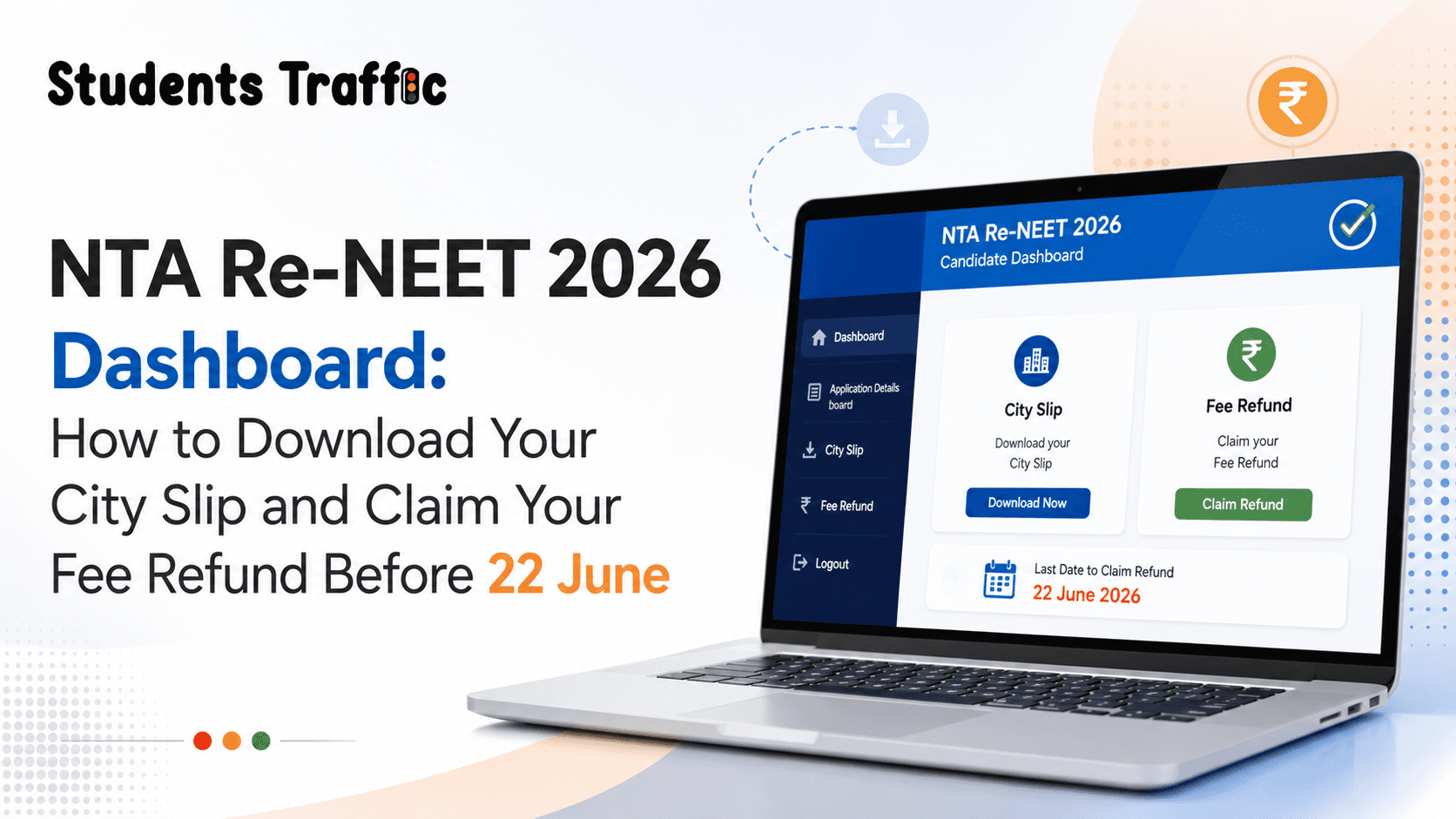
Back to the logistics guide: NTA Re-NEET 2026 Dashboard — City Slip & Fee Refund
Back to the study strategy: The 15-Minute Advantage — High-Weightage Chapters
Back to the full master resource: The Ultimate Re-NEET 2026 Survival Blueprint