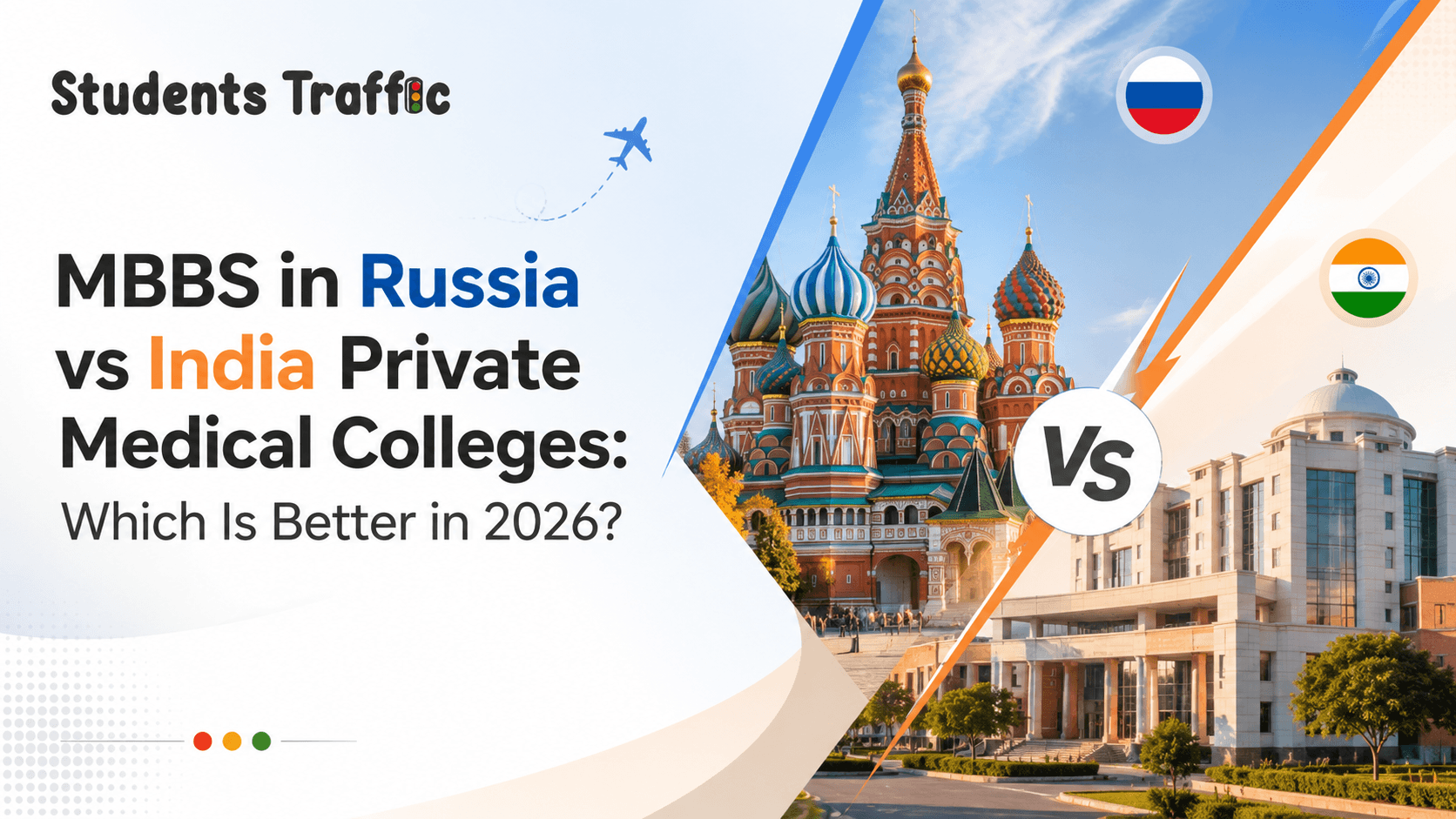
MBBS in Russia vs India Private Medical Colleges: Which Is Better in 2026?
This is the decision thousands of Indian families face every year. You have a NEET score that qualifies for private medical college in India — but not a government seat. Do you pay ₹1–2 crore for a private Indian seat, or spend ₹35–55 lakh for MBBS in Russia? Here is an honest, data-backed comparison.
The Cost Comparison
Total Cost: Russia vs Indian Private Medical College
| Cost Component | Russia (6 years) | India Private (5.5 years) |
|---|---|---|
| Tuition (total) | ₹18–35 lakh | ₹45–1.8 crore |
| Hostel + food | ₹12–18 lakh | ₹5–15 lakh |
| Travel & miscellaneous | ₹3–6 lakh | ₹1–3 lakh |
| Total (all-in) | ₹33–59 lakh | ₹51 lakh–2.16 crore |
| FMGE coaching (Russia only) | ₹2–4 lakh | — |
| India internship (Russia only) | ₹1–2 lakh | Included |
| True total | ₹36–65 lakh | ₹51 lakh–2.16 crore |
At the top-end Indian private college (management quota), Russia saves ₹1.5–1.8 crore. At the bottom-end Indian private college (merit-based NRI quota), costs are more comparable — but Russia still comes out cheaper by ₹15–30 lakh typically.
The Quality Question
Clinical Exposure
India: Private medical colleges have a teaching hospital attached. Clinical exposure in Years 3–5 is in familiar patient population, in the Indian public health context, and entirely in English.
Russia: Clinical years from Year 3 onward in large Russian hospitals. Patient volume is high, case variety is good, but the language of clinical rounds is Russian — students who haven't invested in Russian proficiency get less out of these postings.
Verdict: Indian private colleges have an edge on clinical exposure quality for students who want to practice in India, because disease patterns, drugs, and prescribing conventions are India-specific.
Basic Sciences
India: MBBS curriculum follows the NMC competency-based curriculum (CBME). Modern, India-specific, with integrated teaching.
Russia: Older European model, subject-wise, very deep in basic sciences. Anatomy, Physiology, Biochemistry teaching is exceptionally detailed at good Russian universities.
Verdict: Russia has a slight edge in basic science depth. This is why FMGE performance from Russian universities is above average — the deep basic science serves FMGE well.
Infrastructure
Top Indian private colleges (SRMC Chennai, Amrita Coimbatore, JSS Mysore) have world-class infrastructure. Good Russian universities (Sechenov, Kazan) are also excellent. Mid-tier institutions in both countries are comparable.
The FMGE Hurdle
This is the critical differentiator. India private college graduates can directly sit for NEET-PG after internship. Russia MBBS graduates must first clear FMGE.
- FMGE overall pass rate: ~15–20%
- Russia average: 29.54%
- Best Russian universities: 38–43%
- Cost of FMGE preparation: ₹2–5 lakh + 6–12 months of dedicated study
- Number of allowed FMGE attempts: Unlimited (as of 2026)
The implication: Even if you choose Russia for cost reasons, budget an extra year and ₹3–5 lakh for FMGE. A student from a top Russian university with a 43% pass rate has a reasonable shot in 1–2 attempts. A student from a low-ranked Russian university with 12% pass rate faces a much steeper hill.
The Time Factor
| Route | Total Time to Practice in India |
|---|---|
| India Private MBBS + Internship | 5.5 years |
| Russia MBBS + India Internship + FMGE (1 attempt) | 7–8 years |
| Russia MBBS + India Internship + FMGE (2 attempts) | 8–9 years |
India private college gets you to practice 1–2 years sooner, assuming no MBBS year failures.
PG Competitiveness
India Private College: Directly eligible for NEET-PG after internship. No additional screening.
Russia MBBS: Must clear FMGE first, then appear for NEET-PG. Once FMGE is cleared, NEET-PG eligibility is identical to Indian college graduates.
Verdict: India private college route to PG is faster and has fewer gates. Russia route has one additional mandatory gate (FMGE) that ~60–70% of students nationally don't clear on the first attempt.
Non-Academic Factors
Family Proximity
6 years in Russia means 6 years away from family. Most students visit India once a year during summer break. This is a genuine quality-of-life consideration — especially for students who have never lived independently.
Cultural Experience
Studying in Russia provides international exposure, language skills, and a global perspective that Indian private college cannot replicate. Many Russia alumni cite this as a lasting career advantage.
Safety and Support
Large Russian university cities are safe for Indian students. But Russia is not India. Winters in cities like Perm or Orenburg hit -30°C. Cultural adjustment takes 3–6 months.
Who Should Choose Russia?
Russia is the right call if:
- Your NEET score doesn't get a government seat and you're looking at management quota (₹1+ crore)
- You are self-motivated and can handle independent living
- You are prepared to invest seriously in FMGE coaching
- You want the option of international pathways (USMLE, PLAB) post-MBBS
- You choose a university with >35% FMGE pass rate
India Private College is the right call if:
- The cost difference is manageable for your family
- You want to avoid the FMGE hurdle entirely
- You want to start practicing in India faster
- You have personal circumstances that make 6 years abroad impractical
Further reading: MBBS in Russia fees breakdown · Is MBBS from Russia valid in India? · Cost of living in Russia for Indian students
The Bottom Line
The real competition is: ₹36–65 lakh in Russia (with FMGE risk) vs ₹80 lakh–1.5 crore in an Indian private college (without FMGE, direct PG eligibility). For most families where this cost difference is material, Russia offers a legitimate, well-worn path to medical practice in India — but only if you approach it with your eyes open to the FMGE requirement.