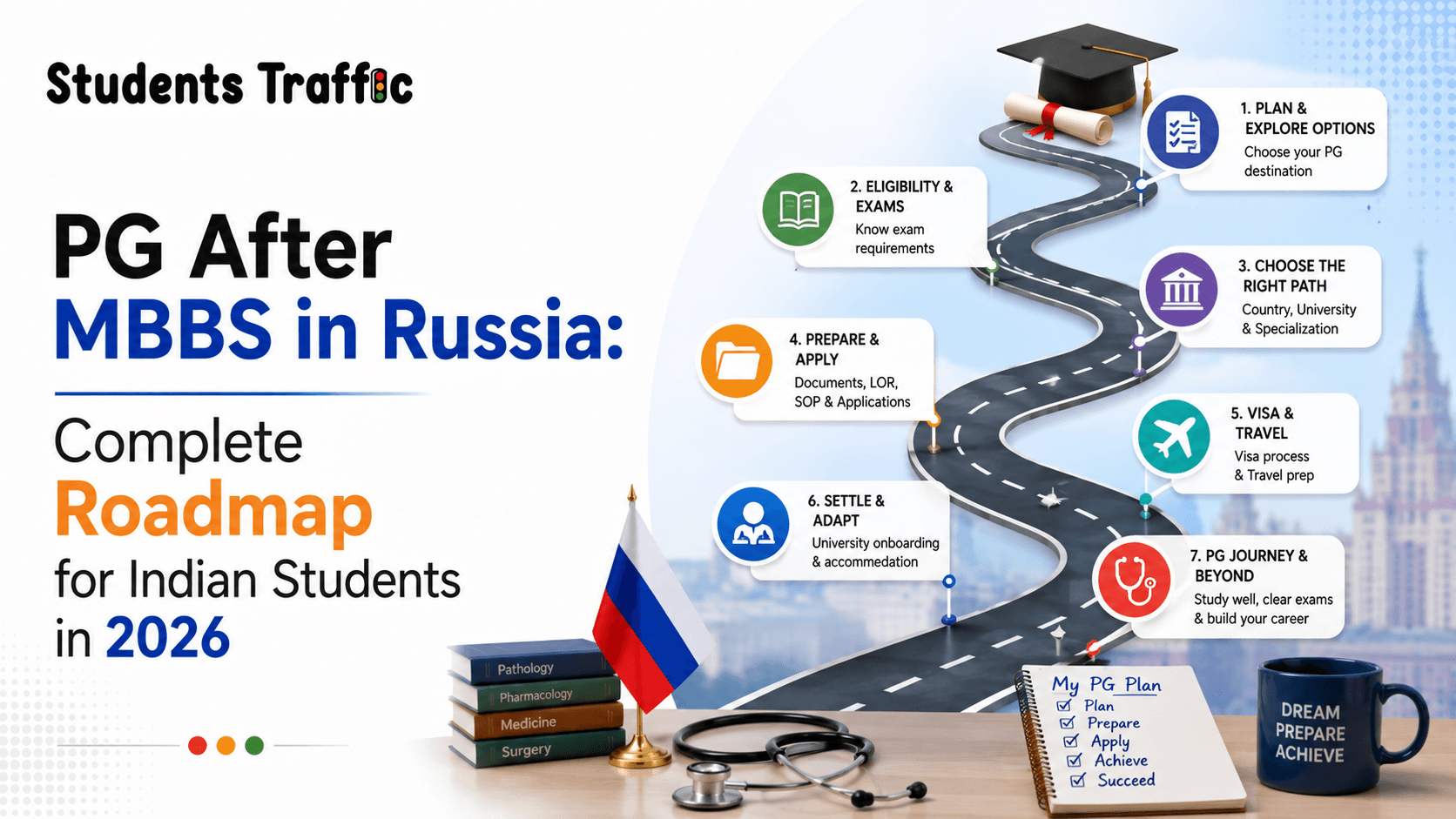
PG After MBBS in Russia: Complete Roadmap for Indian Students in 2026
Getting into MBBS from Russia is the first milestone. The bigger question — one most consultants won't answer honestly — is what happens after you return with your degree. Here is everything you need to know about PG after MBBS in Russia.
The Gateway: FMGE / NExT
Every MBBS graduate from a foreign university must pass the Foreign Medical Graduate Examination (FMGE) before they can practice in India. From 2026 onward, FMGE is being restructured into NExT Step 1 and Step 2, but the fundamental requirement remains: pass a screening test before you can enrol in any Indian PG programme.
FMGE Pass Rates from Russian Universities
This is where hard data matters. Pass rates vary dramatically:
| University | FMGE Pass Rate (2024) |
|---|---|
| Orenburg State Medical University | 43.4% |
| Kazan Federal University | 38–42% |
| Sechenov First Moscow State Medical University | 38–40% |
| Russian average | 29.54% |
| Kursk State Medical University | 22.29% |
| Rostov State Medical University | 12.64% |
The national average for FMGE is around 15–20%. Russian universities as a group perform above average, but individual university performance varies by a factor of 3x. Choose your university carefully — it directly affects your PG prospects.
Preparing for FMGE While Studying in Russia
- Start subject-wise revision from Year 4 onward
- Focus on high-yield FMGE subjects: Pharmacology, Pathology, Medicine, Surgery, OBG
- Use NBE standard textbooks alongside Russian curriculum (which uses European textbooks)
- Join FMGE coaching in India during your 4th-year summer break
- The Russian curriculum is strong in basic sciences; supplement with Indian clinical application practice
After FMGE: Applying for PG in India
Once you clear FMGE and receive your provisional registration from the NMC, you are eligible to appear for NEET-PG — the national entrance test for MD/MS/Diploma seats in India.
The NEET-PG Pathway
- Clear FMGE → Get NMC provisional registration
- Complete 1-year internship at a recognised Indian hospital
- Apply for NEET-PG
- Secure a government/private PG seat
Important: The 1-year internship is mandatory for foreign medical graduates. You must complete it in India, not in Russia, for it to count toward NEET-PG eligibility.
Government vs Private PG Seats
- Government PG seats: Highly competitive. NEET-PG rank cut-offs for government MD/MS seats are brutal — General category needs top 5–10 percentile
- Deemed/Private PG seats: Easier to secure but fees range from ₹25–80 lakh for the 3-year programme
- Diploma seats: Lower cut-off; good option for Anaesthesia, Emergency Medicine, Dermatology (Diploma), Ophthalmology (Diploma)
PG Specialties With the Best Prospects
After MBBS from Russia, students tend to do well in:
- Family Medicine / General Practice — Direct work possible after FMGE
- Anaesthesia (MD/DA) — Moderate seat competition
- Pathology — Strong Russian curriculum aligns with FMGE Pathology sections
- Community Medicine — Lower cut-off, stable career
- Radiology (DMRD) — Diploma option; growing demand
- Emergency Medicine — New specialty, growing seats
Alternative: PG Outside India
If NEET-PG competition feels steep, there are genuine alternatives.
USMLE (USA)
American residency is the gold standard for global MBBS graduates. MBBS from Russia is recognised — many Russian universities are ECFMG/WDOMS listed.
- Steps: USMLE Step 1 → Step 2 CK → ECFMG certification → Residency match (NRMP)
- Timeline: 3–5 years from MBBS completion
- Cost: ₹15–25 lakh for prep + applications
- Income after residency: $250,000–400,000/year (₹2–3.3 crore/year)
Start USMLE prep in Year 3 of MBBS. Sechenov and Kazan alumni have successfully matched into US residency.
PLAB (UK)
The UK route is through PLAB 1 and PLAB 2 — practical and written tests run by the General Medical Council (GMC).
- MBBS from NMC-recognised Russian universities qualifies for PLAB
- NHS offers good training posts and career stability
- Typical timeline: 2–3 years post-MBBS
AMC (Australia) / NZREX (New Zealand)
- Strong demand for doctors; Indian graduates eligible if university is on AMC approved list
- Check the AMC website for your specific university's status
MCCQE (Canada)
- Requires ECFMG certification
- Growing pathway; Canadian residency match is competitive but achievable
State Medical Council Registration
After FMGE, you must register with a State Medical Council (SMC) to practice in that state. Each state has its own process and fee.
- Steps: Apply with FMGE pass certificate + NMC provisional registration + MBBS degree + migration certificate
- Timeline: 30–60 days depending on the state
- Registration is required to prescribe and sign death certificates
Timeline: Year-by-Year After MBBS in Russia
| Year | Milestone |
|---|---|
| Year 0 (final year) | Start FMGE coaching; apply for NMC Eligibility Certificate renewal if needed |
| Year 1 after MBBS | Return to India; sit FMGE; begin 1-year Indian internship |
| Year 2 | Complete internship; apply for NEET-PG or USMLE Step 1 |
| Year 3 | Enrol in PG programme or complete USMLE Step 2 CK |
| Year 4–5 | PG residency / fellowship |
Common Mistakes to Avoid
- Not starting FMGE prep early: Most students who fail FMGE attempted it without India-specific preparation. Russian textbooks don't cover Indian clinical context or exam style.
- Choosing university only on fees: A university where 12% pass FMGE (Rostov) versus 43% (Orenburg) makes a 3x difference in your PG prospects.
- Doing internship in Russia only: Your Russian internship (6th year) does not substitute the mandatory 1-year India internship required by NMC.
- Not getting SMC registration: Treating patients without SMC registration is illegal in India, even after FMGE.
Summary
For context on salaries after completing the PG route, see our salary after MBBS in Russia guide.
PG after MBBS in Russia is absolutely achievable — the path is clear, but it requires planning from Day 1. Choose a university with strong FMGE track records. Start FMGE prep in Year 4. Complete your India internship. Then either compete for NEET-PG seats or pivot to USMLE/PLAB for a global career.