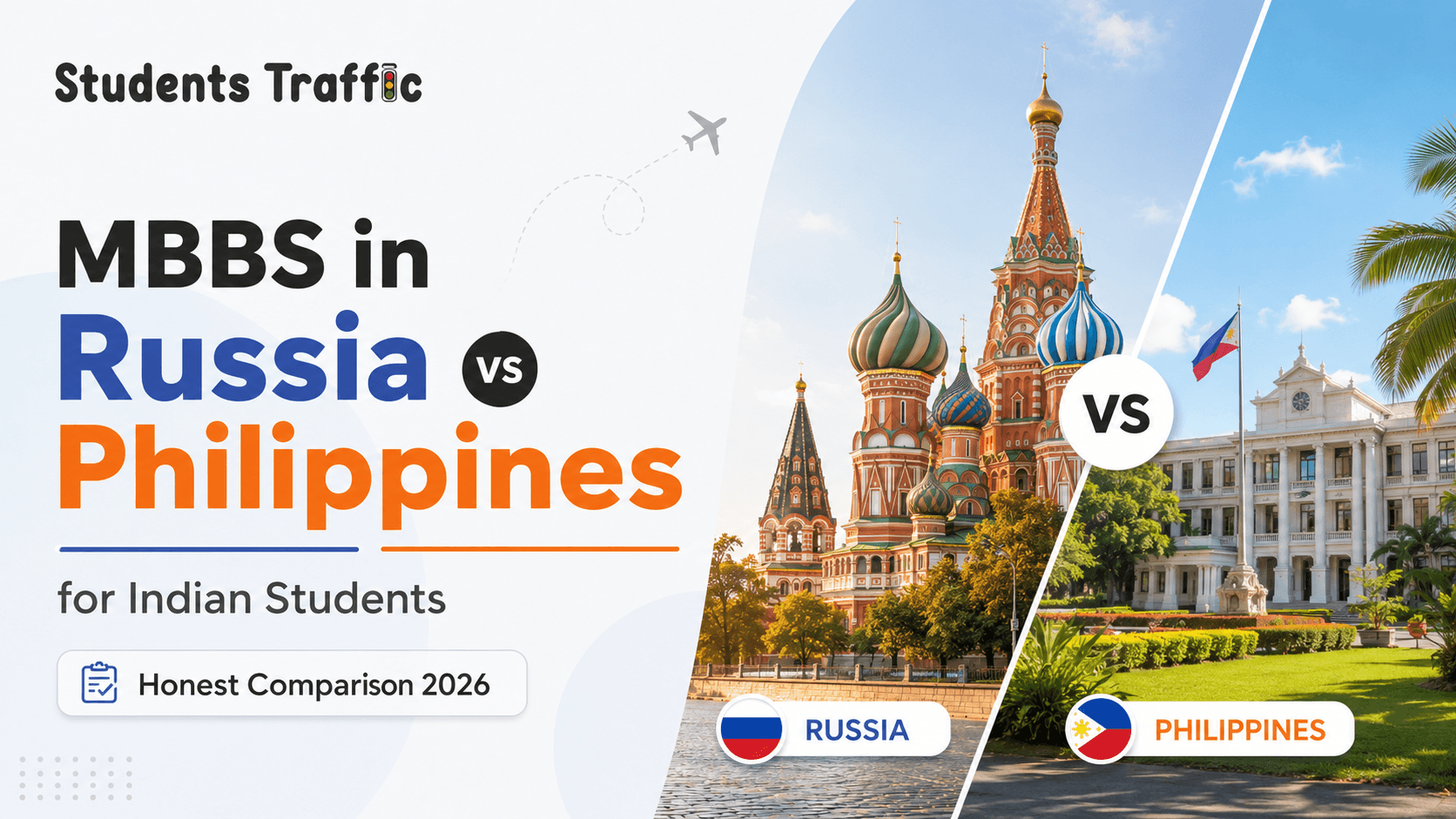
MBBS in Russia vs Philippines for Indian Students: Honest Comparison 2026
Both Russia and the Philippines attract thousands of Indian MBBS students annually. Both offer English-medium medical education at a fraction of Indian private college costs. But they are very different destinations — different curricula, different FMGE outcomes, different climates, different cultures. Here is a head-to-head comparison.
At a Glance
| Factor | Russia | Philippines |
|---|---|---|
| Programme duration | 6 years | 5.5 years (2 yrs BS + 4 yrs MD) |
| Total cost (all-in) | ₹35–65 lakh | ₹40–75 lakh |
| NMC-approved universities | 46 | 17 |
| FMGE pass rate (2024) | 29.54% (top unis: 40%+) | 42.7% (top unis: 60%+) |
| Medium of instruction | English (Russian for clinics) | English throughout |
| Climate | Cold (winters -30°C possible) | Tropical |
| Food options | Limited Indian; adaptable | Indian-friendly cuisine available |
Cost Comparison
Russia (6 years total)
| Item | Total |
|---|---|
| Tuition | ₹18–35 lakh |
| Hostel + food | ₹12–20 lakh |
| Travel + miscellaneous | ₹5–8 lakh |
| Total | ₹35–63 lakh |
Philippines (5.5 years total)
| Item | Total |
|---|---|
| BS Biology (pre-MD, 2 years) | ₹4–8 lakh |
| MD programme (4 years) | ₹20–35 lakh |
| Hostel + food | ₹12–22 lakh |
| Travel + miscellaneous | ₹4–10 lakh |
| Total | ₹40–75 lakh |
Philippines is marginally more expensive on average, though the best value universities in each country are cost-competitive.
FMGE Performance: The Most Important Metric
Philippines
The Philippines has consistently high FMGE pass rates:
| University | FMGE Pass Rate (2024) |
|---|---|
| University of Santo Tomas (UST) | ~60–65% |
| University of the East Ramon Magsaysay (UERM) | ~55–60% |
| Lyceum Northwestern University | ~45–50% |
| Philippines average | 42.7% |
Russia
| University | FMGE Pass Rate (2024) |
|---|---|
| Orenburg State Medical University | 43.4% |
| Kazan Federal University | 38–42% |
| Sechenov First Moscow State Medical University | 38–40% |
| Russia average | 29.54% |
| Kursk State Medical University | 22.29% |
| Rostov State Medical University | 12.64% |
Verdict: Philippines as a country posts higher average FMGE scores. Top Philippine universities outperform top Russian universities. The English-medium teaching throughout — with no Russian language gap in clinical years — is a key driver of this difference.
Curriculum and Teaching Medium
Philippines
The Philippine medical system is modeled on the American system. Teaching is entirely in English. The curriculum emphasizes early clinical exposure, problem-based learning, and USMLE-style reasoning. Students find FMGE preparation more aligned with their classroom training.
Russia
Years 1–3: English-medium lectures in basic sciences. Years 4–6: Clinical rotations largely in Russian. Students must interact with patients in Russian, which requires significant language investment. Basic science depth is excellent but the clinical communication gap is real for students who underinvest in Russian language.
For FMGE preparation: Philippines curriculum is more directly aligned with FMGE content and question style. Russian curriculum provides deeper basic science but requires more bridging for FMGE clinical questions.
Programme Structure
Philippines: BS + MD Model
- 2 years of BS (Bachelor of Science — Biology or similar pre-med)
- 4 years of Doctor of Medicine (MD)
Philippine graduates technically take the same 6 years total as Russia, but the BS is a distinct undergraduate degree — useful as a standalone qualification if the student doesn't proceed to MD.
Russia: Integrated Specialist Degree
Russia's 6-year programme is an integrated Specialist Degree (equivalent to MBBS). Year 6 is a clinical internship year in Russia. NMC treats this as equivalent to MBBS.
NMC Recognition Landscape
- Russia: 46 universities on the NMC approved list — more choice, more flexibility
- Philippines: 17 universities on the NMC list — fewer options, and entry to the top ones is competitive
The key point: only 17 Philippine universities are NMC-approved, but the quality at the top ones (UST, UERM, AMA, Davao Medical School) is very high. In Russia, the 46 approved universities span a wide quality range — from Sechenov (world-class) to universities with 12% FMGE pass rates.
USMLE / International Pathways
Both routes are viable for USMLE, but Philippines has a structural advantage:
- Philippine curriculum is American-model, making USMLE Step 1 and Step 2 preparation more intuitive
- Philippine graduates are ECFMG-eligible if the university is WDOMS-listed
- Many UST, UERM, and AMA graduates match into US residency annually
- Russia's USMLE pathway is equally valid but requires more transition from the European-style Russian curriculum
If your long-term goal is US residency, Philippines has a curriculum alignment advantage.
Life as an Indian Student
Russia
- Large Indian student communities in Kazan, Volgograd, Orenburg, Perm
- Indian restaurants and grocery stores in major university cities
- Harsh winters (essential to prepare for — psychologically and practically)
- Cultural gap is significant; Russian social culture is formal and reserved
Philippines
- Filipino culture is warm, English-speaking, and naturally welcoming
- No language barrier in daily life
- Tropical climate — familiar for Indian students from warmer states
- Food options include Indian restaurants in Manila and major cities
- Closer to India than Russia (4–5 hour flight vs 8–10 hours)
For comfort of living, Philippines wins clearly. The climate, language, and cultural proximity make daily life easier.
Who Should Choose Russia?
- You want a European medical education framework
- You are interested in research opportunities at top universities
- Cost is the primary driver and you've identified a high-FMGE university (Orenburg, Kazan, Sechenov)
- You are prepared for the Russian language investment
- You want maximum NMC-approved university choice and flexibility
Who Should Choose Philippines?
- FMGE success rate is your top priority
- You want English-medium throughout — no language gap in clinical years
- You're considering USMLE or other global pathways post-MBBS
- You prefer a warmer climate and culturally accessible environment
- You want the strongest possible alignment between your medical curriculum and Indian licensing exams
Our Recommendation
For most Indian students prioritising FMGE success and practice in India: Philippines (specifically UST, UERM, or DMSF) is the statistically safer bet. The FMGE pass rates are meaningfully higher, the English-medium clinical training removes the language gap, and the American curriculum model aligns well with both FMGE and NEET-PG preparation.
For students comfortable with the Russian language investment and interested in European or research pathways — or those for whom a specific top-ranked Russian university is accessible — Russia is an equally legitimate choice.
Further reading: Best MBBS colleges in Russia for Indian students · MBBS in Russia fees · Medical colleges in Russia for Indian students
The key rule: don't compare Philippines at its worst against Russia at its best, or vice versa. Compare the specific university you're targeting in each country. Check their NMC status. Look up their FMGE pass rate from the NBE annual report. That comparison, done honestly, will give you the right answer for your situation.