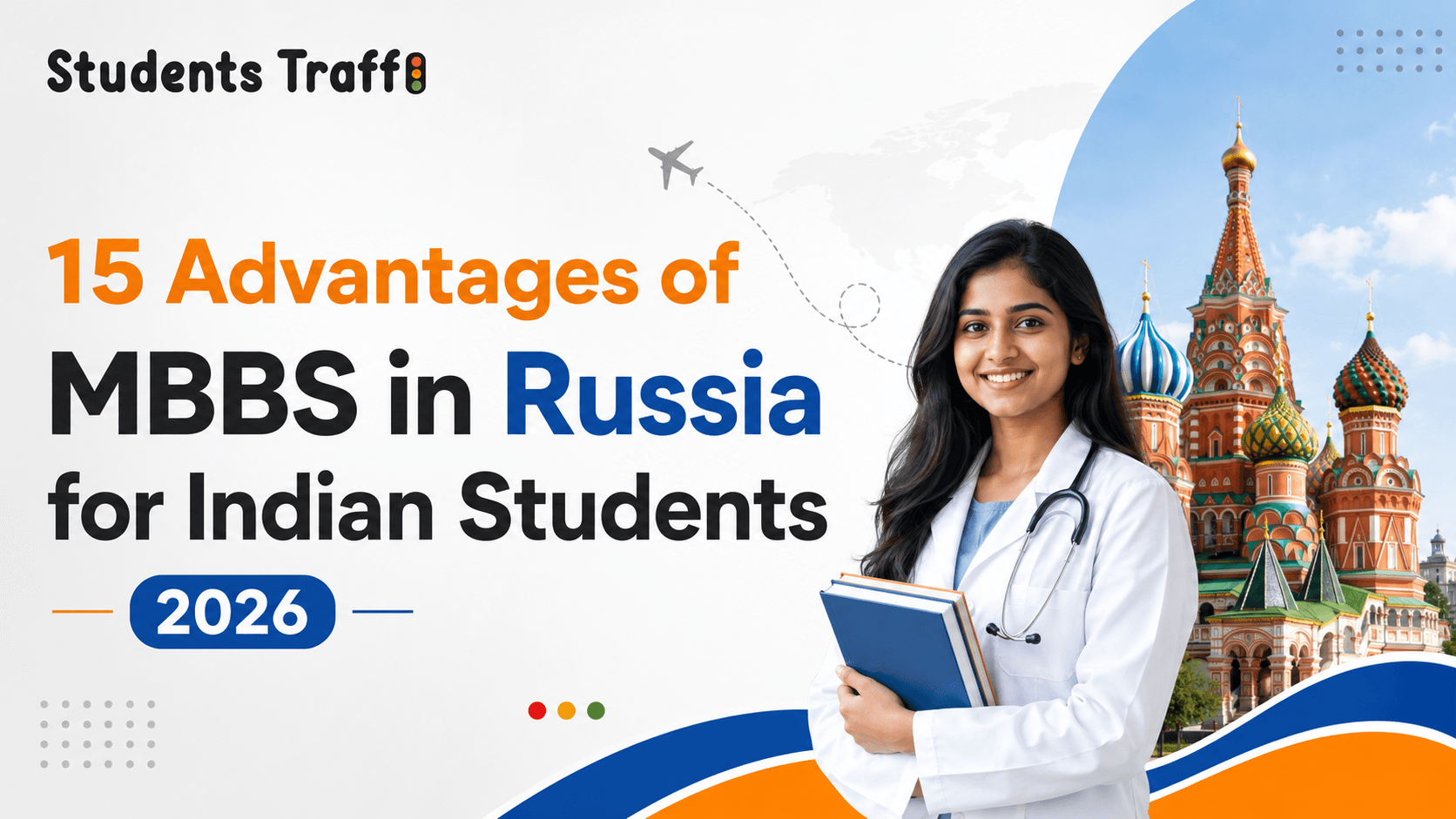
15 Advantages of MBBS in Russia for Indian Students in 2026
Russia has been a destination for Indian MBBS aspirants for over three decades. Today, more than 15,000 Indian students study medicine in Russia annually. Here are the real, evidence-based advantages — and where each one comes with a caveat you should know.
1. NMC-Recognised Degrees
Russian medical universities on the NMC (National Medical Commission) approved list grant degrees valid for FMGE and — going forward — NExT screening. The NMC list includes 46 Russian universities. This is the foundational criterion; if your university is on this list, your degree is legally recognised in India.
Caveat: Not all universities advertising MBBS admission to Indian students are on the NMC list. Verify before you enrol at nmc.org.in.
2. No Russian Entrance Exam Required
Russian universities do not conduct their own entrance examination for Indian students. Admission is based on NEET score (required by Indian law) + Class 12 marks + the university's own eligibility criteria. There is no additional Russian test to clear.
3. Lower Total Cost Than Indian Private Colleges
The total 6-year cost (tuition + hostel + food) at a good Russian university runs ₹35–55 lakh. Indian private medical college fees range from ₹60 lakh to ₹2.2 crore for the same degree. The saving is real and substantial.
Caveat: Factor in the cost of 1–2 FMGE attempts (₹3–6 lakh coaching + exam fees) and the India internship year (₹1–2 lakh).
4. English-Medium Teaching Available
Most Russian medical universities offer an English-medium track for international students. Subject lectures are in English; clinical postings eventually involve Russian language interaction with patients.
Caveat: Russian language proficiency is required for clinical years (Year 3 onward). Basic Russian is taught in Years 1–2, but students who don't invest in it struggle during hospital rotations.
5. Strong Basic Sciences Curriculum
Russian medical education has a globally respected basic sciences foundation. The first three years cover Anatomy, Histology, Biochemistry, Physiology, Pathology, Pharmacology, and Microbiology at significant depth — often more rigorous than Indian colleges. This directly helps with FMGE, which is heavily basic-science weighted.
6. Real Clinical Exposure
Russian universities are integrated with major teaching hospitals. From Year 3, students participate in ward rounds, patient examinations, and clinical procedures. The patient volume at Russian public hospitals is high, and the variety of cases is substantial.
7. World-Class Research Infrastructure at Top Universities
Sechenov First Moscow State Medical University is ranked #1 in Russia for medicine and is a global research institution. Kazan Federal University has a strong neuroscience department. Students interested in research can access labs and co-author papers as undergraduates.
8. Established Indian Student Community
Russia has over 15,000 Indian students in medical programs. Large university cities — Kazan, Volgograd, Orenburg, Perm — have established Indian communities with Indian restaurants, groceries, and cultural celebrations. Most universities have dedicated international student coordinators.
Caveat: Safety conditions and racial tolerance vary by city. Moscow and Kazan have better records than some smaller cities.
9. Recognised by WHO-Listed WDOMS
Russian medical universities are listed in the WDOMS (World Directory of Medical Schools), the global reference database used by medical councils worldwide. This matters for USMLE, PLAB, AMC, and other international licensing pathways.
Note: WDOMS listing ≠ NMC approval. You need both. WDOMS listing enables international routes; NMC listing enables the Indian route.
10. 6-Year Integrated Programme Including Internship
The Russian MD (Specialist Degree) is a 6-year integrated programme. The 6th year is a clinical internship year in Russia. While this does not replace the mandatory 1-year Indian internship required by NMC, it provides strong clinical grounding before you return.
11. No Donation or Management Quota
Unlike Indian private medical colleges where management quota fees can reach ₹1–2 crore per seat above tuition, Russian universities have no donation or capitation fee system. You pay the stated tuition — nothing more.
12. European-Standard Medical Education
Russia's medical curriculum follows European standards — largely aligned with ECTS (European Credit Transfer and Accumulation System). The academic rigour and examination system produce graduates who are competitive for European postgraduate training.
13. Cultural Exposure and Independence
Six years in Russia builds significant personal development. Students return more independent, more resilient, and with a genuinely international outlook. Many of the most successful doctors in India's metros are MBBS from Russia graduates.
14. Good FMGE Performance at Select Universities
At the right university, FMGE pass rates are well above the national average. Orenburg State Medical University reported 43.4% pass rate in 2024 — nearly 3x the national average for foreign medical graduates. Kazan and Sechenov consistently post 38–42%.
15. Growing Indian Support Ecosystem
India has a mature coaching ecosystem for FMGE/NExT preparation for Russia returnees. FMGE coaching centres exist in major cities. Alumni networks from Russian universities are active on social media and provide honest mentorship. The path is well-trodden.
Further reading: Disadvantages of studying MBBS in Russia · MBBS in Russia fees · Is MBBS from Russia valid in India?
The Honest Summary
MBBS in Russia is a genuinely good option for students who: (a) clear NEET but don't get a government seat, (b) can't afford or don't want Indian private college donation fees, and (c) are prepared for 6 years abroad followed by serious FMGE preparation. The advantages are real. So are the challenges. Students who thrive are the ones who go in with accurate expectations — not marketing brochures.