KIIT Deemed to be University — Courses, Fees & Admission | Students Traffic
KIIT Deemed to be University
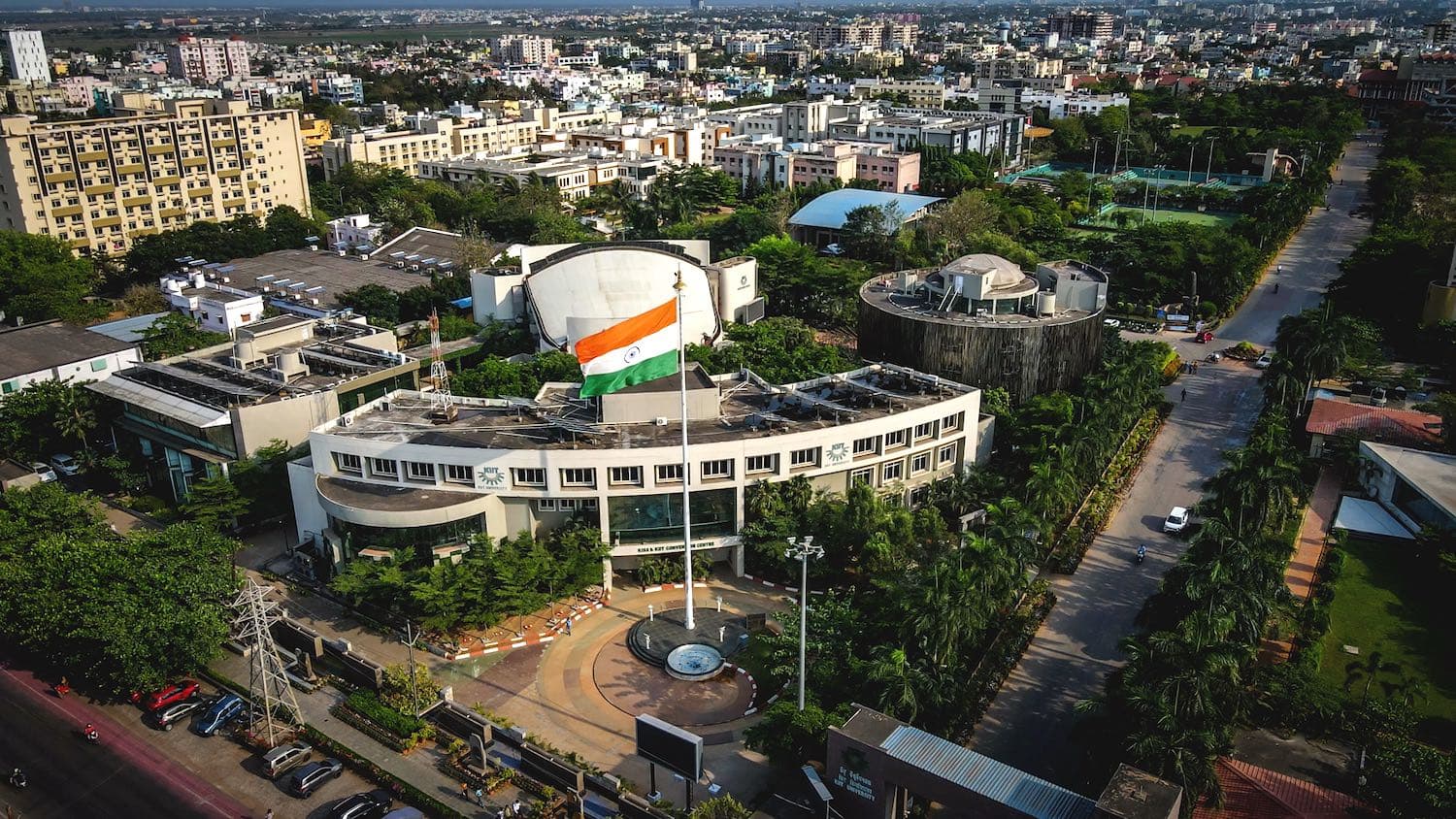
KIIT Deemed to be University is a private, self-financed institution at Patia in Bhubaneswar, Odisha, recognised under Section 3 of the UGC Act, 1956.
Written by Students Traffic Research Team·Updated On: 12 Jul 2026
At a glance
Location
Bhubaneswar, India
University type
Private
Established
1997
Study levels
Bachelor's, Master's
Teaching language
English
Intakes
August
University overview
KIIT Deemed to be University is a private, self-financed institution at Patia in Bhubaneswar, Odisha, recognised under Section 3 of the UGC Act, 1956. Its co-located schools cover engineering and computing, management, law, sciences and biotechnology, design, media and health, and it runs a separate international admissions route with tuition published in US dollars.
KIIT reports a 36 sq km academic township holding 30 co-located schools, more than 3,000 faculty and researchers and over 40,000 learners, including around 2,000 international students from 65 countries and 131 international faculty. Each school runs from its own campus with dedicated laboratories, library and conference halls, alongside a multi-storey central library, 18 sports complexes, 30 food courts and the Biju Patnaik Indoor Stadium. The Central Convention Centre auditorium seats 1,600, and international students can join the India Trek cultural programme and credit-based study abroad options.
Bhubaneswar, IndiaEst. 1997Private University
Why students choose it
Tuition for international applicants is published in advance in US dollars: USD 10,000 a year for undergraduate and postgraduate courses, USD 8,000 a year for SAARC-region applicants and USD 4,000 a year for PhD, with a written refund schedule.
KIIT reports a 36 sq km academic township holding 30 co-located schools, more than 3,000 faculty and researchers and over 40,000 learners, including around 2,000 international students from 65 countries and 131 international faculty. Each school runs from its own campus with dedicated laboratories, library and conference halls, alongside a multi-storey central library, 18 sports complexes, 30 food courts and the Biju Patnaik Indoor Stadium. The Central Convention Centre auditorium seats 1,600, and international students can join the India Trek cultural programme and credit-based study abroad options.
Accommodation
Boys and girls hostels are separate, and KIIT runs a dedicated international hostel for foreign students. Rooms are offered on single, double and triple-sharing bases with attached bathrooms, Wi-Fi and intranet access, and KIIT states that about 30 per cent of hostel rooms are air conditioned. Every hostel has an attached canteen, a 24-hour reading room and facilities for indoor and outdoor games. Hostel, mess and examination charges sit outside the published US dollar tuition table and are confirmed in the admission offer letter, so no accommodation price is published in advance of an offer.
Student perspective
Admissions support
Build a clear application plan for KIIT Deemed to be University
Get focused help with your application, documents and visa process. We will turn the information on this page into a practical next-step plan.
Application planning
Document review
Visa support
Frequently asked questions
Is KIIT a public or a private university?
KIIT is a private, self-financed institution. It holds Deemed to be University status under Section 3 of the UGC Act, 1956, which is a Government of India recognition granting degree-awarding powers; it appears in the Odisha section of the UGC consolidated list of deemed universities and on the UGC list of deemed universities included under Section 12(B) of the UGC Act, and NAAC records it as accredited at grade A++ with a CGPA of 3.52 in Cycle 3.
What is the language of instruction?
Programmes on the international route are taught in English throughout, with no transition to an Indian language part-way through the degree. KIIT additionally runs foundational English courses for non-native speakers, language workshops and sessions introducing basic Hindi for day-to-day communication outside the classroom.
Who is eligible to apply through the KIIT international route?
Five B.Tech branches - civil, computer science, electrical, mechanical and electronics and telecommunication - hold National Board of Accreditation Tier I accreditation under the Washington Accord, running to 30 June 2028.
The university is recognised under Section 3 of the UGC Act, 1956, appears on the UGC list of deemed universities included under Section 12(B), and is accredited by NAAC at A++ with a CGPA of 3.52 in Cycle 3, declared August 2022.
Things to consider
The published international fee table is scoped to Foreign National applicants including NRI, OCI and PIO applicants, so access to this route depends on nationality and residency status rather than on academic profile alone.
Admission to medical courses other than allied medical is on a NEET score only, and Bachelor of Architecture is on a NATA score only, so neither is available through the international application for the 2026 cycle.
An Indian Student visa does not permit employment or business activity, so campus recruitment volumes carry no work rights during the course.
Best fit for
Foreign national, NRI, OCI or PIO applicants who want a US dollar tuition figure and a written refund schedule published before they apply.
Engineering applicants who want a B.Tech branch carrying current National Board of Accreditation Tier I accreditation under the Washington Accord, dated to 30 June 2028.
Applicants to a five-year integrated honours law degree at a Bar Council of India approved Centre of Legal Education, with honours specialisation tracks.
Each hostel has an attached canteen serving Indian and Continental food, and KIIT states that the on-campus mess caters to diverse culinary preferences with multi-cuisine meals and dietary-specific options. Food courts across the township specialise in cuisines from different parts of the world. Banks, ATMs and an in-house computerised post office operate inside the campus, and grocery and restaurant options in Patia and central Bhubaneswar are reachable on the campus bus and shuttle service.
Safety
KIIT publishes a Safety SOP Manual (Version 1.0, 2026) and lists an Anti-Ragging Committee, an Internal Complaints Committee, an Equal Opportunity Cell and a Student Grievance Redressal Committee with an Ombudsperson. A police station, banks and ATMs operate in and around the campus township, and the university publishes a 24x7 student support line alongside a separate student helpline.
Student support
The International Relations Office is the first point of contact for student visa documentation, FRRO registration, visa extension, opening an Indian bank account and certificate authentication. A Dean Academics for International Students and a Faculty-in-Charge in every school handle academic queries, counselling is provided by a staff counsellor and a professional psychiatrist, and KIMS gives enrolled students free medical consultancy.
The published international fee table is scoped to Foreign National applicants, including NRI, OCI and PIO applicants. Applicants from SAARC countries are placed on a separate, lower tuition tier. Applicants who do not fall into one of these categories are outside this route and would apply through the domestic KIITEE process instead.
What does a year at KIIT cost for an international applicant?
KIIT publishes USD 10,000 a year for undergraduate courses, USD 10,000 a year for postgraduate courses, USD 4,000 a year for PhD, and USD 8,000 a year for undergraduate and postgraduate applicants from the SAARC region. campus logistics, meal arrangements and examination charges are quoted separately and are confirmed in the admission offer letter, so a total annual budget can only be assembled once the offer is issued.
How do I apply, and is there an application fee?
Applications go through the KIIT international admissions portal at international.kiit.ac.in. You register, verify your email from the message sent by kiit.global@kiit.ac.in, complete the programme, personal, address and educational-qualification sections, upload documents and submit. KIIT states that the international application is free of charge for foreign nationals and NRI candidates. The MBA at KIIT School of Management is the exception: foreign and NRI MBA applicants pay a US $50 application fee.
Do I need IELTS or TOEFL?
KIIT lists proof of English proficiency such as TOEFL or IELTS among the upload items but marks it as not compulsory. Where documents were not issued in English, English translations are required. KIIT also conducts an online interview during the admission process to check eligibility, subject grasp and English knowledge, so English is assessed directly even without a test score.
Is there an entrance exam for international applicants?
For most programmes the international route replaces the KIITEE entrance test with academic-record assessment plus an online interview. The MBA works differently: KIIT School of Management assesses foreign and NRI candidates on a valid GMAT score taken in 2025 for 2026 admission, followed by a Group Discussion, Personal Interview and Writing Ability Test.
Can I study medicine or architecture through this route?
No. The KIIT international fee page states that admission to medical courses other than allied medical courses is on the basis of a NEET score only, and that Bachelor of Architecture is on the basis of a NATA score only. NEET is administered by the National Testing Agency and foreign, NRI and OCI candidates are eligible to sit it, but eligibility for a particular seat still depends on state and institution rules. Allied and non-clinical health programmes such as the Master of Public Health are outside that restriction.
When does the academic year start and when should I apply?
KIIT academic calendars show an Autumn Academic Session opening on 22 August with reporting, registration and induction on the first two days, and a Spring Academic Session opening on 2 January. The KIIT International Relations Office states that the international application window for each academic year runs from 1 March to 30 September.
Can I work part-time while studying at KIIT?
No. The Bureau of Immigration states that a holder of an Indian Student visa is not permitted to undertake employment or business activity in India. This applies for the whole duration of the course, so no part-time earnings should be built into a funding plan for study in India. Any budget needs to be covered by savings, family support or scholarship.
What scholarships are available to international students?
KIIT states that its International Scholarship Programme awards 100 per cent or 50 per cent of the total fee on merit, covering tuition, books, air-conditioned accommodation, multi-cuisine meal arrangements, 24/7 library and internet access, laptop, registration and examination fees, with MBBS, dental, nursing and architecture courses excluded. Separately, government routes such as the Indian Council for Cultural Relations schemes and Study in India scholarships are applied for through Indian diplomatic missions or the national portal, not through the university. Award numbers are not published, so no scholarship should be assumed when budgeting.
What accreditation does KIIT hold, and what does it mean for me?
KIIT is a Deemed to be University under Section 3 of the UGC Act, 1956, is on the UGC Section 12(B) list, and holds NAAC accreditation at grade A++, CGPA 3.52, Cycle 3, declared August 2022. The NBA register shows current Tier I accreditation under the Washington Accord for five B.Tech branches - civil, computer science, electrical, mechanical, and electronics and telecommunication - to 30 June 2028; other programmes are not covered by it. The Bar Council of India approved-CLE list records KIIT School of Law with approval to 2026-27. Whether an Indian degree is recognised in your home country is decided by that country's own regulator.
What does registration after arrival involve?
A Student visa valid for more than 180 days requires registration with the jurisdictional FRRO or FRO after arrival; the deadline depends on nationality, and Nepalese and Bhutanese citizens are exempt from visa and registration requirements. The Bureau of Immigration also requires a Non-Resident Ordinary bank account with a recognised Indian bank, with details given to the FRRO. The KIIT International Relations Office handles FRRO registration, visa extension, bank-account opening and certificate authentication as part of its arrival support.
Talk to a student
These students studied here and can answer your real questions about academics, hostel life, and daily experience.
No student contacts listed yet for this university.
Request a student conversation
Share your details and we'll match you with a registered student who can answer your questions directly.
Other universities in India
Private
India
Amity University, Noida
Private
India
Amrita Vishwa Vidyapeetham
Public
India
Anna University
Private
India
Arul Tharum VPMM College of Engineering and Technology
Private
India
Ashoka University
Private
India
Birla Institute of Technology and Science, Pilani
Private
India
CHRIST (Deemed to be University)
Private
India
Chandigarh University
Private
India
Dhanalakshmi Srinivasan College of Engineering and Technology
Private
India
FLAME University
Private
India
J.P. College of Engineering
Private
India
JSS Academy of Higher Education & Research
Student reviews
No reviews yet.
Be the first to share your experience at KIIT Deemed to be University.
Add a review
Share your perspective on KIIT Deemed to be University with either a written review or a YouTube video review.