O.P. Jindal Global University — Courses, Fees & Admission | Students Traffic
O.P. Jindal Global University
O. P. Jindal Global University is a private university at Sonipat in Haryana, founded in 2009 and listed by the University Grants Commission among Haryana's private universities.
Written by Students Traffic Research Team·Updated On: 12 Jul 2026
At a glance
Location
Sonipat, India
University type
Private
Established
2009
Study levels
Bachelor's, Master's
Teaching language
English
Intakes
August, September
University overview
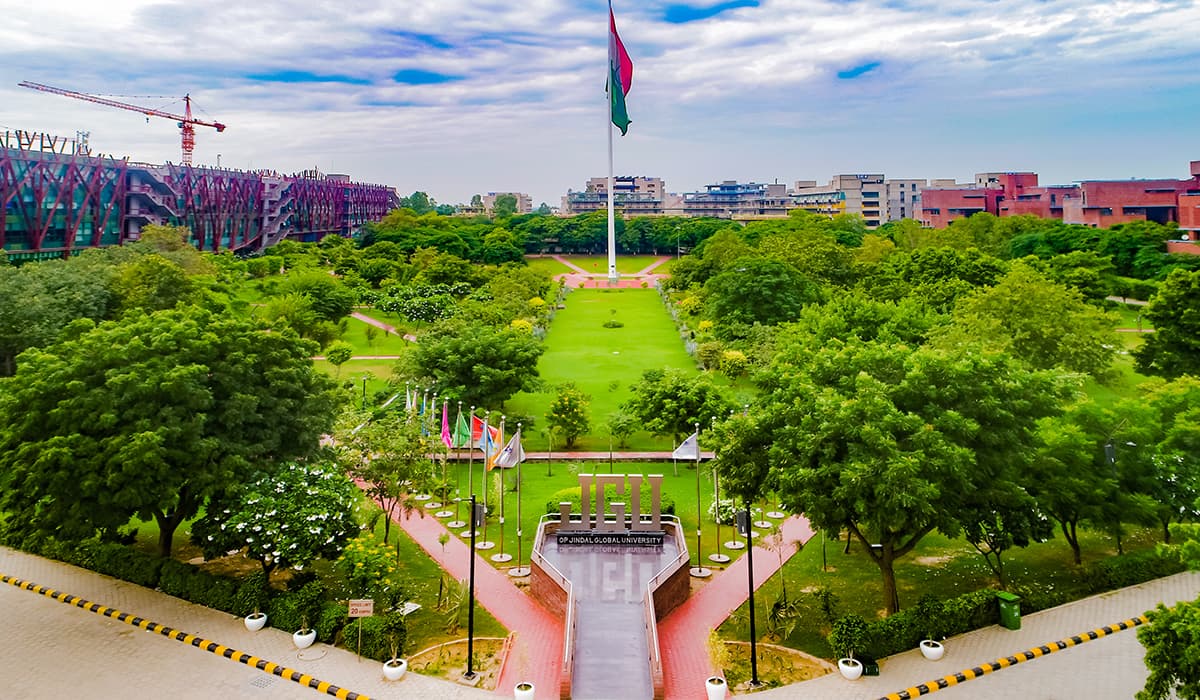
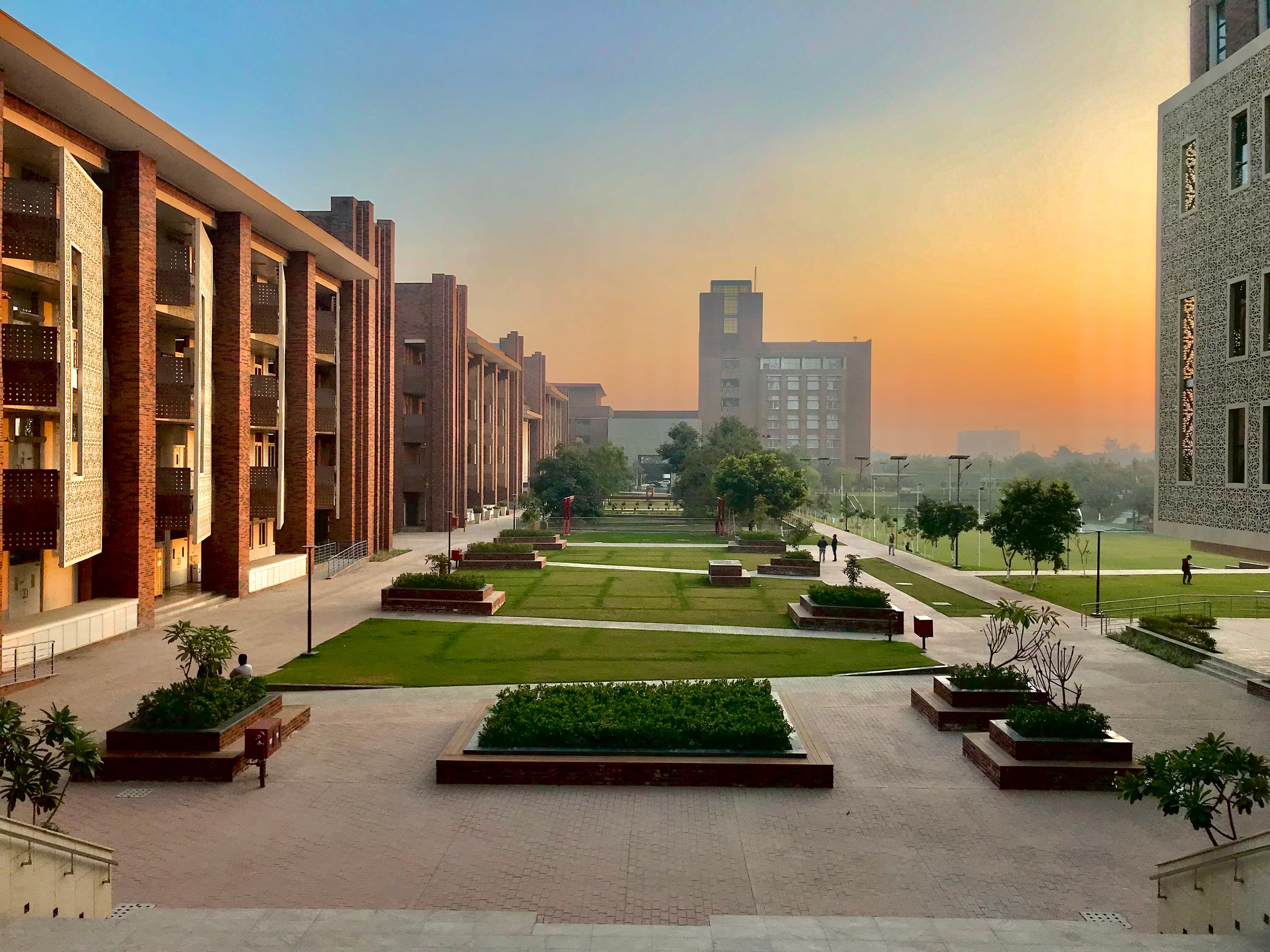
O.P. Jindal Global University is a private university at Sonipat in Haryana, founded in 2009 and listed by the University Grants Commission among Haryana's private universities. Its twelve schools teach law, business, international affairs, public policy, liberal arts, psychology and public health in English on a fully residential campus of more than 16,000 students.
JGU is fully residential, with more than 16,000 students, over 1,100 full-time faculty and around 2,900 administrative staff on one campus at Sonipat Narela Road. Faculty come from more than 50 countries and students from more than 75. The Global Library covers 15,000 square feet, seats over 650 people at once, and keeps more than 60 per cent of its floor area open around the clock. Named facilities include the Naveen Jindal Sports Academy, the RASA and SAMA student activity spaces, a Film and Television Studio and Multimedia Lab, and 50 bookable conference and breakout rooms.
Sonipat, IndiaEst. 2009Private University
Why students choose it
One fee schedule for everyone: JGU charges Indian, NRI and international students the same tuition and residential fees, and states it operates no NRI or Foreign National quota, so an international applicant is not paying a separate international rate.
JGU is fully residential, with more than 16,000 students, over 1,100 full-time faculty and around 2,900 administrative staff on one campus at Sonipat Narela Road. Faculty come from more than 50 countries and students from more than 75. The Global Library covers 15,000 square feet, seats over 650 people at once, and keeps more than 60 per cent of its floor area open around the clock. Named facilities include the Naveen Jindal Sports Academy, the RASA and SAMA student activity spaces, a Film and Television Studio and Multimedia Lab, and 50 bookable conference and breakout rooms.
Accommodation
JGU is a fully residential university and publishes accommodation charges alongside tuition for each residential programme. Rooms are shared: the Student Handbook states accommodation is on a three- and four-people sharing basis, with no single occupancy available. For 2026-27 the annual residential charge is INR 2,32,000 on the five-year law degrees, INR 2,31,100 on the liberal arts, political science and MBA programmes and INR 1,81,100 on the M.A. Public Policy. Allied service charges covering food, laundry, security, housekeeping and electricity add INR 1,48,900 a year on the law degrees and INR 1,24,900 elsewhere, and a one-time refundable deposit of INR 50,000 applies. Both charges rise by up to ten per cent a year. The Master of Public Health is non-residential and carries neither.
Student perspective
Admissions support
Build a clear application plan for O.P. Jindal Global University
Get focused help with your application, documents and visa process. We will turn the information on this page into a practical next-step plan.
Application planning
Document review
Visa support
Frequently asked questions
Is O.P. Jindal Global University public or private?
It is private. The University Grants Commission lists O.P. Jindal Global University, Sonipat among the private universities of Haryana, established under the Haryana Private Universities Act, 2006 by a notification dated 10 November 2006, and founded in 2009 as a non-profit philanthropic initiative. The UGC also notified it as an Institution of Eminence on 4 November 2020, one of only four private institutions on that twelve-strong national list.
What language are the programmes taught in?
English. The JGU Academic Regulations state that the medium of instruction and assessment at the university is English unless the Academic Council determines otherwise for a specific course or programme. There is no local-language teaching phase in the liberal arts, political science, public policy, public health or MBA programmes listed here.
Do international students pay a different fee?
Cluster breadth that most Indian private universities lack: law, business, international affairs, public policy, liberal arts, psychology, journalism, design and public health are taught in twelve schools on one campus, with the law school on the Bar Council of India approved list to 2026-27.
One of only four private universities notified by the UGC as an Institution of Eminence, on a national list of twelve institutions, notified on 4 November 2020.
Things to consider
There is one annual entry point. The Academic Calendar 2026-2027 starts Fall Semester A classes on 3 August 2026 for all schools; a missed intake means waiting a full year.
Rooms are shared three or four ways and single occupancy is not available, which is a real adjustment for applicants used to individual accommodation.
Every JGU dining hall is vegetarian, with eggs in some meals. Non-vegetarian daily living is on payment at separate campus outlets rather than in the main dining halls.
Best fit for
Applicants who want a social sciences, policy or humanities degree in English at an Indian price point rather than a computing or engineering degree.
Graduates of any discipline moving into public health or public policy, since both master's degrees accept a bachelor's in any subject.
Students who value a compact, fully residential campus with catering, housekeeping and health services included in one published charge.
Catering and housekeeping are contracted to Sodexo. All JGU dining halls serve vegetarian food, with eggs in some meals; non-vegetarian food is available on payment at other campus outlets. The Vidya Devi Jindal dining block runs over seven floors and seats 7,000 at a time. Named outlets in the T6 food court include Subway, Bikanervala, Dunkin', Oki Poki and Millets & More, most open from 11:00 to 01:00. Dining staff handle allergy, intolerance and religious dietary requests on request.
Safety
The JGU Health Centre has a dedicated Emergency Ward and runs a 24/7 helpline staffed by a resident medical officer on duty, backed by an Emergency Response Coordination Centre and Advanced Cardiac Life Support and Basic Life Support ambulances stationed across campus. A published escalation matrix runs from the duty officer through the head of nursing to the Chief Medical Superintendent. Security issues route to a Quick Response Team.
Student support
Sukoon On Campus provides 24x7 mental health support, confidential one-to-one therapy and a dedicated helpline. Statutory bodies include the Anti-Ragging Committee, the Committee on Gender Sensitisation Against Sexual Harassment, the Committee on Disability Issues and the Anti-Discrimination Committee. The English Language Centre, running since 2012, teaches reading, writing, listening and speaking to students from other language backgrounds.
No. JGU publishes one fee schedule and applies it to Indian, NRI and international students alike, and states that it has no NRI or Foreign National quota, no management quota and no donation or capitation seats. Admission is on merit through the same rounds every applicant goes through.
What does a year actually cost?
For 2026-27, tuition ranges from INR 3,50,000 for the B.A. (Hons.) Political Science to INR 7,00,000 for the Full-Time MBA and the five-year law degrees. Residential programmes add INR 2,32,000, INR 2,31,100 or INR 1,81,100 a year in residential charges, plus INR 1,48,900 on the law degrees or INR 1,24,900 elsewhere in allied services covering daily living, laundry, security, housekeeping and electricity. A one-time refundable deposit of INR 50,000 applies. The Master of Public Health is non-residential and costs INR 3,50,000 plus the deposit.
Do the fees increase during the degree?
Yes. JGU states that tuition, residential and allied service charges are each subject to an annual increase of up to ten per cent. On a four-year undergraduate degree that compounding makes the final year noticeably more expensive than the first, so the total cost of the degree is higher than four times the first-year figure.
How do I apply, and through which portal?
Applications go through admissions.jgu.edu.in, JGU's own admissions portal, and JGU states that it does not appoint or authorise any agent, intermediary or consultant for admissions. Undergraduate applicants submit a personal statement and supplemental questions, sit the JSAT or an accepted equivalent, and attend an online faculty interview.
What entrance test do I need?
It depends on the programme. Liberal arts and political science applicants need a JSAT score or an at-par SAT or ACT result. The five-year law degrees are decided on the LNAT-UK, and Jindal Global Law School states it accepts no other law admissions test. The Full-Time MBA requires GMAT 450 or above, GRE 295 or above, NMAT 160 or above, or CAT, MAT, XAT, CMAT or ATMA at the 50th percentile or above, for the 2026 admission cycle. The M.A. Public Policy uses its own closed-book examination, and the MPH an online entrance test or a listed national or international test score.
Is an English-language test required?
The published eligibility criteria for the liberal arts, political science, public policy, public health and MBA programmes do not list an IELTS or TOEFL requirement. JGU runs an English Language Centre, established in 2012, that supports students from other language backgrounds across reading, writing, listening and speaking once they are enrolled.
What do I need if my degree was awarded outside India?
Postgraduate applicants holding a bachelor's degree from outside India must submit an equivalency certificate from the Association of Indian Universities. Undergraduate applicants schooled outside India must have completed twelve years of education recognised in their own country, with a grading conversion sheet or normalisation scale where the board does not use Indian grading. JGU accepts IB Diploma and IB Career-related Programme candidates only, not IB Certificate holders, and Cambridge applicants need a minimum of 24 credits.
What recognition does JGU hold, and what does it mean for me?
Three things carry weight. The UGC lists JGU among Haryana's private universities under the Haryana Private Universities Act, 2006, so its degrees are UGC-recognised. The UGC separately notified JGU as an Institution of Eminence on 4 November 2020. And the Bar Council of India records Jindal Global Law School on its approved list of Centres of Legal Education, approved to 2026-27, which is what makes the five-year law degrees valid Indian law qualifications. BCI approval governs India; whether any degree opens professional practice elsewhere is decided by that jurisdiction's own regulator. JGU holds no current NAAC accreditation.
When do classes start and is there more than one intake?
There is one annual entry point for these programmes. The JGU Academic Calendar 2026-2027 begins Fall Semester A classes on 3 August 2026 across all schools, and sets Term 1 of the one-year master's structure from the same date. The Master of Public Health runs on its own schedule, with Term 1 from 4 September 2026 to 25 October 2026.
What visa and registration steps apply after admission?
A study visa is mandatory. JGU states that students travelling on any visa other than a study visa are not eligible to study or register, that the visa must name O.P. Jindal Global University, and that it must be valid from programme registration until after the study end date. Processing can take three months or longer. After arrival, e-FRRO registration must be completed within 14 days, using a bonafide letter and residence proof issued by the international office and collected within three days of reaching campus.
What accommodation will I get?
Shared rooms. The Student Handbook states that JGU accommodation is on a three- and four-people sharing basis with no single occupancy available, in separate blocks for male and female students. Residential and allied service charges are billed annually alongside tuition and cover daily living, laundry, security, housekeeping and electricity, so most day-to-day living costs sit inside the published fee.
Talk to a student
These students studied here and can answer your real questions about academics, hostel life, and daily experience.
No student contacts listed yet for this university.
Request a student conversation
Share your details and we'll match you with a registered student who can answer your questions directly.
Other universities in India
Private
India
Amity University, Noida
Private
India
Amrita Vishwa Vidyapeetham
Public
India
Anna University
Private
India
Arul Tharum VPMM College of Engineering and Technology
Private
India
Ashoka University
Private
India
Birla Institute of Technology and Science, Pilani
Private
India
CHRIST (Deemed to be University)
Private
India
Chandigarh University
Private
India
Dhanalakshmi Srinivasan College of Engineering and Technology
Private
India
FLAME University
Private
India
J.P. College of Engineering
Private
India
JSS Academy of Higher Education & Research
Student reviews
No reviews yet.
Be the first to share your experience at O.P. Jindal Global University.
Add a review
Share your perspective on O.P. Jindal Global University with either a written review or a YouTube video review.